J N Sujay, Kumar Shiva, Vijay Tanushree
Department of Anesthesiology, Sri Siddhartha Medical College and Research Institute, Tumkur, Karnataka, India.
Anesth Pain Med. 2021 Feb 16;11(1):e108915. doi: 10.5812/aapm.108915. eCollection 2021 Feb.
Functional endoscopic sinus surgery (FESS) is a surgical intervention for sinus diseases. Bleeding is a common concern during FESS. Hemodynamic stability and quality surgical field visibility help to achieve the best outcomes.
The present study primarily intended to compare the effectiveness of dexmedetomidine versus labetalol in providing controlled hypotension during FESS and then to assess the quality of the surgical field.
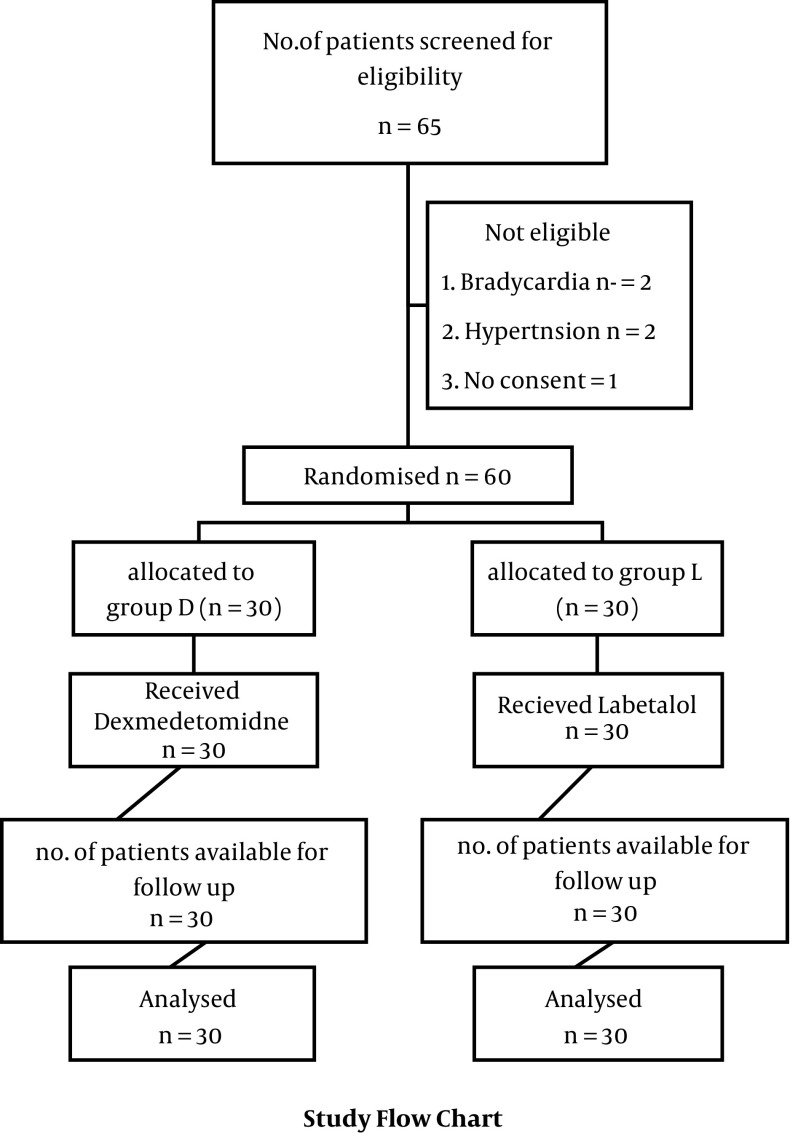
The current research was conducted as a prospective randomized double-blinded clinical study. Sixty patients of the American Society of Anesthesiologists grade I or II status undergoing FESS under general anesthesia were divided into two groups, each with 30 members. Patients receiving dexmedetomidine and labetalol were named as group D and L, respectively. The study intended to manage mean arterial pressure (MAP) between 65 - 75 mmHg. The visibility of the operative field was evaluated using Fromme and Boezaart scoring system. Total intraoperative fentanyl consumption and postoperative first analgesic request time were recorded.
The MAP target was achieved in both groups. Intergroup differences concerning MAP were observed in both D (75.0 ± 2.0) and L (82.4 ± 5.2) groups (P-value < 0.05). Scores for blood loss were significantly lower in the D group (1.3 ± 0.3) compared to the L group (2.1 ± 0.3) (P-value < 0.05). There was no intergroup difference concerning the mean heart rate (group D; 70.8 ± 4.2, and group L; 73.4 ± 4.4). The total dose of fentanyl consumed was found to be significantly lower in the group D (41.9 ± 5.8) compared to group L (59.9 ± 5.3) (P-value < 0.05). The first analgesic request time was significantly longer in the group D (50.2 ± 9.1) compared to group L (24.8 ± 5.1) (P-value < 0.05).
Dexmedetomidine provided better hemodynamic stability and operative field visibility as compared to labetalol during FESS.
功能性鼻内镜鼻窦手术(FESS)是一种针对鼻窦疾病的外科干预手段。出血是FESS过程中常见的问题。血流动力学稳定性和良好的手术视野有助于取得最佳手术效果。
本研究主要旨在比较右美托咪定与拉贝洛尔在FESS期间提供控制性低血压的有效性,然后评估手术视野质量。
本研究作为一项前瞻性随机双盲临床研究开展。60例美国麻醉医师协会I或II级状态、在全身麻醉下接受FESS的患者被分为两组,每组30名成员。接受右美托咪定和拉贝洛尔的患者分别命名为D组和L组。本研究旨在将平均动脉压(MAP)控制在65 - 75 mmHg之间。使用弗罗梅和博扎尔特评分系统评估手术视野的可视性。记录术中芬太尼总消耗量和术后首次镇痛需求时间。
两组均达到MAP目标。D组(75.0 ± 2.0)和L组(82.4 ± 5.2)在MAP方面均观察到组间差异(P值 < 0.05)。D组(1.3 ± 0.3)的失血评分显著低于L组(2.1 ± 0.3)(P值 < 0.05)。两组在平均心率方面无组间差异(D组;70.8 ± 4.2,L组;73.4 ± 4.4)。发现D组(41.9 ± 5.8)的芬太尼总消耗量显著低于L组(59.9 ± 5.3)(P值 < 0.05)。D组(50.2 ± 9.1)的首次镇痛需求时间显著长于L组(24.8 ± 5.1)(P值 < 0.05)。
在FESS期间,与拉贝洛尔相比,右美托咪定提供了更好的血流动力学稳定性和手术视野可视性。