Hsu Chih-Wei, Carvalho Andre F, Tsai Shang-Ying, Wang Liang-Jen, Tseng Ping-Tao, Lin Pao-Yen, Tu Yu-Kang, Vieta Eduard, Solmi Marco, Hung Chi-Fa, Kao Hung-Yu
Department of Psychiatry, Kaohsiung Chang Gung Memorial Hospital and Chang Gung University College of Medicine, Kaohsiung, Taiwan.
Department of Computer Science and Information Engineering, National Cheng Kung University, Tainan, Taiwan.
Acta Psychiatr Scand. 2021 Oct;144(4):368-378. doi: 10.1111/acps.13346. Epub 2021 Jul 16.
To compare differences in efficacy during maintenance treatment for bipolar disorder (BD) according to lithium serum levels. A multicenter retrospective cohort study and a dose-response meta-analysis were conducted.
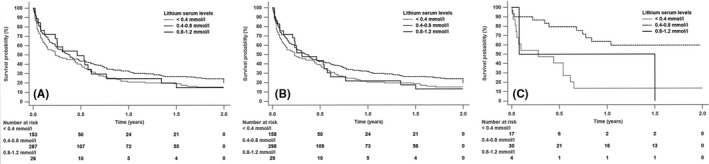
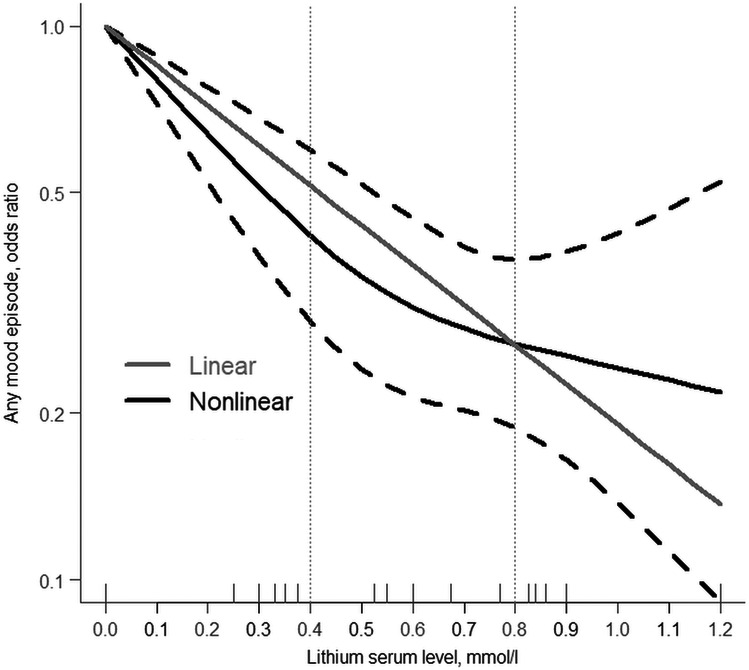
The cohort study was conducted in Taiwan from 2001 to 2019 to identify patients with euthymic BD according to different serum levels (<0.4, 0.4-0.8, and 0.8-1.2 mmol/L). We adopted adjusted hazard ratios (aHRs) with 95% confidence intervals (CIs) for time to the recurrence of mood episodes having the <0.4 mmol/L group as the reference group. Moreover, we systematically searched for related articles in major databases before January 31, 2021 (PROSPERO: CRD42021235812). We used random-effects modeling to estimate the dose-response relationships between lithium serum levels and recurrence of mood episodes, which were depicted as odds ratios (ORs) with 95% CIs.
A total of 1406 participants (cohort: 466; meta-analysis: 940) were included. In the cohort study, the 0.4-0.8 mmol/L group was associated with a significantly lower risk of recurrences (aHR: 0.75), while the 0.8-1.2 mmol/L group had a lower risk without statistical significance (aHR: 0.77). The dose-response meta-analysis showed that with the increase in lithium serum levels, the risk decreased (linear model OR: 0.85, for every 0.1 mmol/L increase; non-linear model OR: 1.00 at 0.0 mmol/L, 0.42 at 0.4 mmol/L, and 0.27 at 0.8 mmol/L).
Although confounding by indication cannot be excluded, the combined results suggest a significant preventative effect on the recurrence of major affective episodes among those with serum levels of 0.4-0.8 mmol/L.
根据血清锂水平比较双相情感障碍(BD)维持治疗期间的疗效差异。进行了一项多中心回顾性队列研究和剂量反应荟萃分析。
队列研究于2001年至2019年在台湾进行,根据不同血清水平(<0.4、0.4 - 0.8和0.8 - 1.2 mmol/L)确定心境正常的BD患者。以<0.4 mmol/L组为参照组,采用调整风险比(aHRs)及95%置信区间(CIs)计算心境发作复发时间。此外,我们在2021年1月31日前系统检索了主要数据库中的相关文章(PROSPERO:CRD42021235812)。我们使用随机效应模型估计血清锂水平与心境发作复发之间的剂量反应关系,以比值比(ORs)及95% CIs表示。
共纳入1406名参与者(队列研究:466名;荟萃分析:940名)。在队列研究中,0.4 - 0.8 mmol/L组复发风险显著较低(aHR:0.75),而0.8 - 1.2 mmol/L组复发风险较低但无统计学意义(aHR:0.77)。剂量反应荟萃分析表明,随着血清锂水平升高,风险降低(线性模型OR:0.85,每升高0.1 mmol/L;非线性模型OR:0.0 mmol/L时为1.00,0.4 mmol/L时为0.42,0.8 mmol/L时为0.27)。
尽管不能排除指征性混杂因素,但综合结果表明血清水平为0.4 - 0.8 mmol/L者对主要情感发作复发有显著预防作用。