Breast Service, Department of Surgery, Memorial Sloan Kettering Cancer Center, New York, NY, 10065, USA.
Biostatistics Service, Department of Epidemiology and Biostatistics, Memorial Sloan Kettering Cancer Center, New York, NY, 10065, USA.
Ann Surg Oncol. 2021 Oct;28(10):5507-5512. doi: 10.1245/s10434-021-10446-8. Epub 2021 Jul 10.
Nonsteroidal anti-inflammatory drugs (NSAIDs) are increasingly used in ambulatory breast surgery. The risk of hematoma associated with intraoperative ketorolac is low, but whether concomitant routine discharge with NSAIDs increases the risk of hematoma is unclear.
We retrospectively identified patients who underwent lumpectomy and sentinel lymph node biopsy (SLNB), and compared the 30-day risk of hematoma between patients discharged with opioids (opioid period: January 2018-August 2018) and patients discharged with NSAIDs with or without opioids (NSAID period: January 2019-April 2020). The association between study period and hematoma risk was assessed using multivariable models. Covariates included intraoperative ketorolac, home aspirin, and race/ethnicity. During the NSAID period, a survey was used to assess analgesic consumption on postoperative days 1-5.
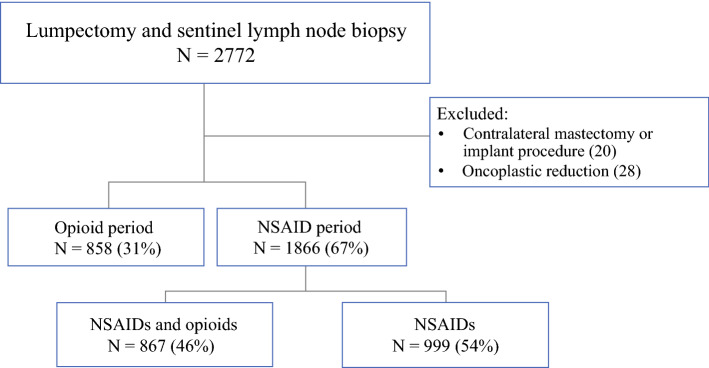
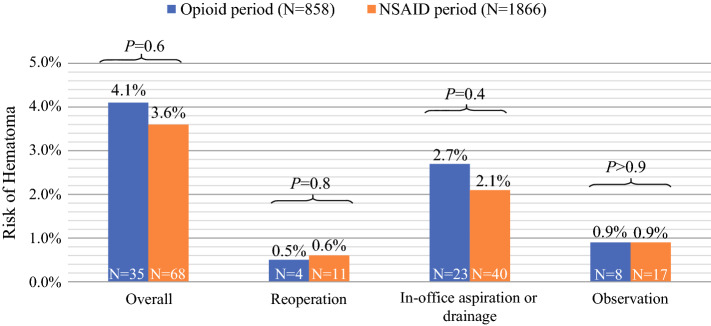
In total, 2724 patients were identified: 858 (31%) in the opioid period and 1866 (69%) in the NSAID period. In the NSAID period, 867 (46%) received NSAIDs and opioids, and 999 (54%) received NSAIDs only. Receipt of intraoperative ketorolac was higher in the NSAID period (78 vs. 64%, P < 0.001). The risks of any hematoma (4.1 vs. 3.6%, P = 0.6) and reoperation for bleeding (0.5 vs. 0.6%, P = 0.8) were similar between groups. Study period was not associated with hematoma risk (odds ratio 0.87, 95% confidence interval 0.56-1.35, P = 0.5). Among survey respondents (41%), nonopioid analgesic consumption did not increase after opioids were removed from the discharge regimen (median, 6 pills/group, P = 0.06).
NSAIDs are associated with a low risk of hematoma after lumpectomy and SLNB, and should be prescribed instead of opioids, unless contraindicated.
非甾体抗炎药(NSAIDs)在门诊乳房手术中越来越多地被使用。术中使用酮咯酸相关的血肿风险较低,但同时常规使用 NSAIDs 是否会增加血肿风险尚不清楚。
我们回顾性地确定了接受乳房肿块切除术和前哨淋巴结活检(SLNB)的患者,并比较了接受阿片类药物出院的患者(阿片类药物时期:2018 年 1 月至 2018 年 8 月)与同时使用 NSAIDs 和/或阿片类药物出院的患者(NSAID 时期:2019 年 1 月至 2020 年 4 月)在 30 天内血肿风险。使用多变量模型评估研究期间与血肿风险的相关性。协变量包括术中酮咯酸、家庭用阿司匹林和种族/民族。在 NSAID 期间,使用一项调查评估术后第 1-5 天的镇痛药物消耗。
共确定了 2724 名患者:阿片类药物时期 858 名(31%),NSAID 时期 1866 名(69%)。在 NSAID 时期,867 名(46%)患者同时使用 NSAIDs 和阿片类药物,999 名(54%)患者仅使用 NSAIDs。NSAID 时期术中使用酮咯酸的比例较高(78% vs. 64%,P < 0.001)。两组患者的任何血肿(4.1% vs. 3.6%,P = 0.6)和再次出血手术(0.5% vs. 0.6%,P = 0.8)风险相似。研究期间与血肿风险无关(比值比 0.87,95%置信区间 0.56-1.35,P = 0.5)。在调查受访者中(41%),在阿片类药物从出院方案中去除后,非阿片类镇痛药物的消耗并没有增加(中位数,每组 6 片,P = 0.06)。
NSAIDs 与乳房肿块切除术和 SLNB 后血肿风险低相关,应替代阿片类药物处方,除非禁忌。