Li Jingfa, Su Yue, Yu Bo, Wang Peng, Sun Dongliang
School of Mechanical Engineering, Beijing Key Laboratory of Pipeline Critical Technology and Equipment for Deepwater Oil and Gas Development, Beijing Institute of Petrochemical Technology, Beijing 102617, China.
Beijing Key Laboratory of Process Fluid Filtration and Separation, College of Mechanical and Transportation Engineering, China University of Petroleum (Beijing), Beijing 102249, China.
ACS Omega. 2021 Jun 21;6(26):16722-16735. doi: 10.1021/acsomega.1c00248. eCollection 2021 Jul 6.
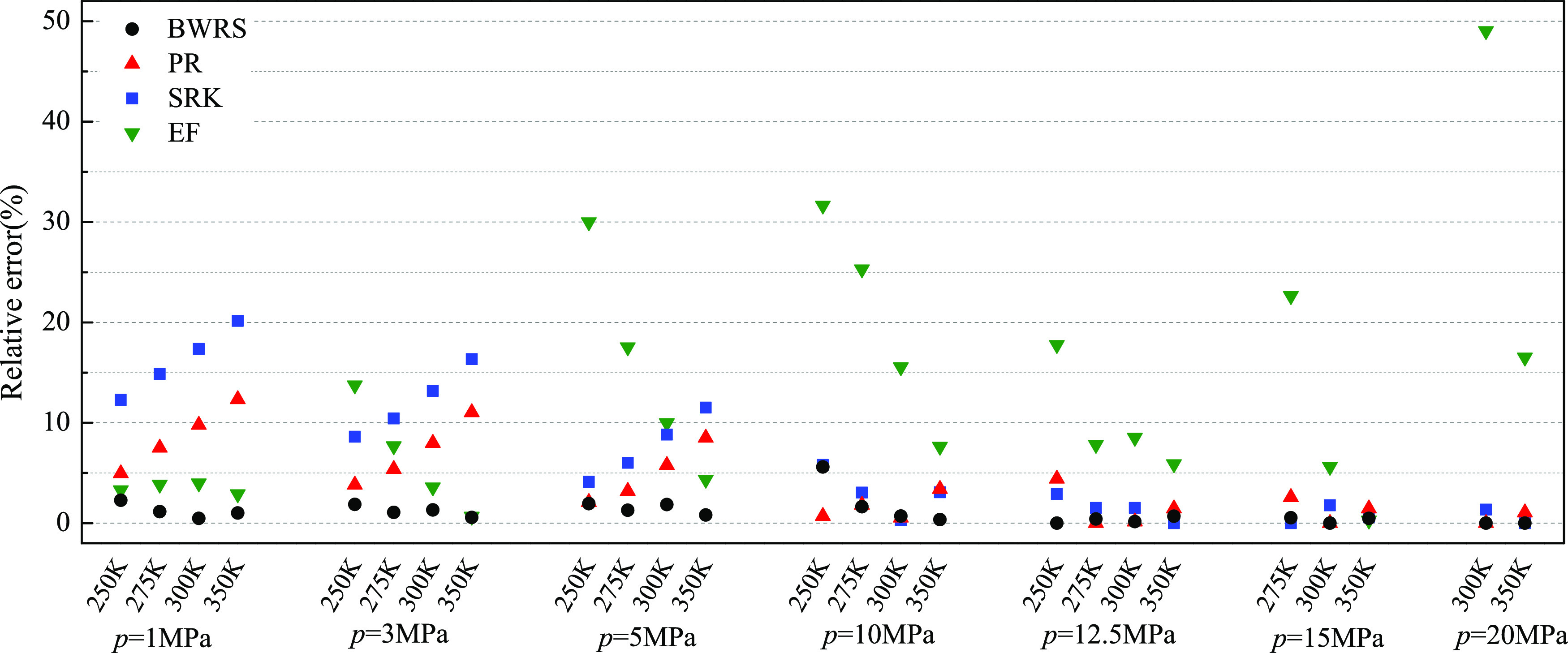
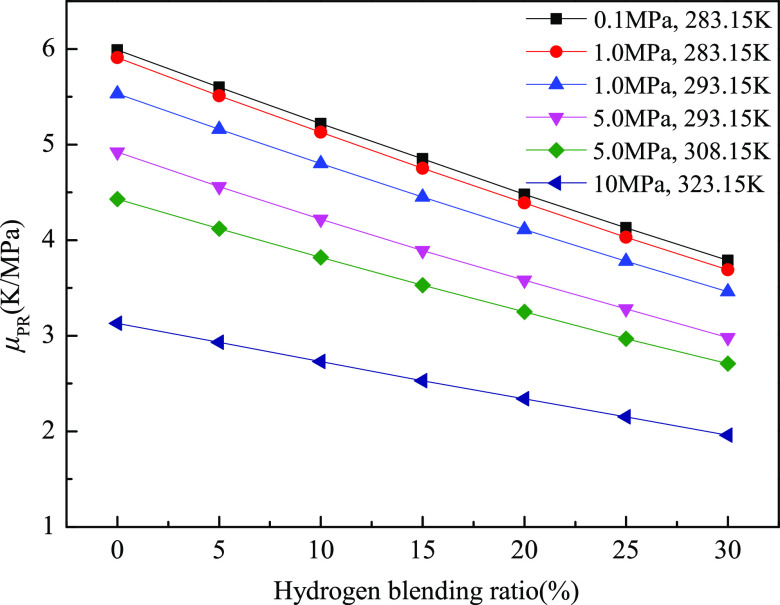
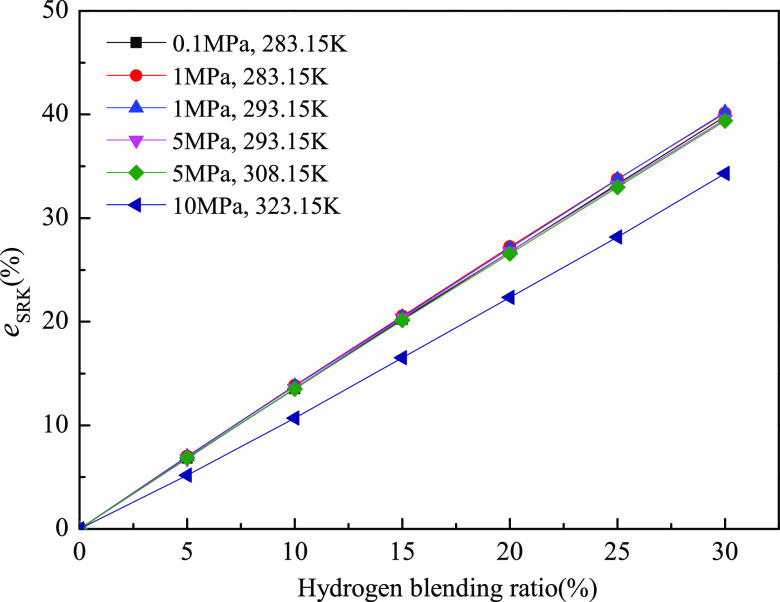
Blending hydrogen into the natural gas pipeline is considered as a feasible way for large-scale and long-distance delivery of hydrogen. However, the blended hydrogen can exert major impacts on the Joule-Thomson (J-T) coefficient of natural gas, which is a significant parameter for liquefaction of natural gas and formation of natural gas hydrate in engineering. In this study, the J-T coefficient of natural gas at different hydrogen blending ratios is numerically investigated. First, the theoretical formulas for calculating the J-T coefficient of the natural gas-hydrogen mixture using the Soave-Redlich-Kwong (SRK) equation of state (EOS), Peng-Robinson EOS (PR-EOS), and Benedict-Webb-Rubin-Starling EOS (BWRS-EOS) are, respectively, derived, and the calculation accuracy is verified by experimental data. Then, the J-T coefficients of natural gas at six different hydrogen blending ratios and thermodynamic conditions are calculated and analyzed using the derived theoretical formulas and a widely used empirical formula. Results indicate that the J-T coefficient of the natural gas-hydrogen mixture decreases approximately linearly with the increase of the hydrogen blending ratio. When the hydrogen blending ratio reaches 30% (mole fraction), the J-T coefficient of the natural gas-hydrogen mixture decreases by 40-50% compared with that of natural gas. This work also provides a J-T coefficient database of a methane-hydrogen mixture with a hydrogen blending ratio of 5-30% at a pressure of 0.5-20 MPa and temperatures of 275, 300, and 350 K as a reference and a benchmark for interested readers.
将氢气混入天然气管道被认为是大规模、长距离输送氢气的一种可行方式。然而,混入的氢气会对天然气的焦耳-汤姆逊(J-T)系数产生重大影响,而J-T系数是工程中天然气液化和天然气水合物形成的一个重要参数。在本研究中,对不同氢气混合比下天然气的J-T系数进行了数值研究。首先,分别推导了使用Soave-Redlich-Kwong(SRK)状态方程(EOS)、Peng-Robinson EOS(PR-EOS)和Benedict-Webb-Rubin-Starling EOS(BWRS-EOS)计算天然气-氢气混合物J-T系数的理论公式,并通过实验数据验证了计算精度。然后,使用推导的理论公式和一个广泛使用的经验公式,计算并分析了六种不同氢气混合比和热力学条件下天然气的J-T系数。结果表明,天然气-氢气混合物的J-T系数随氢气混合比的增加近似呈线性下降。当氢气混合比达到30%(摩尔分数)时,天然气-氢气混合物的J-T系数相比天然气下降了40-50%。这项工作还提供了一个氢气混合比为5-30%、压力为0.5-20 MPa、温度为275 K、300 K和350 K的甲烷-氢气混合物的J-T系数数据库,供感兴趣的读者参考和作为基准。