School of GeoSciences, University of Edinburgh, Edinburgh, United Kingdom.
Department of Biological Sciences, University of Alberta, Edmonton, AB, Canada.
PLoS One. 2021 Jul 12;16(7):e0254564. doi: 10.1371/journal.pone.0254564. eCollection 2021.
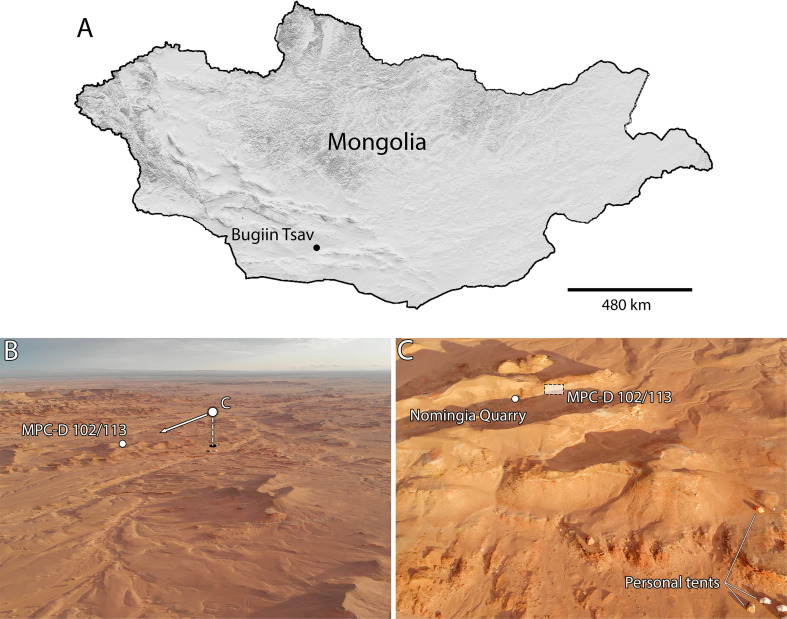
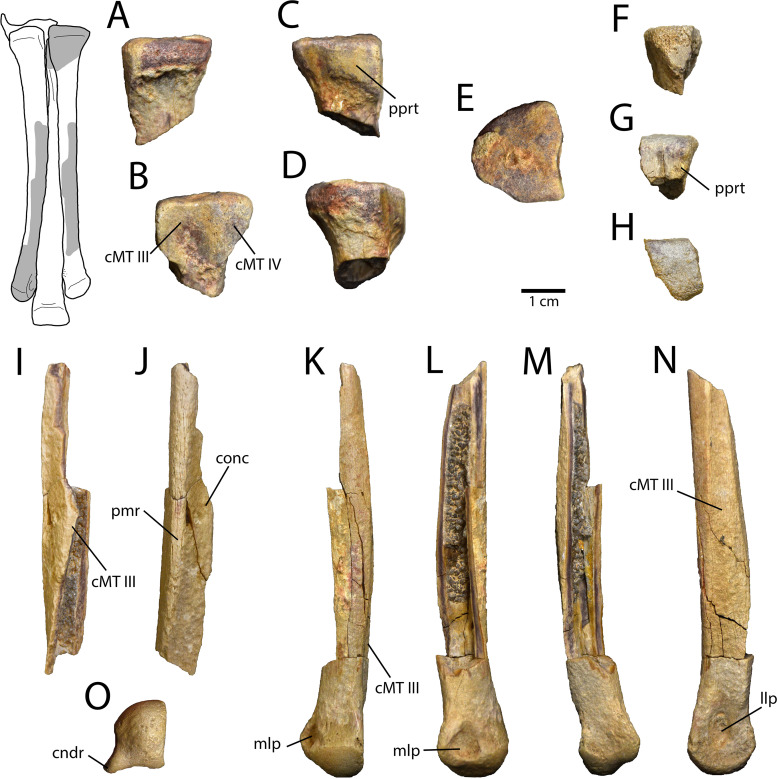
The Nemegt Formation of the Gobi Desert of Mongolia has produced one of the most abundant and diverse oviraptorosaur records globally. However, the caenagnathid component of this fauna remains poorly known. Two caenagnathid taxa are currently recognized from the Nemegt Formation: Elmisaurus rarus and Nomingia gobiensis. Because these taxa are known from mostly non-overlapping material, there are concerns that they could represent the same animal. A partial, weathered caenagnathid skeleton discovered adjacent to the holotype quarry of Nomingia gobiensis is referable to Elmisaurus rarus, revealing more of the morphology of the cranium, mandible, pectoral girdle, and pubis. Despite metatarsals clearly exhibiting autapomorphies of Elmisaurus rarus, overlapping elements are identical to those of Nomingia gobiensis, and add to a growing body of evidence that these taxa represent a single morphotype. In the absence of any positive evidence for two caenagnathid taxa in the Nemegt Formation, Nomingia gobiensis is best regarded as a junior synonym of Elmisaurus rarus. Low caenagnathid diversity in the Nemegt Formation may reflect broader coexistence patterns with other oviraptorosaur families, particularly oviraptorids. In contrast to North America, competition with the exceptionally diverse oviraptorids may have restricted caenagnathids to marginal roles in Late Cretaceous Asian ecosystems.
蒙古国戈壁沙漠的内梅盖特组产生了全球最丰富、最多样化的偷蛋龙类记录之一。然而,这种动物群的恐手龙类成分仍然知之甚少。目前,从内梅盖特组中识别出了两种恐手龙类:Elmisaurus rarus 和 Nomingia gobiensis。由于这些分类群的材料大多不重叠,因此有人担心它们可能代表同一种动物。在 Nomingia gobiensis 的正型采石场附近发现了一块风化的部分恐手龙类骨架,可归入 Elmisaurus rarus,揭示了更多的头骨、下颌骨、胸带和耻骨形态。尽管跗跖骨明显具有 Elmisaurus rarus 的特徵,但重叠的元素与 Nomingia gobiensis 的相同,并为这些分类群代表单一形态型提供了越来越多的证据。在没有任何证据表明内梅盖特组中有两种恐手龙类的情况下,Nomingia gobiensis 最好被视为 Elmisaurus rarus 的次同物异名。内梅盖特组中恐手龙类的多样性较低可能反映了与其他偷蛋龙科动物更广泛的共存模式,特别是偷蛋龙科。与北美洲不同,与异常多样的偷蛋龙科的竞争可能使恐手龙类在白垩纪晚期亚洲生态系统中扮演边缘角色。