Division of Hematology-Oncology, Department of Medicine Samsung Medical Center, Sungkyunkwan University School of Medicine, 81 Irwon-ro, Gangnam-gu, 06351, Seoul, South Korea.
Department of Internal Medicine, Seoul Metropolitan Government Seoul National University Boramae Medical Center, Seoul, South Korea.
BMC Cancer. 2021 Jul 12;21(1):802. doi: 10.1186/s12885-021-08445-9.
Afatinib is approved globally for EGFR-TKI treatment-naïve patients with EGFR mutation-positive non-small cell lung cancer (NSCLC). In this Korean expanded access program, we evaluated its 'real-world' safety and efficacy.
EGFR-TKI treatment-naïve patients with EGFR mutation-positive NSCLC received afatinib 40 mg/day until disease progression or other withdrawal criteria. Dose reductions were permitted for adverse events (AEs). The primary endpoint was the number of patients with AEs (CTCAE version 3.0). Other endpoints included progression-free survival (PFS), overall response rate (ORR), duration of response (DOR), and changes in investigator-assessed cancer-related symptoms.
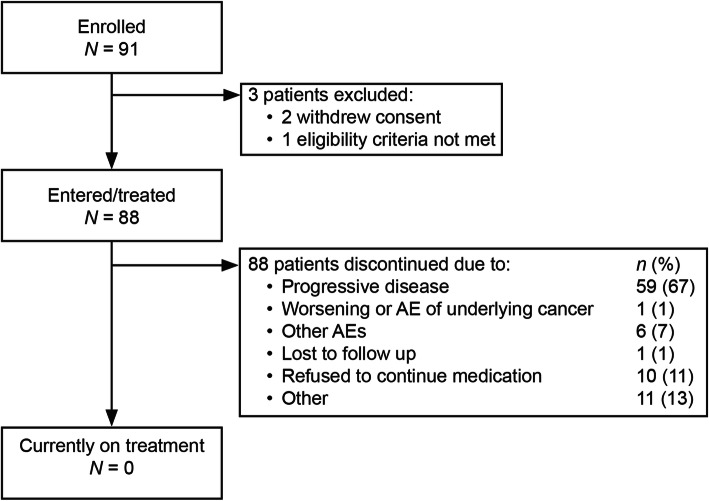
Eighty-eight patients received afatinib, including 27 (31%) with brain metastases and 16 (18%) with uncommon EGFR mutations. Median PFS was 17.0 months (95% confidence interval [CI] 12.9-23.3 months). Grade 3 treatment-related AEs (TRAEs) were reported in 51 (58%) patients; the most common were diarrhea (22%) and rash/acne (20%). No grade > 3 TRAEs were reported. AEs leading to dose reduction occurred in 49 (56%) patients. Treatment discontinuation due to TRAEs occurred in 4 (5%) patients. ORR was 81% overall, 89% in patients with brain metastases, and 55% in patients with uncommon mutations (excluding T790M/exon 20 insertions). Median DOR was 15.1 months (95% CI 12.4-21.4 months). Cancer-related symptoms were improved/unchanged/worsened in 34-66%/36-66%/0-3% of patients over the first year.
No unexpected safety signals for afatinib were observed. AEs were manageable; the treatment discontinuation rate was low. Afatinib showed encouraging efficacy in a broad patient population including those with brain metastases or tumors harboring uncommon EGFR mutations.
ClinicalTrials.gov NCT01931306 ; 29/08/2013.
阿法替尼已在全球获批用于治疗初治的表皮生长因子受体(EGFR)突变阳性非小细胞肺癌(NSCLC)患者。在这项韩国扩大准入计划中,我们评估了其“真实世界”的安全性和疗效。
初治的 EGFR 突变阳性 NSCLC 患者接受阿法替尼 40mg/天治疗,直至疾病进展或其他停药标准。发生不良反应(AE)时可进行剂量调整。主要终点是 AE 患者数量(CTCAE 版本 3.0)。其他终点包括无进展生存期(PFS)、总缓解率(ORR)、缓解持续时间(DOR)和研究者评估的癌症相关症状变化。
88 例患者接受了阿法替尼治疗,包括 27 例(31%)有脑转移和 16 例(18%)有罕见 EGFR 突变。中位 PFS 为 17.0 个月(95%CI 12.9-23.3 个月)。51 例(58%)患者报告了 3 级治疗相关 AE(TRAEs);最常见的是腹泻(22%)和皮疹/痤疮(20%)。无 3 级以上 TRAEs 报告。49 例(56%)患者因 AE 而减少剂量。4 例(5%)患者因 TRAE 而停止治疗。总体 ORR 为 81%,脑转移患者为 89%,罕见突变(不包括 T790M/外显子 20 插入)患者为 55%。中位 DOR 为 15.1 个月(95%CI 12.4-21.4 个月)。在第一年,34%-66%的患者的癌症相关症状得到改善/不变/恶化,36%-66%的患者得到改善/不变/恶化,0%-3%的患者得到恶化。
阿法替尼未观察到新的安全性信号。AE 可管理;停药率低。阿法替尼在包括脑转移或携带罕见 EGFR 突变的肿瘤患者在内的广泛患者人群中显示出令人鼓舞的疗效。
ClinicalTrials.gov NCT01931306;2013 年 8 月 29 日。