Speech and Hearing Science, University of Tennessee Health Science Center, Knoxville, TN, United States.
Psychology, University of East Anglia, Norwich, England.
Neuroimage. 2021 Oct 15;240:118385. doi: 10.1016/j.neuroimage.2021.118385. Epub 2021 Jul 10.
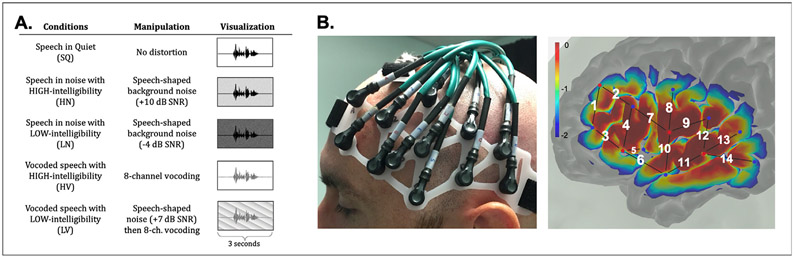
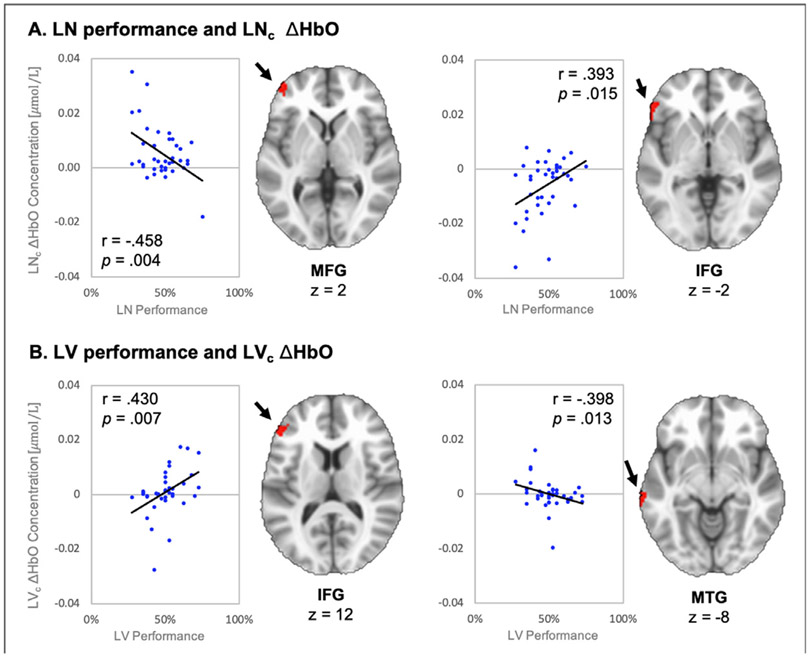
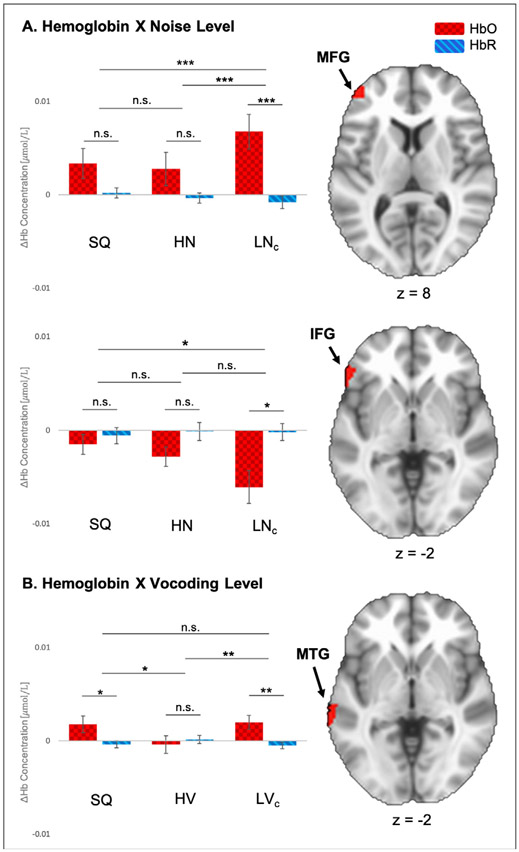
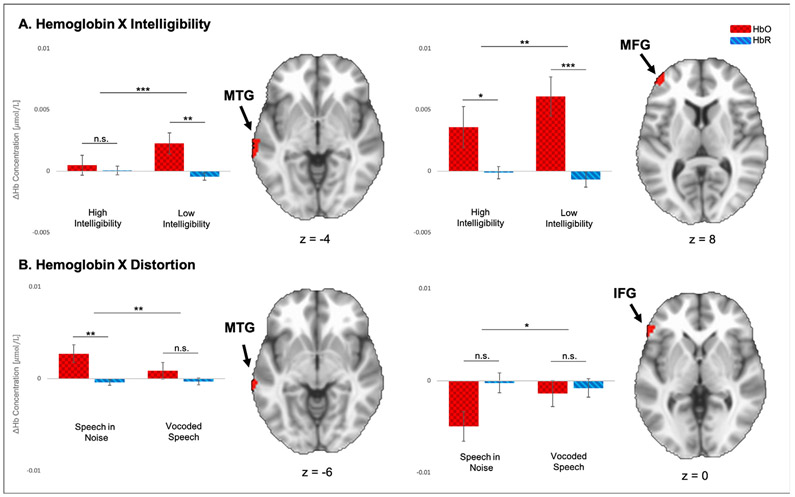
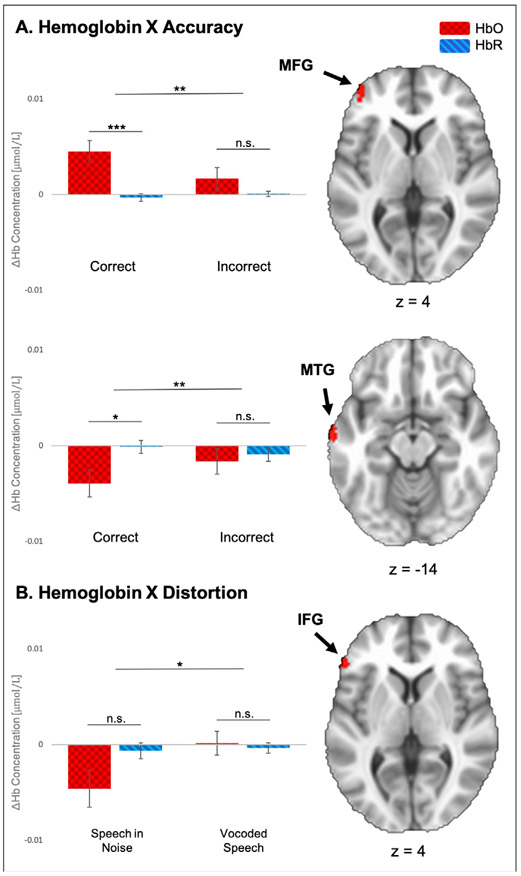
In this study we used functional near-infrared spectroscopy (fNIRS) to investigate neural responses in normal-hearing adults as a function of speech recognition accuracy, intelligibility of the speech stimulus, and the manner in which speech is distorted. Participants listened to sentences and reported aloud what they heard. Speech quality was distorted artificially by vocoding (simulated cochlear implant speech) or naturally by adding background noise. Each type of distortion included high and low-intelligibility conditions. Sentences in quiet were used as baseline comparison. fNIRS data were analyzed using a newly developed image reconstruction approach. First, elevated cortical responses in the middle temporal gyrus (MTG) and middle frontal gyrus (MFG) were associated with speech recognition during the low-intelligibility conditions. Second, activation in the MTG was associated with recognition of vocoded speech with low intelligibility, whereas MFG activity was largely driven by recognition of speech in background noise, suggesting that the cortical response varies as a function of distortion type. Lastly, an accuracy effect in the MFG demonstrated significantly higher activation during correct perception relative to incorrect perception of speech. These results suggest that normal-hearing adults (i.e., untrained listeners of vocoded stimuli) do not exploit the same attentional mechanisms of the frontal cortex used to resolve naturally degraded speech and may instead rely on segmental and phonetic analyses in the temporal lobe to discriminate vocoded speech.
在这项研究中,我们使用功能近红外光谱(fNIRS)来研究正常听力成年人的神经反应,这些反应与言语识别准确性、言语刺激的可理解性以及言语失真的方式有关。参与者听句子并大声报告他们听到的内容。通过声码化(模拟人工耳蜗语音)或自然添加背景噪声来人为地改变语音质量。每种类型的失真都包括高和低可懂度条件。安静时的句子用作基线比较。使用新开发的图像重建方法分析 fNIRS 数据。首先,在低可懂度条件下,颞中回(MTG)和额中回(MFG)的皮质反应升高与言语识别有关。其次,MTG 的激活与低可懂度声码化语音的识别有关,而 MFG 的活动主要由背景噪声中的语音识别驱动,这表明皮质反应随失真类型而变化。最后,MFG 中的准确性效应表明,在正确感知语音时,激活显著高于错误感知语音时的激活。这些结果表明,正常听力成年人(即未经训练的声码化刺激听众)不会利用前额叶皮层中用于解决自然降级语音的相同注意力机制,而是可能依赖于颞叶中的分段和语音分析来区分声码化语音。