
高剂量胸部放射治疗非小细胞肺癌:一种用于症状性放射性肺炎的放射性肺损伤的新型分级尺度。
High-dose thoracic radiation therapy for non-small cell lung cancer: a novel grading scale of radiation-induced lung injury for symptomatic radiation pneumonitis.
机构信息
Department of Oncology, Aalborg University Hospital, Hobrovej 18-22, 9000, Aalborg, Denmark.
Clinical Cancer Research Center, Aalborg University Hospital, Aalborg, Denmark.
出版信息
Radiat Oncol. 2021 Jul 15;16(1):131. doi: 10.1186/s13014-021-01857-8.
BACKGROUND
Symptomatic radiation pneumonitis (RP) may be a serious complication after thoracic radiation therapy (RT) for non-small cell lung cancer (NSCLC). This prospective observational study sought to evaluate the utility of a novel radiation-induced lung injury (RILI) grading scale (RGS) for the prediction of RP.
MATERIALS AND METHODS
Data of 41 patients with NSCLC treated with thoracic RT of 60-66 Gy were analysed. CT scans were scheduled before RT, one month post-RT, and every three months thereafter for one year. Symptomatic RP was defined as Common Terminology Criteria for Adverse Events grade ≥ 2. RGS grading ranged from 0 to 3. The inter-observer variability of the RGS was assessed by four senior radiologists. CT scans performed 28 ± 10 days after RT were used to analyse the predictive value of the RGS. The change in the RGS severity was correlated to dosimetric parameters.
RESULTS
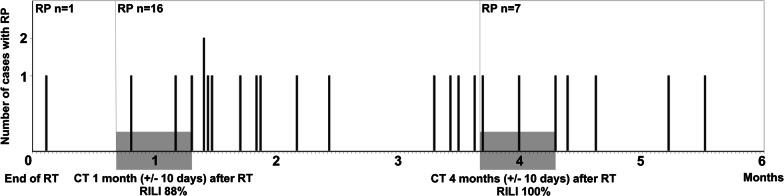
The CT obtained one month post-RT showed RILI in 36 (88%) of patients (RGS grade 0 [5 patients], 1 [25 patients], 2 [6 patients], and 3 [5 patients]). The inter-observer agreement of the RGS grading was high (Kendall's W coefficient of concordance = 0.80, p < 0.01). Patients with RGS grades 2-3 had a significantly higher risk for development of RP (relative risk (RR): 2.4, 95% CI 1.6-3.7, p < 0.01) and RP symptoms within 8 weeks after RT (RR: 4.8, 95% CI 1.3-17.6, p < 0.01) compared to RGS grades 0-1. The specificity and sensitivity of the RGS grades 2-3 in predicting symptomatic RP was 100% (95% CI 80.5-100%) and 45.4% (95% CI 24.4-67.8%), respectively. Increase in RGS severity correlated to mean lung dose and the percentage of the total lung volume receiving 5 Gy.
CONCLUSIONS
The RGS is a simple radiologic tool associated with symptomatic RP. A validation study is warranted.
背景
非小细胞肺癌(NSCLC)患者接受胸部放射治疗(RT)后,可能会出现有症状的放射性肺炎(RP),这是一种严重的并发症。本前瞻性观察研究旨在评估一种新的放射性肺损伤(RILI)分级量表(RGS)在预测 RP 中的效用。
材料和方法
分析了 41 例接受 60-66 Gy 胸部 RT 的 NSCLC 患者的数据。在 RT 前、RT 后 1 个月和此后每 3 个月进行 CT 扫描,持续 1 年。有症状的 RP 定义为不良事件常用术语标准等级≥2。RGS 分级范围为 0 至 3。由 4 位资深放射科医生评估 RGS 的观察者间变异性。使用 RT 后 28±10 天的 CT 扫描分析 RGS 的预测价值。RGS 严重程度的变化与剂量学参数相关。
结果
在 RT 后 1 个月进行的 CT 扫描显示 36 例(88%)患者存在 RILI(RGS 0 级[5 例]、1 级[25 例]、2 级[6 例]和 3 级[5 例])。RGS 分级的观察者间一致性很高(Kendall 一致性系数 W=0.80,p<0.01)。RGS 分级为 2-3 级的患者发生 RP 的风险显著更高(相对风险(RR):2.4,95%置信区间 1.6-3.7,p<0.01)和 RT 后 8 周内出现 RP 症状的风险更高(RR:4.8,95%置信区间 1.3-17.6,p<0.01)。与 RGS 分级 0-1 相比,RGS 分级 2-3 预测有症状 RP 的特异性和敏感性分别为 100%(95%置信区间 80.5-100%)和 45.4%(95%置信区间 24.4-67.8%)。RGS 严重程度的增加与平均肺剂量和肺体积 5 Gy 接受量相关。
结论
RGS 是一种与有症状 RP 相关的简单影像学工具,需要进一步验证。




 Zotero 插件