Cellular Immunology Unit, Division of Immunology, Transplantation, and Infectious Diseases.
Unit of B Cell Neoplasia, Division of Experimental Oncology, and.
Blood Adv. 2021 Jul 27;5(14):2817-2828. doi: 10.1182/bloodadvances.2020003795.
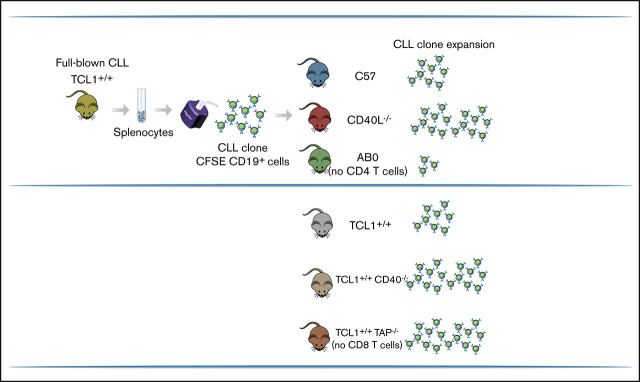
Chronic lymphocytic leukemia (CLL) is caused by the progressive accumulation of mature CD5+ B cells in secondary lymphoid organs. In vitro data suggest that CD4+ T lymphocytes also sustain survival and proliferation of CLL clones through CD40L/CD40 interactions. In vivo data in animal models are conflicting. To clarify this clinically relevant biological issue, we generated genetically modified Eμ-TCL1 mice lacking CD4+ T cells (TCL1+/+AB0), CD40 (TCL1+/+CD40-/-), or CD8+ T cells (TCL1+/+TAP-/-), and we monitored the appearance and progression of a disease that mimics aggressive human CLL by flow cytometry and immunohistochemical analyses. Findings were confirmed by adoptive transfer of leukemic cells into mice lacking CD4+ T cells or CD40L or mice treated with antibodies depleting CD4 T cells or blocking CD40L/CD40 interactions. CLL clones did not proliferate in mice lacking or depleted of CD4+ T cells, thus confirming that CD4+ T cells are essential for CLL development. By contrast, CD8+ T cells exerted an antitumor activity, as indicated by the accelerated disease progression in TCL1+/+TAP-/- mice. Antigen specificity of CD4+ T cells was marginal for CLL development, because CLL clones efficiently proliferated in transgenic mice whose CD4 T cells had a T-cell receptor with CLL-unrelated specificities. Leukemic clones also proliferated when transferred into wild-type mice treated with monoclonal antibodies blocking CD40 or into CD40L-/- mice, and TCL1+/+CD40-/- mice developed frank CLL. Our data demonstrate that CD8+ T cells restrain CLL progression, whereas CD4+ T cells support the growth of leukemic clones in TCL1 mice through CD40-independent and apparently noncognate mechanisms.
慢性淋巴细胞白血病(CLL)是由次级淋巴器官中成熟的 CD5+ B 细胞的进行性积累引起的。体外数据表明,CD4+ T 淋巴细胞还通过 CD40L/CD40 相互作用维持 CLL 克隆的存活和增殖。动物模型中的体内数据存在冲突。为了阐明这一具有临床相关性的生物学问题,我们生成了缺乏 CD4+ T 细胞(TCL1+/+AB0)、CD40(TCL1+/+CD40-/-)或 CD8+ T 细胞(TCL1+/+TAP-/-)的基因修饰 Eμ-TCL1 小鼠,并通过流式细胞术和免疫组织化学分析监测模仿侵袭性人类 CLL 的疾病的出现和进展。通过将白血病细胞过继转移到缺乏 CD4+ T 细胞或 CD40L 的小鼠中,或用耗竭 CD4 T 细胞或阻断 CD40L/CD40 相互作用的抗体处理小鼠,对发现进行了确认。在缺乏或耗尽 CD4+ T 细胞的小鼠中,CLL 克隆不会增殖,从而证实 CD4+ T 细胞是 CLL 发展所必需的。相比之下,CD8+ T 细胞发挥了抗肿瘤活性,因为 TCL1+/+TAP-/-小鼠的疾病进展加速。CD4+ T 细胞对 CLL 发展的抗原特异性是微不足道的,因为 CLL 克隆在其 CD4 T 细胞具有与 CLL 无关特异性的转基因小鼠中有效增殖。当将白血病克隆转移到用阻断 CD40 的单克隆抗体处理的野生型小鼠中或转移到 CD40L-/-小鼠中时,白血病克隆也会增殖,并且 TCL1+/+CD40-/-小鼠出现明显的 CLL。我们的数据表明,CD8+ T 细胞抑制 CLL 进展,而 CD4+ T 细胞通过 CD40 非依赖性和明显非特异性机制在 TCL1 小鼠中支持白血病克隆的生长。