Department of Mathematics, Michigan State University, MI 48824, USA.
Department of Mathematics, Michigan State University, MI 48824, USA; Department of Electrical and Computer Engineering, Michigan State University, MI 48824, USA; Department of Biochemistry and Molecular Biology, Michigan State University, MI 48824, USA.
J Mol Biol. 2021 Sep 3;433(18):167155. doi: 10.1016/j.jmb.2021.167155. Epub 2021 Jul 14.
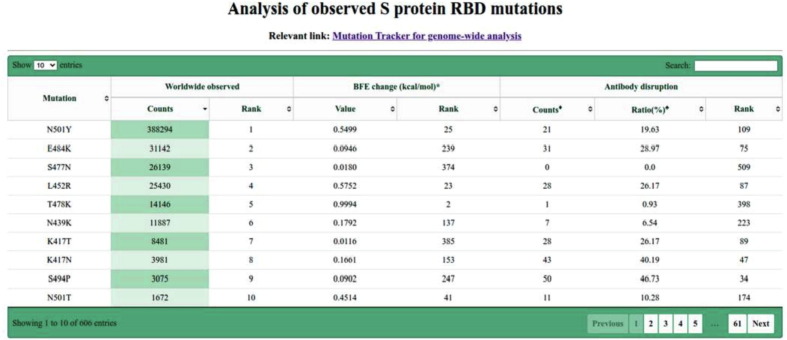
The ongoing massive vaccination and the development of effective intervention offer the long-awaited hope to end the global rage of the COVID-19 pandemic. However, the rapidly growing SARS-CoV-2 variants might compromise existing vaccines and monoclonal antibody (mAb) therapies. Although there are valuable experimental studies about the potential threats from emerging variants, the results are limited to a handful of mutations and Eli Lilly and Regeneron mAbs. The potential threats from frequently occurring mutations on the SARS-CoV-2 spike (S) protein receptor-binding domain (RBD) to many mAbs in clinical trials are largely unknown. We fill the gap by developing a topology-based deep learning strategy that is validated with tens of thousands of experimental data points. We analyze 796,759 genome isolates from patients to identify 606 non-degenerate RBD mutations and investigate their impacts on 16 mAbs in clinical trials. Our findings, which are highly consistent with existing experimental results about Alpha, Beta, Gamma, Delta, Epsilon, and Kappa variants shed light on potential threats of 100 most observed mutations to mAbs not only from Eli Lilly and Regeneron but also from Celltrion and Rockefeller University that are in clinical trials. We unveil, for the first time, that high-frequency mutations R346K/S, N439K, G446V, L455F, V483F/A, F486L, F490L/S, Q493L, and S494P might compromise some of mAbs in clinical trials. Our study gives rise to a general perspective about how mutations will affect current vaccines.
正在进行的大规模疫苗接种和有效干预措施的发展为结束 COVID-19 大流行的全球肆虐带来了期待已久的希望。然而,不断出现的 SARS-CoV-2 变体可能会影响现有疫苗和单克隆抗体(mAb)疗法的效果。尽管有关于新兴变体潜在威胁的宝贵实验研究,但结果仅限于少数突变和礼来公司和再生元公司的 mAbs。目前还不清楚经常发生的 SARS-CoV-2 刺突(S)蛋白受体结合域(RBD)突变对临床试验中许多 mAbs 的潜在威胁。我们通过开发一种基于拓扑结构的深度学习策略来填补这一空白,该策略经过了数万实验数据点的验证。我们分析了来自患者的 796759 个基因组分离物,以确定 606 个非简并的 RBD 突变,并研究了它们对临床试验中 16 种 mAbs 的影响。我们的研究结果与关于 Alpha、Beta、Gamma、Delta、Epsilon 和 Kappa 变体的现有实验结果高度一致,揭示了 100 种最常见突变对临床试验中不仅来自礼来公司和再生元公司,还来自赛尔群和洛克菲勒大学的 mAbs 的潜在威胁。我们首次揭示了高频突变 R346K/S、N439K、G446V、L455F、V483F/A、F486L、F490L/S、Q493L 和 S494P 可能会影响一些临床试验中的 mAbs。我们的研究提供了一个关于突变将如何影响当前疫苗的总体观点。