Leeuwerke Steven J G, Menting Theo P, Stoel Martin G, Geelkerken Robert H
Department of Vascular Surgery, Medisch Spectrum Twente, Enschede, The Netherlands.
Thorax Centre Twente, Medisch Spectrum Twente, Enschede, The Netherlands.
EJVES Vasc Forum. 2021 Jun 11;52:13-16. doi: 10.1016/j.ejvsvf.2021.06.003. eCollection 2021.
Transcatheter aortic valve implantation (TAVI) has evolved into the preferred alternative to surgical valve replacement for severe aortic valve stenosis with high surgical risk. With expanding indications, life threatening complications including transcatheter aortic valve embolisation and inversion (TAVEI), in which the valve dislodges, inverts, and migrates caudally, may increase concomitantly.
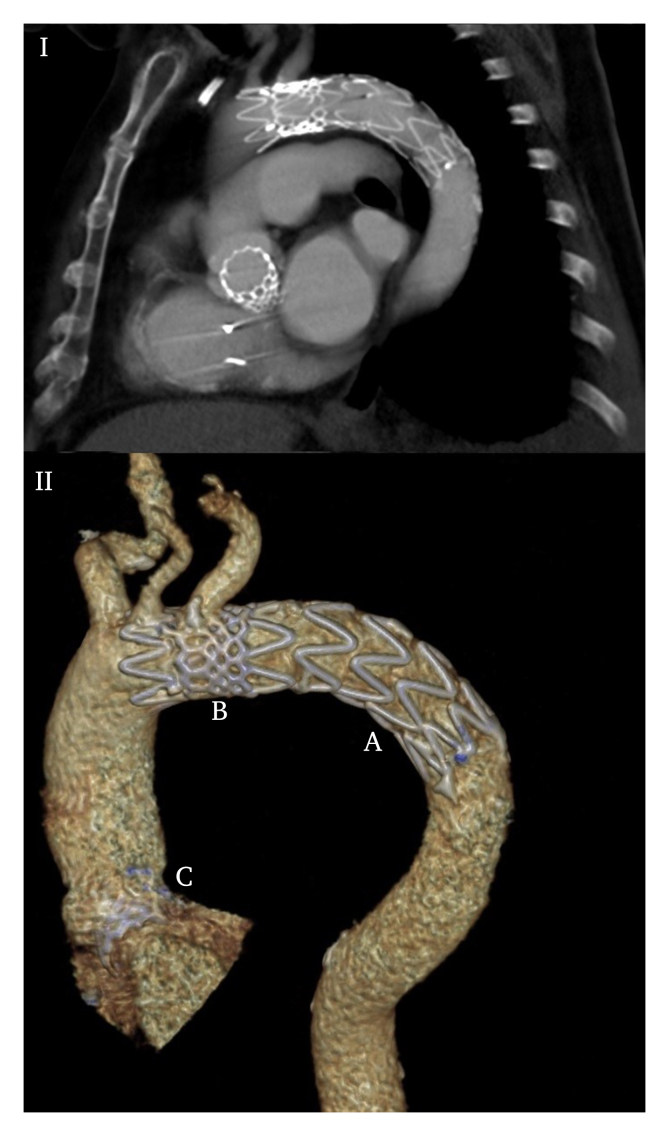
An 80 year old male with severe aortic valve stenosis underwent balloon expandable transcatheter aortic valve implantation (TAVI). Valve embolisation into the aortic arch inverted the bioprothesis, excluding the option of fixation in the descending aorta. Through-valve thoracic endovascular aortic repair (TEVAR) was performed after bifemoral snaring using a through-and-through wire technique and pulling the valve into the descending aorta.
TAVI is emerging as the preferred treatment for severe aortic valve stenosis and comes with unique procedural complications, such as life threatening transcatheter aortic valve embolisation and inversion (TAVEI). Although some authors prefer treating embolisation of a non-inverted balloon expandable valve into the aorta by using the valvuloplasty balloon to pull the valve distally and fixing it in the descending aorta, this risks further expansion of the valve and consequently fixing it in an undesirable position and is not possible if the valve inverts. Downstream placement of the valve by snaring with a guiding catheter covering/protecting a through-and-through wire technique, combined with through-valve TEVAR, provides a new bail out strategy for this serious complication and may reduce TAVEI associated mortality and morbidity.
经导管主动脉瓣植入术(TAVI)已发展成为具有高手术风险的严重主动脉瓣狭窄患者外科瓣膜置换的首选替代方案。随着适应症的扩大,包括经导管主动脉瓣栓塞和倒置(TAVEI)在内的危及生命的并发症可能会随之增加,在TAVEI中瓣膜会脱落、倒置并向尾端迁移。
一名80岁重度主动脉瓣狭窄男性患者接受了球囊扩张式经导管主动脉瓣植入术(TAVI)。瓣膜栓塞至主动脉弓导致生物瓣膜倒置,排除了在降主动脉固定的可能性。采用贯穿钢丝技术双侧股动脉圈套后,通过瓣膜进行胸段血管腔内主动脉修复术(TEVAR),并将瓣膜拉入降主动脉。
TAVI正成为重度主动脉瓣狭窄的首选治疗方法,且伴有独特的手术并发症,如危及生命的经导管主动脉瓣栓塞和倒置(TAVEI)。尽管一些作者倾向于使用瓣膜成形球囊将未倒置的球囊扩张式瓣膜向远端牵拉并固定在降主动脉来治疗其栓塞至主动脉的情况,但这有导致瓣膜进一步扩张并因此固定在不理想位置的风险,而且如果瓣膜倒置则无法进行。通过使用覆盖/保护贯穿钢丝技术的引导导管圈套并结合经瓣膜TEVAR将瓣膜置于下游,为这种严重并发症提供了一种新的补救策略,并可能降低与TAVEI相关的死亡率和发病率。