Glanville Kylie P, Coleman Jonathan R I, O'Reilly Paul F, Galloway James, Lewis Cathryn M
Social Genetic and Developmental Psychiatry Centre, Institute of Psychiatry, Psychology and Neuroscience, King's College London, London, United Kingdom.
NIHR Biomedical Research Centre, South London and Maudsley NHS Trust, King's College London, London, United Kingdom.
Biol Psychiatry Glob Open Sci. 2021 Jun;1(1):48-58. doi: 10.1016/j.bpsgos.2021.03.002.
Epidemiological studies report increased comorbidity between depression and autoimmune diseases. The role of shared genetic influences in the observed comorbidity is unclear. We investigated the evidence for pleiotropy between these traits in the UK Biobank (UKB).
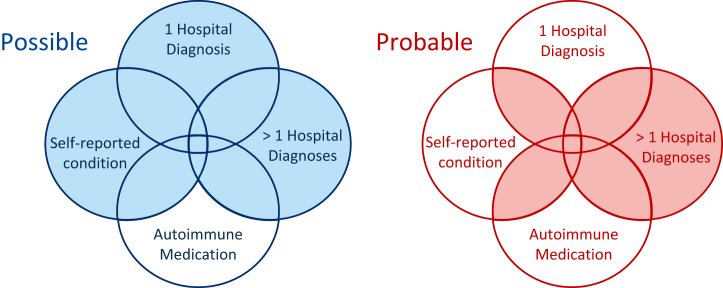
We defined autoimmune and depression cases using hospital episode statistics, self-reported conditions and medications, and mental health questionnaires. Pairwise comparisons of depression prevalence between autoimmune cases and controls, and vice versa, were performed. Cross-trait polygenic risk score (PRS) analyses tested for pleiotropy, i.e., whether PRSs for depression could predict autoimmune disease status, and vice versa.
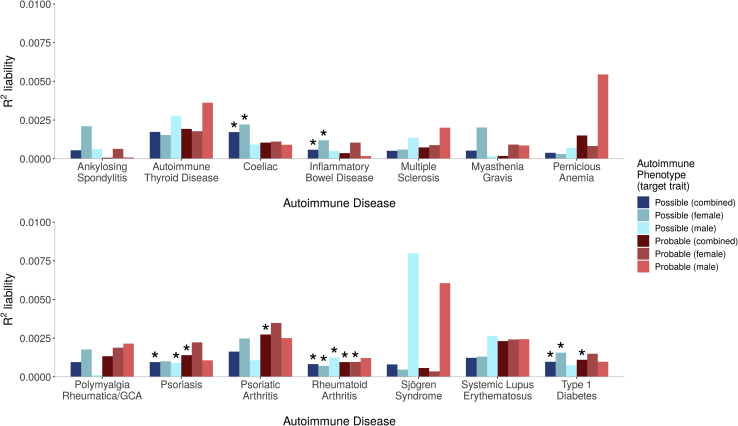
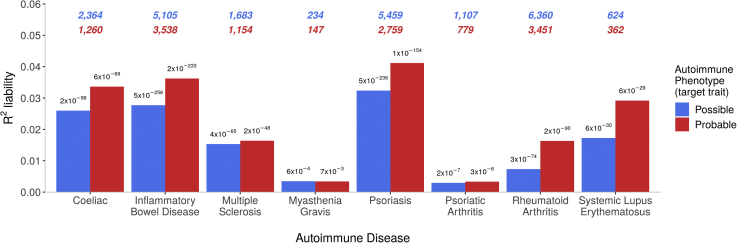
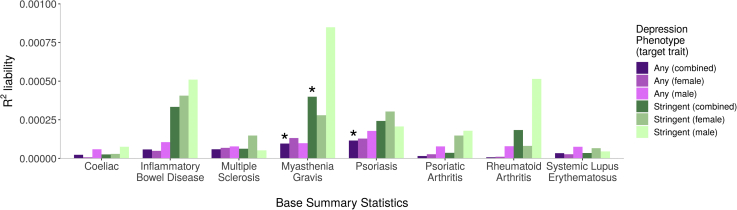
We identified 28,479 cases of autoimmune diseases (pooling across 14 traits) and 324,074 autoimmune controls, and 65,075 cases of depression and 232,552 depression controls. The prevalence of depression was significantly higher in autoimmune cases than in controls, and similarly, the prevalence of autoimmune disease was higher in depression cases than in controls. PRSs for myasthenia gravis and psoriasis were significantly higher in depression cases than in controls ( 5.2 × 10, ≤ 0.04%). PRSs for depression were significantly higher in inflammatory bowel disease, psoriasis, psoriatic arthritis, rheumatoid arthritis, and type 1 diabetes cases than in controls ( 5.8 × 10, range = 0.06%-0.27%), and lower in celiac disease cases than in controls ( 5.4 × 10, range = 0.11%-0.15%).
Consistent with the literature, depression was more common in individuals with autoimmune diseases than in controls, and vice versa. PRSs showed some evidence for involvement of shared genetic factors, but the modest values suggest that shared genetic architecture accounts for a small proportion of the increased risk across traits.
流行病学研究报告称抑郁症与自身免疫性疾病之间的共病率有所增加。在观察到的共病现象中,共享基因影响的作用尚不清楚。我们在英国生物银行(UKB)中研究了这些性状之间基因多效性的证据。
我们使用医院病历统计数据、自我报告的疾病和用药情况以及心理健康问卷来定义自身免疫性疾病和抑郁症病例。对自身免疫性疾病病例与对照之间的抑郁症患病率进行了两两比较,反之亦然。跨性状多基因风险评分(PRS)分析检测了基因多效性,即抑郁症的PRS是否可以预测自身免疫性疾病状态,反之亦然。
我们确定了28479例自身免疫性疾病病例(汇总了14种性状)和324074例自身免疫性对照,以及65075例抑郁症病例和232552例抑郁症对照。自身免疫性疾病病例中的抑郁症患病率显著高于对照组,同样,抑郁症病例中的自身免疫性疾病患病率也高于对照组。重症肌无力和银屑病的PRS在抑郁症病例中显著高于对照组(5.2×10,P≤0.04%)。炎症性肠病、银屑病、银屑病关节炎、类风湿关节炎和1型糖尿病病例中的抑郁症PRS显著高于对照组(5.8×10,范围为0.06%-0.27%),而乳糜泻病例中的抑郁症PRS低于对照组(5.4×10,范围为0.11%-0.15%)。
与文献一致,自身免疫性疾病患者中的抑郁症比对照组更常见,反之亦然。PRS显示出一些共享基因因素参与的证据,但适度的P值表明共享基因结构在跨性状增加的风险中占比很小。