Kelling Jeffrey, Ohmann Robin, Meyer Jörg, Kühne Tim, Cuniberti Gianaurelio, Wolf Jannic, Juckeland Guido, Huhn Thomas, Zahn Peter, Moresco Francesca, Gemming Sibylle
Department of Information Services and Computing, Helmholtz-Zentrum Dresden-Rossendorf (HZDR), Bautzner Landstraße 400, 01328, Dresden, Germany.
Institute of Ion Beam Physics and Materials Research, Helmholtz-Zentrum Dresden-Rossendorf (HZDR), Bautzner Landstraße 400, 01328, Dresden, Germany.
Sci Rep. 2021 Jul 19;11(1):14649. doi: 10.1038/s41598-021-93724-5.
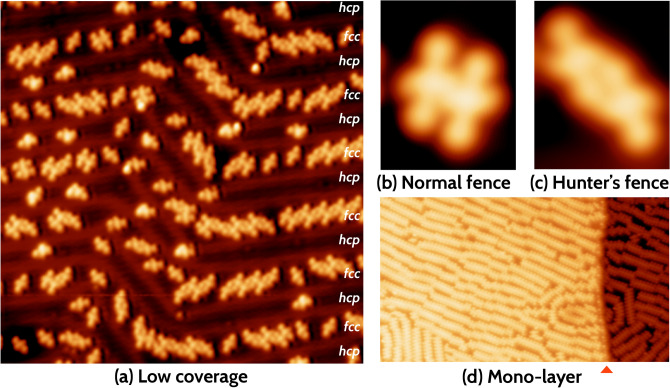
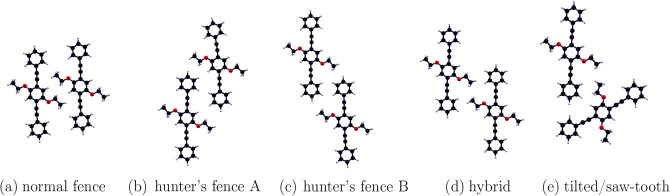
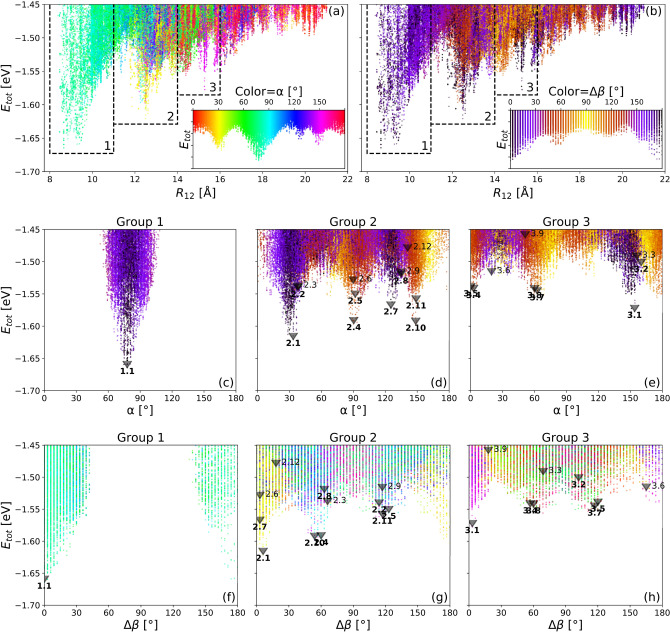
Due to the low corrugation of the Au(111) surface, 1,4-bis(phenylethynyl)-2,5-bis(ethoxy)benzene (PEEB) molecules can form quasi interlocked lateral patterns, which are observed in scanning tunneling microscopy experiments at low temperatures. We demonstrate a multi-dimensional clustering approach to quantify the anisotropic pair-wise interaction of molecules and explain these patterns. We perform high-throughput calculations to evaluate an energy function, which incorporates the adsorption energy of single PEEB molecules on the metal surface and the intermolecular interaction energy of a pair of PEEB molecules. The analysis of the energy function reveals, that, depending on coverage density, specific types of pattern are preferred which can potentially be exploited to form one-dimensional molecular wires on Au(111).
由于Au(111)表面的波纹度较低,1,4-双(苯乙炔基)-2,5-双(乙氧基)苯(PEEB)分子可以形成准互锁的横向图案,这在低温扫描隧道显微镜实验中可以观察到。我们展示了一种多维聚类方法来量化分子的各向异性成对相互作用并解释这些图案。我们进行高通量计算以评估一个能量函数,该函数包含单个PEEB分子在金属表面的吸附能和一对PEEB分子的分子间相互作用能。对能量函数的分析表明,根据覆盖密度,特定类型的图案更受青睐,这有可能被用于在Au(111)上形成一维分子线。