J Med Libr Assoc. 2021 Apr 1;109(2):301-310. doi: 10.5195/jmla.2021.903.
To conduct a bibliometric analysis of Letters to the Editor published on the Zika virus from 1952-2018.
A PubMed search was conducted using the terms (Zika OR ZIKV). Results were limited to 1952-2018 and Publication Type = Letter. Results were exported to EndNote, and the full text of each Letter examined. Each Letter was assigned to one of five categories: Reader Response, Author Reply, Observation, Case Report, or Research. Additional study parameters included number of authors, number of references, use of graphics, and funding. Citation reports were generated for each category and the entire dataset, producing lists sorted by Times Cited.
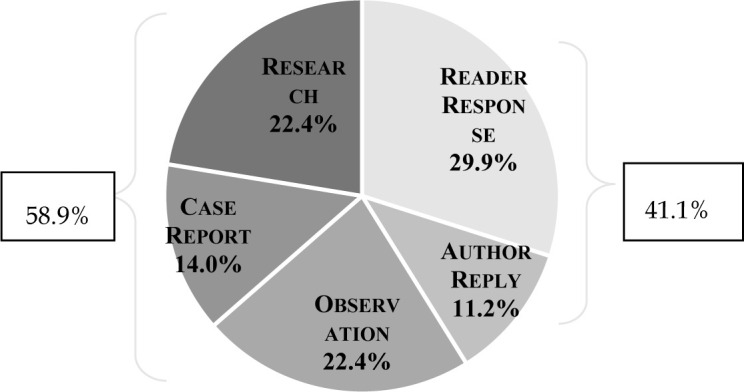
Of 499 Letters, only 15 (3.0%) were published before 2016. In 2016, at the height of the Zika virus epidemic in the Americas, 244 (48.9%) Letters were published, dropping to 145 (29.1%) in 2017 and 95 (19.0%) in 2018. Letters included 149 (29.9%) Reader Responses, 56 (11.2%) Author Replies, 112 (22.4%) Observations, 70 (14.0%) Case Reports, and 112 (22.4%) Research. The Letters were written by 1-35 authors; 369 (74.0%) Letters had 1-5 authors, and 130 (26.0%) had 6 or more. The Letters cited 0-63 references, with an average of 7.0 per Letter. Graphics appeared in 192 (38.5%) Letters, and 77 (15.4%) Letters reported funding. An interesting anomaly was the 104 (20.8%) Letters authored or co-authored by 1 individual.
Letters to the Editor remain an important component of scientific communication and may serve as a valuable source of clinical and research information.
对 1952 年至 2018 年发表的关于寨卡病毒的读者来信进行文献计量分析。
使用术语(寨卡或 ZIKV)在 PubMed 上进行搜索。结果仅限于 1952 年至 2018 年,出版物类型=信件。结果导出到 EndNote,并检查了每封信的全文。每封信被分配到五个类别之一:读者回复、作者回复、观察、病例报告或研究。其他研究参数包括作者人数、参考文献数量、图形使用情况和资金。为每个类别和整个数据集生成引文报告,生成按引用次数排序的列表。
在 499 封信件中,只有 15 封(3.0%)发表于 2016 年之前。在 2016 年,也就是美洲寨卡病毒疫情高峰期,发表了 244 封(48.9%)的信件,2017 年降至 145 封(29.1%),2018 年降至 95 封(19.0%)。信件包括 149 封(29.9%)读者回复、56 封(11.2%)作者回复、112 封(22.4%)观察报告、70 封(14.0%)病例报告和 112 封(22.4%)研究报告。信件由 1-35 位作者撰写;369 封(74.0%)信件有 1-5 位作者,130 封(26.0%)有 6 位或更多作者。信件引用了 0-63 篇参考文献,平均每封信引用 7.0 篇。192 封(38.5%)信件中有图形,77 封(15.4%)信件报告了资金情况。一个有趣的异常现象是,有 104 封(20.8%)信件是由 1 个人单独撰写或合著的。
读者来信仍然是科学交流的一个重要组成部分,可能是临床和研究信息的宝贵来源。