Sharma Manoj, Dai Chia-Liang, Batra Kavita, Chen Ching-Chen, Pharr Jennifer R, Coughenour Courtney, Awan Asma, Catalano Hannah
Department of Environmental and Occupational Health, School of Public Health, University of Nevada, Las Vegas, NV 89119, USA.
Department of Teaching and Learning, College of Education, University of Nevada, Las Vegas, NV 89154, USA.
Pharmacy (Basel). 2021 Jul 15;9(3):126. doi: 10.3390/pharmacy9030126.
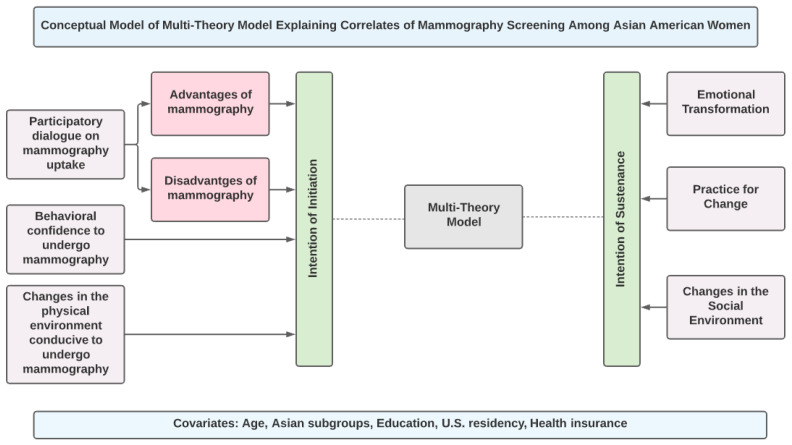
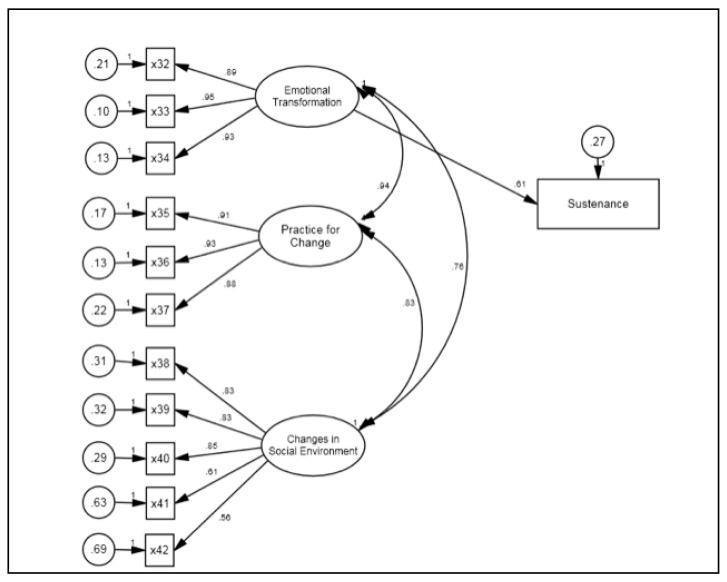
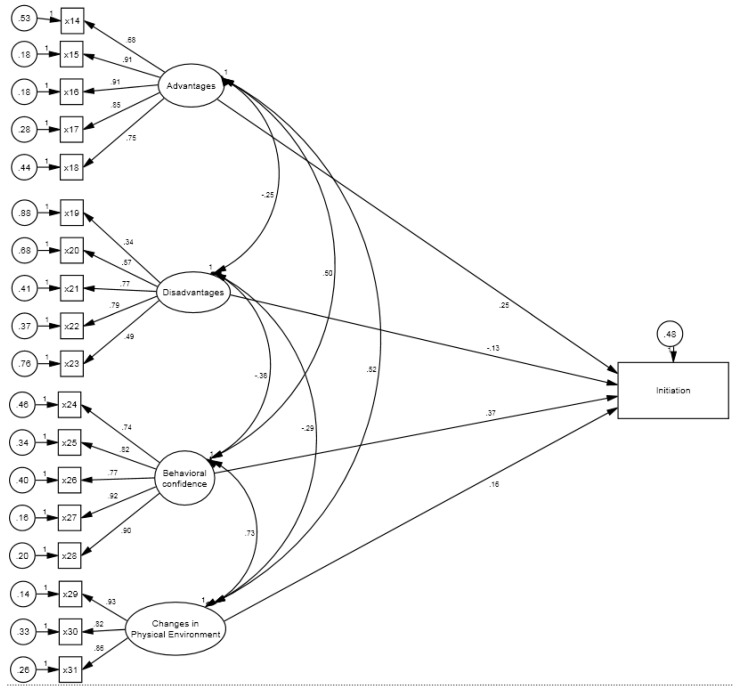
Globally, breast cancer is the most common malignancy affecting women. The incidence of breast cancer has been growing among Asian American women. Mammography is a screening procedure that provides early diagnosis for the timely treatment to reduce premature mortality due to breast cancer. However, there are no national data available that summarize the rates of mammography screening among Asian American women. Some small-scale studies have reported low rates of mammography uptake among Asian American women. This cross-sectional study utilized the fourth-generation, multi-theory model (MTM) of health behavior change to explain the correlates of mammography screening among Asian American women between the ages of 45-54 years. A 44-item instrument was evaluated for face, content, and construct validity (using structural equation modeling) and reliability (Cronbach's alpha) and administered electronically to a nationally representative sample of Asian American women ( = 374). The study found that Asian American women who have had received mammograms in the past 12 months as per recommendations, all three constructs of MTM, namely, participatory dialogue (β = 0.156, < 0.05), behavioral confidence (β = 0.236, < 0.001), and changes in the physical environment (β = 0.426, < 0.001) were statistically significant and crucial in their decision to initiate getting a mammogram, accounting for a substantial 49.9% of the variance in the decision to seek mammography. The study also found that the MTM constructs of emotional transformation (β = 0.437, < 0.001) and practice for change (β = 0.303, < 0.001) were significant for maintaining the repeated behavior of getting annual mammograms and were responsible for 53.9% of the variance. This evidence-based study validates the use of MTM in designing and evaluating mammography screening promotion programs among Asian American women aged 45-54 years.
在全球范围内,乳腺癌是影响女性的最常见恶性肿瘤。美国亚裔女性中乳腺癌的发病率一直在上升。乳房X线摄影是一种筛查程序,可提供早期诊断以便及时治疗,从而降低因乳腺癌导致的过早死亡率。然而,目前尚无全国性数据总结美国亚裔女性的乳房X线摄影筛查率。一些小规模研究报告称,美国亚裔女性的乳房X线摄影检查使用率较低。这项横断面研究利用健康行为改变的第四代多理论模型(MTM)来解释45至54岁美国亚裔女性乳房X线摄影筛查的相关因素。对一份包含44个条目的问卷进行了表面效度、内容效度和结构效度(使用结构方程模型)以及信度(克朗巴哈系数)评估,并以电子方式发放给具有全国代表性的美国亚裔女性样本(n = 374)。研究发现,按照建议在过去12个月内接受过乳房X线摄影检查的美国亚裔女性中,MTM的所有三个构成要素,即参与性对话(β = 0.156,p < 0.05)、行为信心(β = 0.236,p < 0.001)和物理环境变化(β = 0.426,p < 0.001)在她们决定开始进行乳房X线摄影检查方面具有统计学意义且至关重要,占寻求乳房X线摄影检查决策差异的49.9%。研究还发现,MTM的情感转变(β = 0.437,p < 0.001)和改变实践(β = 0.303,p < 0.001)构成要素对于维持每年进行乳房X线摄影检查的重复行为具有显著意义,并占差异的53.9%。这项基于证据的研究验证了MTM在设计和评估45至54岁美国亚裔女性乳房X线摄影筛查促进项目中的应用。