
世界贸易中心救援和恢复工作人员的癌症生存情况:一项协作队列研究。
Cancer survival among World Trade Center rescue and recovery workers: A collaborative cohort study.
机构信息
Department of Medicine, Montefiore Medical Center, New York, New York, USA.
Fire Department of the City of New York (FDNY), Brooklyn, New York, USA.
出版信息
Am J Ind Med. 2021 Oct;64(10):815-826. doi: 10.1002/ajim.23278. Epub 2021 Jul 19.
BACKGROUND
World Trade Center (WTC)-exposed responders may be eligible to receive no-cost medical monitoring and treatment for certified conditions, including cancer. The survival of responders with cancer has not previously been investigated.
METHODS
This study compared the estimated relative survival of WTC-exposed responders who developed cancer while enrolled in two WTC medical monitoring and treatment programs in New York City (WTC-MMTP responders) and WTC-exposed responders not enrolled (WTC-non-MMTP responders) to non-responders from New York State (NYS-non-responders), all restricted to the 11-southernmost NYS counties, where most responders resided. Parametric survival models estimated cancer-specific and all-cause mortality. Follow-up ended at death or on December 31, 2016.
RESULTS
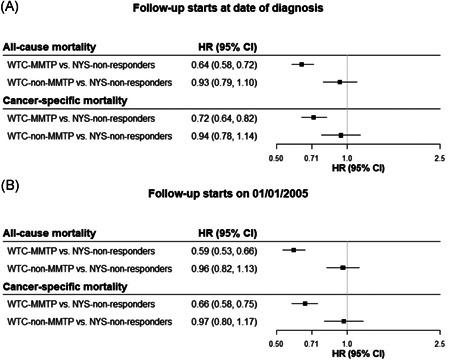
From January 1, 2005 to December 31, 2016, there were 2,037 cancer cases and 303 deaths (248 cancer-related deaths) among WTC-MMTP responders, 564 cancer cases, and 143 deaths (106 cancer-related deaths) among WTC-non-MMTP responders, and 574,075 cancer cases and 224,040 deaths (158,645 cancer-related deaths) among the NYS-non-responder population. Comparing WTC-MMTP responders with NYS-non-responders, the cancer-specific mortality hazard ratio (HR) was 0.72 (95% confidence interval [CI] = 0.64-0.82), and all-cause mortality HR was 0.64 (95% CI = 0.58-0.72). The cancer-specific HR was 0.94 (95% CI = 0.78-1.14), and all-cause mortality HR was 0.93 (95% CI = 0.79-1.10) comparing WTC-non-MMTP responders to the NYS-non-responder population.
CONCLUSIONS
WTC-MMTP responders had lower mortality compared with NYS-non-responders, after controlling for demographic factors and temporal trends. There may be survival benefits from no-out-of-pocket-cost medical care which could have important implications for healthcare policy, however, other occupational and socioeconomic factors could have contributed to some of the observed survival advantage.
背景
世界贸易中心(WTC)暴露的应急人员有资格获得免费的医疗监测和治疗,以治疗经认证的疾病,包括癌症。以前从未研究过患有癌症的应急人员的生存情况。
方法
本研究比较了在纽约市两个 WTC 医疗监测和治疗计划(WTC-MMTP 应急人员)中登记患有癌症的 WTC 暴露应急人员与未登记(WTC-non-MMTP 应急人员)的 WTC 暴露应急人员的癌症特异性和全因死亡率的相对生存率,以及纽约州(NYS)非响应者(NYS-non-responders),所有这些都限制在纽约州最南端的 11 个县,大多数响应者居住在这些县。参数生存模型估计了癌症特异性和全因死亡率。随访截止于死亡或 2016 年 12 月 31 日。
结果
从 2005 年 1 月 1 日至 2016 年 12 月 31 日,WTC-MMTP 响应者中有 2037 例癌症病例和 303 例死亡(248 例癌症相关死亡),564 例癌症病例和 143 例死亡(106 例癌症相关死亡)在 WTC-non-MMTP 响应者中,而 NYS-non-responder 人群中有 574075 例癌症病例和 224040 例死亡(158645 例癌症相关死亡)。与 NYS-non-responder 相比,WTC-MMTP 响应者的癌症特异性死亡率风险比(HR)为 0.72(95%置信区间[CI] = 0.64-0.82),全因死亡率 HR 为 0.64(95% CI = 0.58-0.72)。与 NYS-non-responder 相比,WTC-non-MMTP 响应者的癌症特异性 HR 为 0.94(95% CI = 0.78-1.14),全因死亡率 HR 为 0.93(95% CI = 0.79-1.10)。
结论
在控制人口统计学因素和时间趋势后,WTC-MMTP 响应者的死亡率与 NYS-non-responder 相比有所降低。免费医疗保健可能会带来生存获益,这对医疗保健政策具有重要意义,但是,其他职业和社会经济因素可能导致了部分观察到的生存优势。


 Zotero 插件