Samarelli Anna Valeria, Tonelli Roberto, Heijink Irene, Martin Medina Aina, Marchioni Alessandro, Bruzzi Giulia, Castaniere Ivana, Andrisani Dario, Gozzi Filippo, Manicardi Linda, Moretti Antonio, Cerri Stefania, Fantini Riccardo, Tabbì Luca, Nani Chiara, Mastrolia Ilenia, Weiss Daniel J, Dominici Massimo, Clini Enrico
Laboratory of Cell Therapies and Respiratory Medicine, Department of Medical and Surgical Sciences for Children and Adults University Hospital of Modena and Reggio Emilia, Modena, Italy.
University Hospital of Modena, Respiratory Diseases Unit, Department of Medical and Surgical Sciences, University of Modena Reggio Emilia, Modena, Italy.
Front Pharmacol. 2021 Jul 5;12:692551. doi: 10.3389/fphar.2021.692551. eCollection 2021.
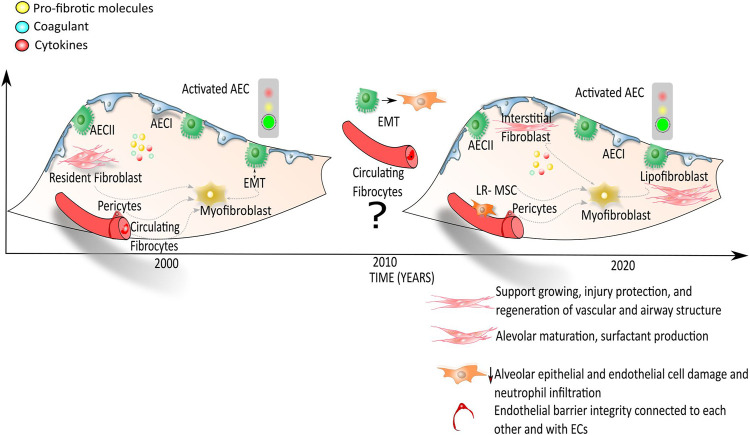
Idiopathic pulmonary fibrosis (IPF) is one of the most aggressive forms of idiopathic interstitial pneumonias, characterized by chronic and progressive fibrosis subverting the lung's architecture, pulmonary functional decline, progressive respiratory failure, and high mortality (median survival 3 years after diagnosis). Among the mechanisms associated with disease onset and progression, it has been hypothesized that IPF lungs might be affected either by a regenerative deficit of the alveolar epithelium or by a dysregulation of repair mechanisms in response to alveolar and vascular damage. This latter might be related to the progressive dysfunction and exhaustion of the resident stem cells together with a process of cellular and tissue senescence. The role of endogenous mesenchymal stromal/stem cells (MSCs) resident in the lung in the homeostasis of these mechanisms is still a matter of debate. Although endogenous MSCs may play a critical role in lung repair, they are also involved in cellular senescence and tissue ageing processes with loss of lung regenerative potential. In addition, MSCs have immunomodulatory properties and can secrete anti-fibrotic factors. Thus, MSCs obtained from other sources administered systemically or directly into the lung have been investigated for lung epithelial repair and have been explored as a potential therapy for the treatment of lung diseases including IPF. Given these multiple potential roles of MSCs, this review aims both at elucidating the role of resident lung MSCs in IPF pathogenesis and the role of administered MSCs from other sources for potential IPF therapies.
特发性肺纤维化(IPF)是特发性间质性肺炎中最具侵袭性的形式之一,其特征为慢性进行性纤维化破坏肺结构、肺功能下降、进行性呼吸衰竭以及高死亡率(诊断后中位生存期为3年)。在与疾病发生和进展相关的机制中,有人提出IPF肺可能受肺泡上皮再生缺陷或对肺泡和血管损伤的修复机制失调影响。后者可能与驻留干细胞的渐进性功能障碍和耗竭以及细胞和组织衰老过程有关。肺内源性间充质基质/干细胞(MSCs)在这些机制的稳态中的作用仍存在争议。尽管内源性MSCs可能在肺修复中起关键作用,但它们也参与细胞衰老和组织老化过程,导致肺再生潜能丧失。此外,MSCs具有免疫调节特性,能分泌抗纤维化因子。因此,从其他来源获取的MSCs经全身给药或直接注入肺内,已被研究用于肺上皮修复,并被探索作为包括IPF在内的肺部疾病的潜在治疗方法。鉴于MSCs的这些多种潜在作用,本综述旨在阐明肺驻留MSCs在IPF发病机制中的作用以及其他来源的给药MSCs在潜在IPF治疗中的作用。