Yamaguchi Nobutoshi
Division of Biological Science, Graduate School of Science and Technology, Nara Institute of Science and Technology, Nara, Japan.
Front Plant Sci. 2021 Jul 5;12:701406. doi: 10.3389/fpls.2021.701406. eCollection 2021.
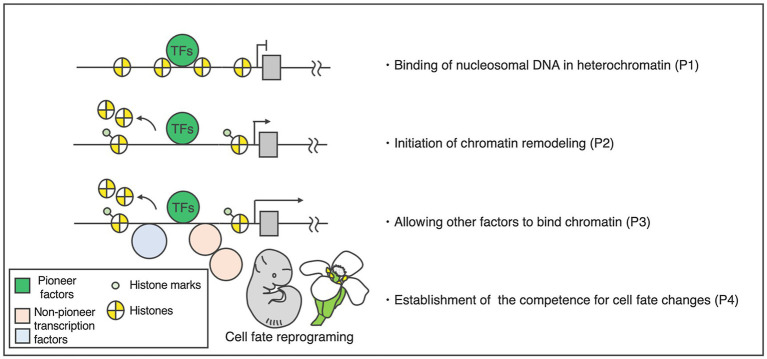
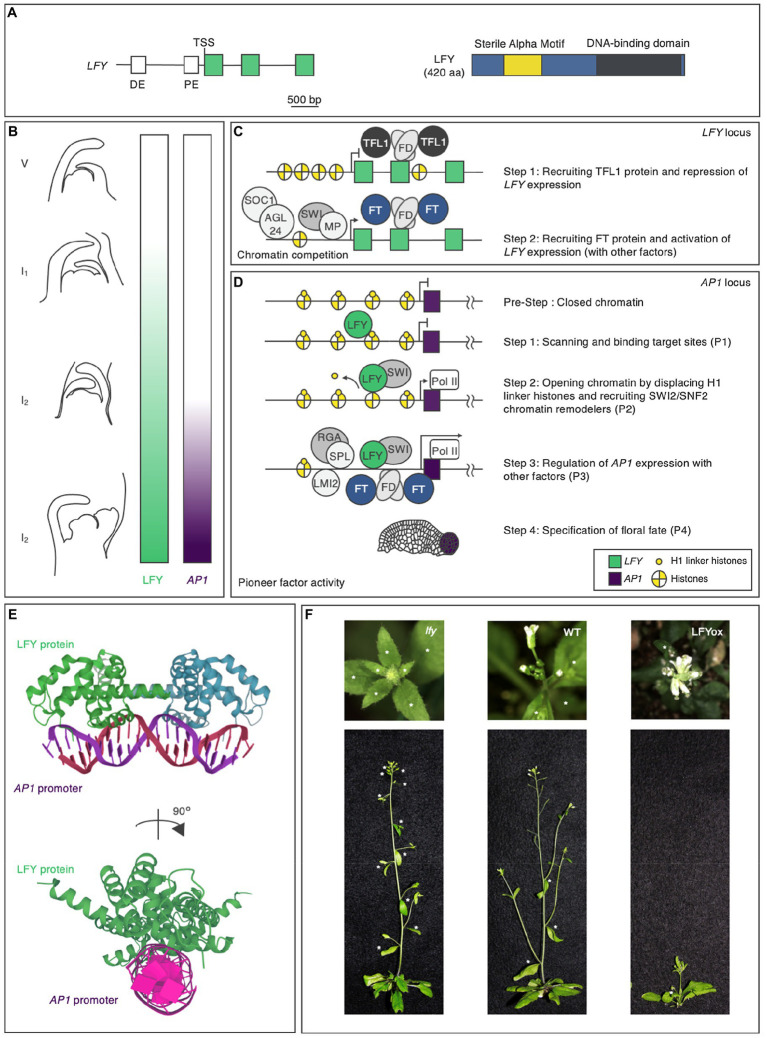
A subset of eukaryotic transcription factors (TFs) possess the ability to reprogram one cell type into another. Genes important for cellular reprograming are typically located in closed chromatin, which is covered by nucleosomes. Pioneer factors are a special class of TFs that can initially engage their target sites in closed chromatin prior to the engagement with, opening of, or modification of the sites by other factors. Although many pioneer factors are known in animals, a few have been characterized in plants. The TF LEAFY (LFY) acts as a pioneer factor specifying floral fate in . In response to endogenous and environmental cues, plants produce appropriate floral inducers (florigens). During the vegetative phase, LFY is repressed by the TERMINAL FLOWER 1 (TFL1)-FD complex, which functions as a floral inhibitor, or anti-florigen. The florigen FLOWERING LOCUS T (FT) competes with TFL1 to prevent the binding of the FD TF to the locus. The resulting FT-FD complex functions as a transient stimulus to activate its targets. Once has been transcribed in the appropriate spatiotemporal manner, LFY binds to nucleosomes in closed chromatin regions. Subsequently, LFY opens the chromatin by displacing H1 linker histones and recruiting the SWI/SNF chromatin-remodeling complex. Such local changes permit the binding of other TFs, leading to the expression of the floral meristem identity gene . This mini-review describes the latest advances in our understanding of the pioneer TF LFY, providing insight into the establishment of gene expression competence through the shaping of the plant epigenetic landscape.
真核转录因子(TFs)的一个子集具有将一种细胞类型重编程为另一种细胞类型的能力。对细胞重编程重要的基因通常位于被核小体覆盖的封闭染色质中。先驱因子是一类特殊的TFs,它们能够在其他因子结合、打开或修饰位点之前,首先与封闭染色质中的靶位点结合。尽管在动物中已知许多先驱因子,但在植物中只有少数被鉴定出来。TF LEAFY(LFY)作为一种先驱因子,在[具体植物]中决定花的命运。响应内源性和环境信号,植物产生适当的花诱导物(成花素)。在营养生长阶段,LFY被TERMINAL FLOWER 1(TFL1)-FD复合物抑制,该复合物作为花抑制剂或抗成花素发挥作用。成花素FLOWERING LOCUS T(FT)与TFL1竞争,以阻止FD TF与[具体位点]结合。由此产生的FT-FD复合物作为一种短暂刺激来激活其靶标。一旦[相关基因]以适当的时空方式转录,LFY就会与封闭染色质区域中的核小体结合。随后,LFY通过取代H1连接组蛋白并招募SWI/SNF染色质重塑复合物来打开染色质。这种局部变化允许其他TFs结合,从而导致花分生组织特征基因的表达。本综述描述了我们对先驱TF LFY理解的最新进展,为通过塑造植物表观遗传景观建立基因表达能力提供了见解。