Division of Radiation Biophysics, Department of Radiation Oncology, Massachusetts General Hospital and Harvard Medical School, Boston, MA, United States of America.
J. Crayton Pruitt Family Department of Biomedical Engineering, University of Florida, Gainesville, FL, United States of America.
Phys Med Biol. 2021 Aug 3;66(16). doi: 10.1088/1361-6560/ac16ea.
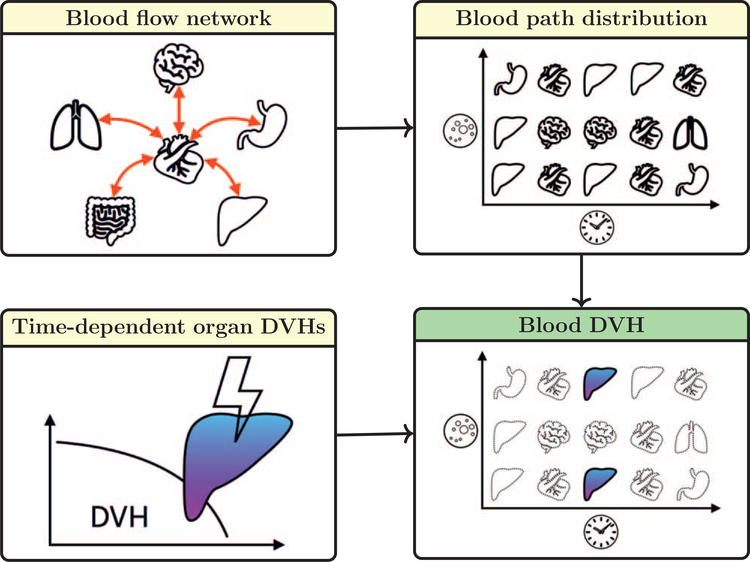
We have developed a time-dependent computational framework, hematological dose (HEDOS), to estimate dose to circulating blood cells from radiation therapy treatment fields for any treatment site. Two independent dynamic models were implemented in HEDOS: one describing the spatiotemporal distribution of blood particles (BPs) in organs and the second describing the time-dependent radiation field delivery. A whole-body blood flow network based on blood volumes and flow rates from ICRP Publication 89 was simulated to produce the spatiotemporal distribution of BPs in organs across the entire body using a discrete-time Markov process. Constant or time-varying transition probabilities were applied and their impact on transition time was investigated. The impact of treatment time and anatomical site were investigated using imaging data and dose distributions from a liver cancer and a brain cancer patient. The simulations revealed different dose levels to the circulating blood for brain irradiation compared to liver irradiation even for similar field sizes due to the different blood flow properties of the two organs. The volume of blood receiving any dose () after a single radiation fraction increases from 1.2% for a 1 s delivery time to 20.9% for 120 s delivery time for the brain cancer treatment, and from 10% (1 s) to 48.7% (120 s) for a liver cancer treatment. Other measures of the low-dose bath to the circulating blood such as the dose to small volumes of blood () decreases with longer delivery time. Furthermore, we demonstrate that the blood dose-volume histogram is highly sensitive to changes in the treatment time, indicating that dynamic modeling of blood flow and radiation fields is necessary to evaluate dose to circulating blood cells for the assessment of radiation-induced lymphopenia. HEDOS is publicly available and allows for the estimation of patient-specific dose to circulating blood cells based on organ DVHs, thus enabling the study of the impact of different treatment plans, dose rates, and fractionation schemes.
我们开发了一个时变计算框架,即血液剂量(HEDOS),以估算任何治疗部位的放射治疗治疗野中循环血细胞的剂量。HEDOS 中实现了两个独立的动态模型:一个描述器官中血液粒子(BP)的时空分布,另一个描述时变辐射场传递。基于 ICRP 出版物 89 中的血液体积和流速,模拟了一个全身血液流动网络,以使用离散时间马尔可夫过程产生整个身体器官中 BP 的时空分布。应用了常数或时变转移概率,并研究了它们对转移时间的影响。使用肝癌和脑癌患者的成像数据和剂量分布研究了治疗时间和解剖部位的影响。模拟结果表明,由于两个器官的血液流动特性不同,即使对于相似的射野大小,脑照射与肝照射相比,循环血液的剂量水平也不同。单次放射分割后接受任何剂量()的血液体积从 120 秒治疗时间的 20.9%增加到脑癌治疗的 1.2%,从肝癌治疗的 10%(1 秒)增加到 48.7%(120 秒)。循环血液的低剂量浴的其他度量,如小体积血液的剂量()随着输送时间的延长而降低。此外,我们证明了血液剂量-体积直方图对治疗时间的变化非常敏感,这表明需要对血流和辐射场进行动态建模,以评估循环血细胞的剂量,以评估辐射诱导的淋巴细胞减少症。HEDOS 是公开的,可以根据器官 DVH 估算患者特定的循环血细胞剂量,从而能够研究不同治疗计划、剂量率和分割方案的影响。