Center for Rare Diseases Bonn (ZSEB), University Hospital, Bonn, Germany.
Department of Neonatology and Pediatric Care, Children's University Hospital, Bonn, Germany.
Orphanet J Rare Dis. 2021 Jul 22;16(1):326. doi: 10.1186/s13023-021-01945-8.
Rare diseases (RDs) affect less than 5/10,000 people in Europe and fewer than 200,000 individuals in the United States. In rheumatology, RDs are heterogeneous and lack systemic classification. Clinical courses involve a variety of diverse symptoms, and patients may be misdiagnosed and not receive appropriate treatment. The objective of this study was to identify and classify some of the most important RDs in rheumatology. We also attempted to determine their combined prevalence to more precisely define this area of rheumatology and increase awareness of RDs in healthcare systems. We conducted a comprehensive literature search and analyzed each disease for the specified criteria, such as clinical symptoms, treatment regimens, prognoses, and point prevalences. If no epidemiological data were available, we estimated the prevalence as 1/1,000,000. The total point prevalence for all RDs in rheumatology was estimated as the sum of the individually determined prevalences.
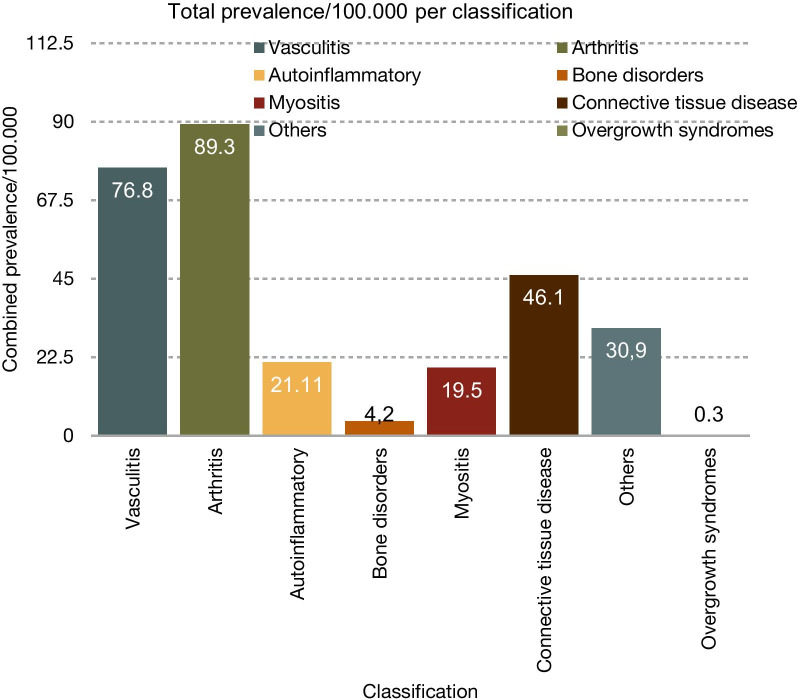
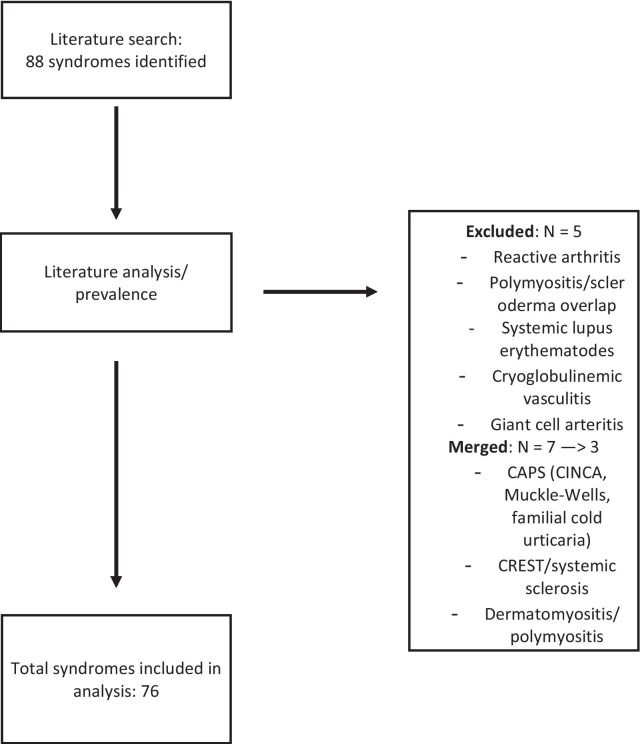
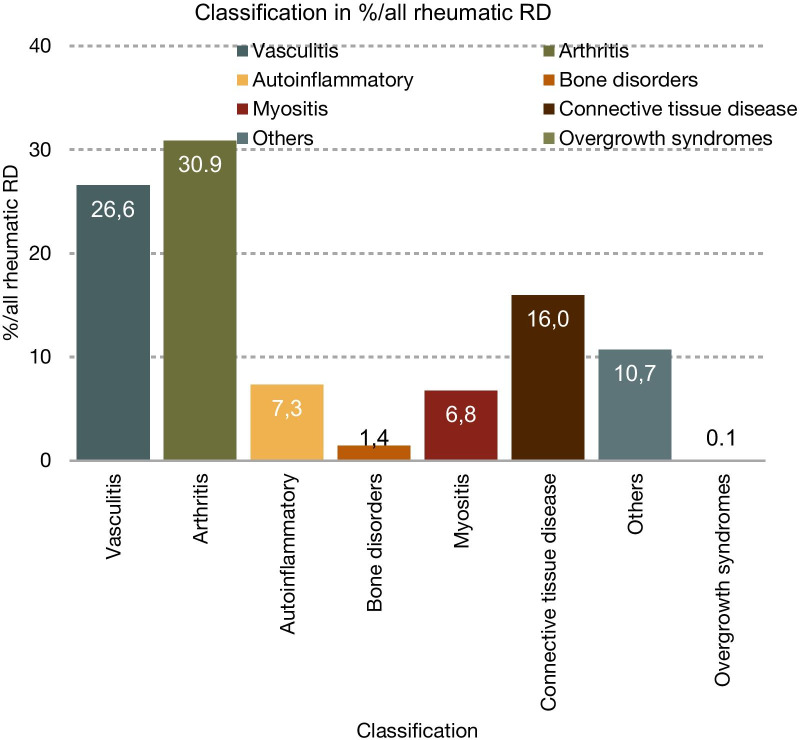
A total of 76 syndromes and diseases were identified, including vasculitis/vasculopathy (n = 15), arthritis/arthropathy (n = 11), autoinflammatory syndromes (n = 11), myositis (n = 9), bone disorders (n = 11), connective tissue diseases (n = 8), overgrowth syndromes (n = 3), and others (n = 8). Out of the 76 diseases, 61 (80%) are classified as chronic, with a remitting-relapsing course in 27 cases (35%) upon adequate treatment. Another 34 (45%) diseases were predominantly progressive and difficult to control. Corticosteroids are a therapeutic option in 49 (64%) syndromes. Mortality is variable and could not be determined precisely. Epidemiological studies and prevalence data were available for 33 syndromes and diseases. For an additional eight diseases, only incidence data were accessible. The summed prevalence of all RDs was 28.8/10,000.
RDs in rheumatology are frequently chronic, progressive, and present variable symptoms. Treatment options are often restricted to corticosteroids, presumably because of the scarcity of randomized controlled trials. The estimated combined prevalence is significant and almost double that of ankylosing spondylitis (18/10,000). Thus, healthcare systems should assign RDs similar importance as any other common disease in rheumatology.
罕见病(RDs)在欧洲的发病率低于每 5/10000 人,在美国的发病率低于 200000 人。在风湿病学中,RDs 具有异质性,缺乏系统分类。临床病程涉及多种不同的症状,患者可能会被误诊,得不到适当的治疗。本研究的目的是确定和分类一些最重要的风湿病学 RD。我们还试图确定它们的综合患病率,以更准确地定义这一风湿病学领域,并提高医疗保健系统对 RD 的认识。我们进行了全面的文献检索,并根据特定标准分析了每种疾病,如临床症状、治疗方案、预后和点患病率。如果没有流行病学数据,我们将患病率估计为 1/1000000。所有风湿病学 RD 的总点患病率是通过单独确定的患病率相加得到的。
共确定了 76 种综合征和疾病,包括血管炎/血管病(n=15)、关节炎/关节病(n=11)、自身炎症综合征(n=11)、肌炎(n=9)、骨骼疾病(n=11)、结缔组织疾病(n=8)、过度生长综合征(n=3)和其他(n=8)。在这 76 种疾病中,61 种(80%)被归类为慢性疾病,在 27 种情况下(35%)经适当治疗后具有缓解-复发过程。另有 34 种(45%)疾病主要呈进行性,难以控制。皮质类固醇是 49 种(64%)综合征的治疗选择。死亡率各不相同,无法准确确定。有 33 种综合征和疾病有流行病学研究和患病率数据。对于另外 8 种疾病,只有发病数据可用。所有 RD 的患病率总和为 28.8/10000。
风湿病学中的 RD 通常是慢性的、进行性的,表现出不同的症状。治疗选择通常限于皮质类固醇,这可能是由于缺乏随机对照试验。估计的综合患病率显著,几乎是强直性脊柱炎(18/10000)的两倍。因此,医疗保健系统应将 RD 与风湿病学中的任何其他常见疾病一样重视。