University of Tübingen, Tübingen, Germany.
Department of Biology and Program in Neuroscience and Cognitive Science, University of Maryland, College Park, MD, USA.
Nat Commun. 2021 Jul 22;12(1):4473. doi: 10.1038/s41467-021-24629-0.
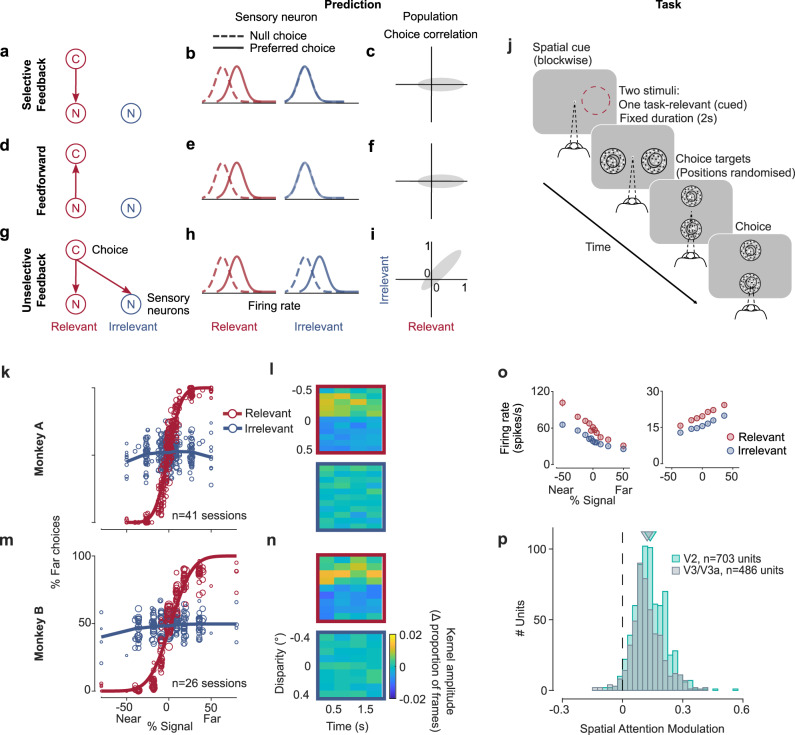
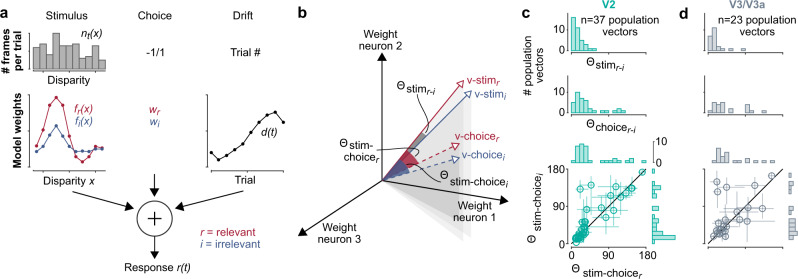
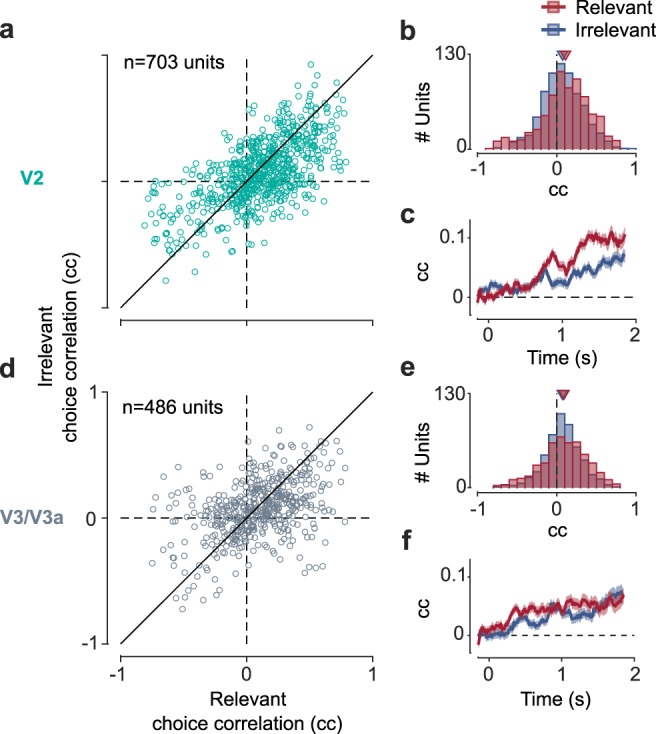
Feedback in the brain is thought to convey contextual information that underlies our flexibility to perform different tasks. Empirical and computational work on the visual system suggests this is achieved by targeting task-relevant neuronal subpopulations. We combine two tasks, each resulting in selective modulation by feedback, to test whether the feedback reflected the combination of both selectivities. We used visual feature-discrimination specified at one of two possible locations and uncoupled the decision formation from motor plans to report it, while recording in macaque mid-level visual areas. Here we show that although the behavior is spatially selective, using only task-relevant information, modulation by decision-related feedback is spatially unselective. Population responses reveal similar stimulus-choice alignments irrespective of stimulus relevance. The results suggest a common mechanism across tasks, independent of the spatial selectivity these tasks demand. This may reflect biological constraints and facilitate generalization across tasks. Our findings also support a previously hypothesized link between feature-based attention and decision-related activity.
大脑中的反馈被认为传递了上下文信息,这些信息是我们执行不同任务的灵活性的基础。视觉系统的实证和计算工作表明,这是通过针对与任务相关的神经元亚群来实现的。我们结合了两个任务,每个任务都通过反馈进行选择性调节,以测试反馈是否反映了这两种选择性的组合。我们使用在两个可能位置之一指定的视觉特征辨别,并将决策形成与运动计划解耦以进行报告,同时在猕猴中等级视觉区域进行记录。在这里,我们表明,尽管行为具有空间选择性,仅使用与任务相关的信息,但与决策相关的反馈的调节是空间非选择性的。群体反应显示出类似的刺激选择对齐,而与刺激相关性无关。研究结果表明,任务之间存在共同的机制,而与这些任务所需的空间选择性无关。这可能反映了生物限制,并有助于跨任务的泛化。我们的发现还支持了先前关于基于特征的注意力和与决策相关的活动之间存在联系的假设。