Diagnocat Inc, San Francisco, CA, USA.
Division of Dentistry, School of Medical Sciences, The University of Manchester, Manchester, UK.
Sci Rep. 2021 Jul 22;11(1):15006. doi: 10.1038/s41598-021-94093-9.
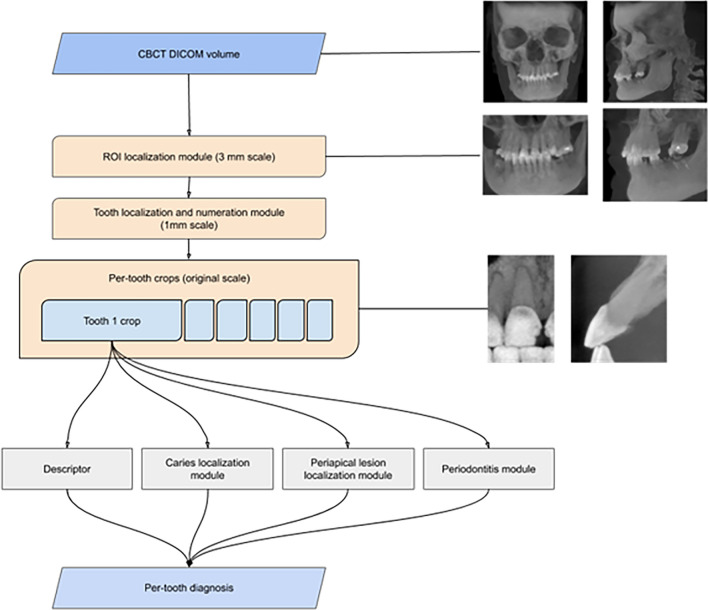
In this study, a novel AI system based on deep learning methods was evaluated to determine its real-time performance of CBCT imaging diagnosis of anatomical landmarks, pathologies, clinical effectiveness, and safety when used by dentists in a clinical setting. The system consists of 5 modules: ROI-localization-module (segmentation of teeth and jaws), tooth-localization and numeration-module, periodontitis-module, caries-localization-module, and periapical-lesion-localization-module. These modules use CNN based on state-of-the-art architectures. In total, 1346 CBCT scans were used to train the modules. After annotation and model development, the AI system was tested for diagnostic capabilities of the Diagnocat AI system. 24 dentists participated in the clinical evaluation of the system. 30 CBCT scans were examined by two groups of dentists, where one group was aided by Diagnocat and the other was unaided. The results for the overall sensitivity and specificity for aided and unaided groups were calculated as an aggregate of all conditions. The sensitivity values for aided and unaided groups were 0.8537 and 0.7672 while specificity was 0.9672 and 0.9616 respectively. There was a statistically significant difference between the groups (p = 0.032). This study showed that the proposed AI system significantly improved the diagnostic capabilities of dentists.
在这项研究中,评估了一种基于深度学习方法的新型人工智能系统,以确定其在临床环境中由牙医使用时对解剖标志、病理学、临床效果和安全性的 CBCT 成像诊断的实时性能。该系统由 5 个模块组成:ROI 定位模块(牙齿和颌骨的分割)、牙齿定位和编号模块、牙周炎模块、龋齿定位模块和根尖病变定位模块。这些模块使用基于最先进架构的 CNN。总共使用了 1346 次 CBCT 扫描来训练这些模块。经过标注和模型开发后,对 AI 系统进行了 Diagnocat AI 系统的诊断能力测试。24 名牙医参与了系统的临床评估。30 次 CBCT 扫描由两组牙医进行检查,一组由 Diagnocat 辅助,另一组则无辅助。辅助组和无辅助组的整体敏感性和特异性的结果是对所有条件的综合计算。辅助组和无辅助组的敏感性值分别为 0.8537 和 0.7672,特异性分别为 0.9672 和 0.9616。组间存在统计学差异(p=0.032)。这项研究表明,所提出的人工智能系统显著提高了牙医的诊断能力。