Division of Pediatric Genetics, Metabolism and Genomic Medicine, Department of Pediatrics, Michigan Medicine, Ann Arbor, Michigan, United States of America.
Division of Genetic Medicine, Department of Internal Medicine, University of Michigan, Ann Arbor, Michigan, United States of America.
PLoS One. 2021 Jul 23;16(7):e0255278. doi: 10.1371/journal.pone.0255278. eCollection 2021.
Over the past two decades non-communicable diseases (NCDs) have steadily increased as a cause of worldwide disability and mortality with a concomitant decrease in disease burden from communicable, maternal, neonatal and nutritional conditions. Congenital anomalies, the most common NCD affecting children, have recently become the fifth leading cause of under-five mortality worldwide, ahead of other conditions such as malaria, neonatal sepsis and malnutrition. Genetic counseling has been shown to be an effective method to decrease the impact of congenital anomalies and genetic conditions but is absent in almost all sub-Saharan Africa countries. To address this need for counseling services we designed and implemented the first broad-based genetic counseling curriculum in Ethiopia, launching it at St. Paul's Millennium Medical College (SPHMMC) in Addis Ababa, Ethiopia.
The curriculum, created by Michigan Medicine and SPHMMC specialists, consisted of medical knowledge and genetic counseling content and was delivered to two cohorts of nurses. Curriculum evaluation consisted of satisfaction surveys and pre- and post-assessments covering medical knowledge and genetic counseling content. Following Cohort 1 training, the curriculum was modified to increase the medical knowledge material and decrease Western genetic counseling principles material.
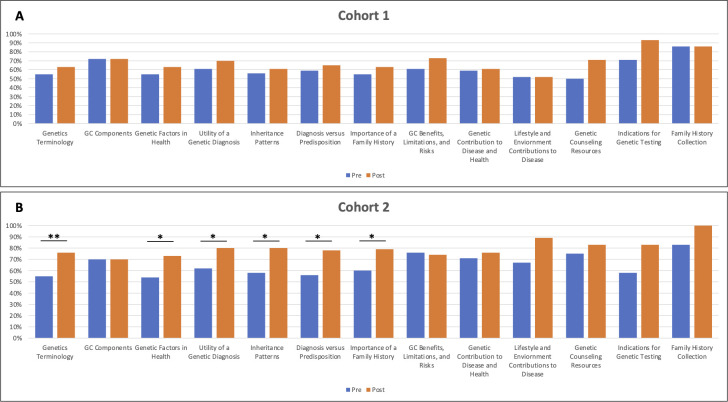
Both cohorts reported high levels of satisfaction but felt the workshop was too short. No significant improvements in assessment scores were seen for Cohort 1 in terms of total scores and medical knowledge and genetic counseling-specific questions. Following curriculum modification, improvements were seen in Cohort 2 with an increase in total assessment scores from 63% to 73% (p = 0.043), with medical knowledge-specific questions increasing from 57% to 79% (p = 0.01) with no significant change in genetic counseling-specific scores. Multiple logistic, financial, cultural and systems-specific barriers were identified with recommendations for their consideration presented.
Genetics medical knowledge of Ethiopian nurses increased significantly following curriculum delivery though difficulty was encountered with Western genetic counseling material.
在过去的二十年中,非传染性疾病(NCD)稳步上升,成为全球残疾和死亡的主要原因,同时传染性疾病、孕产妇、新生儿和营养状况导致的疾病负担减少。先天性异常是影响儿童的最常见的 NCD,最近已成为全球五岁以下儿童死亡的第五大主要原因,超过疟疾、新生儿败血症和营养不良等其他疾病。遗传咨询已被证明是减少先天性异常和遗传疾病影响的有效方法,但在几乎所有撒哈拉以南非洲国家都没有提供。为了满足这种咨询服务的需求,我们在埃塞俄比亚设计并实施了第一个基于广泛基础的遗传咨询课程,在埃塞俄比亚亚的斯亚贝巴的圣保罗千年医学学院(SPHMMC)推出了该课程。
该课程由密歇根医学和 SPHMMC 专家创建,包括医学知识和遗传咨询内容,并提供给两批护士。课程评估包括满意度调查以及涵盖医学知识和遗传咨询内容的预评估和后评估。在第一期培训之后,课程进行了修改,以增加医学知识内容并减少西方遗传咨询原则的内容。
两个队列都报告了很高的满意度,但认为讲习班时间太短。在第一期培训中,从总分数和医学知识以及遗传咨询特定问题来看,评估分数没有显著提高。在课程修改之后,第二期培训的成绩有所提高,总评估分数从 63%增加到 73%(p=0.043),医学知识特定问题的分数从 57%增加到 79%(p=0.01),遗传咨询特定问题的分数没有显著变化。确定了多种与财务、文化和系统相关的特定障碍,并提出了对其进行考虑的建议。
埃塞俄比亚护士的遗传医学知识在课程交付后显著增加,尽管西方遗传咨询材料遇到了困难。