State Key Laboratory of Ophthalmology, Zhongshan Ophthalmic Center, Sun Yat-Sen University, Guangzhou 510060, China.
Int J Mol Sci. 2021 Jul 14;22(14):7517. doi: 10.3390/ijms22147517.
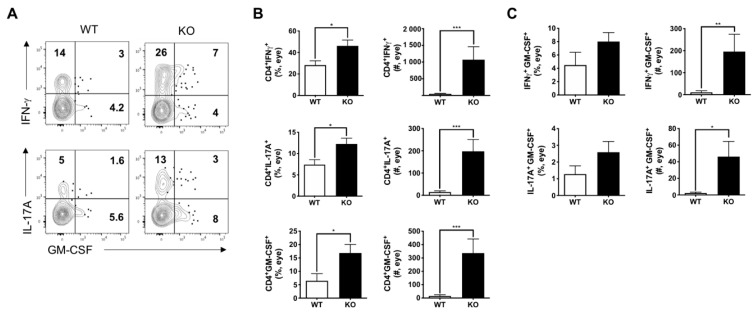
Human uveitis is an autoimmune disease of the central nervous system that is characterized by ocular inflammation with the involvement of uveitogenic Th1 and Th17 responses. In experimental autoimmune uveitis (EAU), the animal model for human uveitis, both responses are proven to be critical in disease development. Therefore, targeting both Th1 and Th17 cells has therapeutic implication for disease resolution. IL-27 is a multifunctional cytokine that can either promote or inhibit T cell responses and is implicated in both autoimmune and infectious diseases. The aim of this study is to characterize the role of IL-27/IL-27R signaling in regulating uveitogenic Th1/Th17 responses in EAU. By immunizing IL-27Rα mice and their wild-type (WT) littermates for EAU, we demonstrated that IL-27 signaling deficiency exacerbated EAU with severe ocular inflammation and impairment of visual function. Furthermore, there was a significant increase in the eye-infiltrating Th1 and Th17 cells in IL-27Rα EAU mice compared to WT. Their retinal antigen-specific Th1 and Th17 responses were also significantly increased, as represented by the elevation of their signature cytokines, IFN-γ and IL-17A, respectively. We also observed the upregulation of another pathogenic cytokine, granulocyte-macrophage colony-stimulating factor (GM-CSF), from effector T cells in IL-27Rα EAU mice. Mechanistic studies confirmed that IL-27 inhibited GM-CSF production from Th17 cells. In addition, the induction of IL-10 producing type 1 regulatory T (Tr1) cells was impaired in IL-27Rα EAU mice. These results identified that IL-27 signaling plays a suppressive role in EAU by regulating multiple CD4 cell subsets, including the effector Th1 and Th17 cells and the regulatory Tr1 cells. Our findings provide new insights for therapeutic potential in controlling uveitis by enhancing IL-27 signaling.
人葡萄膜炎是一种中枢神经系统自身免疫性疾病,其特征是眼部炎症伴致葡萄膜炎性 Th1 和 Th17 应答。在实验性自身免疫性葡萄膜炎 (EAU) 中,人葡萄膜炎的动物模型中,两种应答均被证实对疾病发展至关重要。因此,靶向 Th1 和 Th17 细胞均对疾病缓解具有治疗意义。IL-27 是一种多功能细胞因子,既能促进又能抑制 T 细胞应答,与自身免疫和感染性疾病均有关。本研究旨在阐明 IL-27/IL-27R 信号在调节 EAU 致葡萄膜炎性 Th1/Th17 应答中的作用。通过对 IL-27Rα 小鼠及其野生型 (WT) 同窝仔鼠进行 EAU 免疫,我们发现 IL-27 信号缺失使 EAU 加重,出现严重眼部炎症和视力功能损害。此外,与 WT 相比,IL-27Rα EAU 小鼠眼内浸润的 Th1 和 Th17 细胞显著增加。其视网膜抗原特异性 Th1 和 Th17 应答也显著增加,分别表现为特征性细胞因子 IFN-γ 和 IL-17A 的升高。我们还观察到 IL-27Rα EAU 小鼠效应 T 细胞中另一种致病性细胞因子粒细胞-巨噬细胞集落刺激因子 (GM-CSF) 的上调。机制研究证实,IL-27 抑制 Th17 细胞 GM-CSF 的产生。此外,IL-27Rα EAU 小鼠中诱导产生的 IL-10 产生型 1 调节性 T (Tr1) 细胞受损。这些结果表明,IL-27 通过调节多个 CD4 细胞亚群,包括效应性 Th1 和 Th17 细胞以及调节性 Tr1 细胞,在 EAU 中发挥抑制作用。我们的研究结果为通过增强 IL-27 信号控制葡萄膜炎提供了新的治疗潜力。