Kominek Jan, Zachar Martin, Guzej Michal, Bartuli Erik, Kotrbacek Petr
Heat Transfer and Fluid Flow Laboratory, Faculty of Mechanical Engineering, Brno University of Technology (BUT), Technicka 2896, 616 69 Brno, Czech Republic.
Polymers (Basel). 2021 Jul 12;13(14):2286. doi: 10.3390/polym13142286.
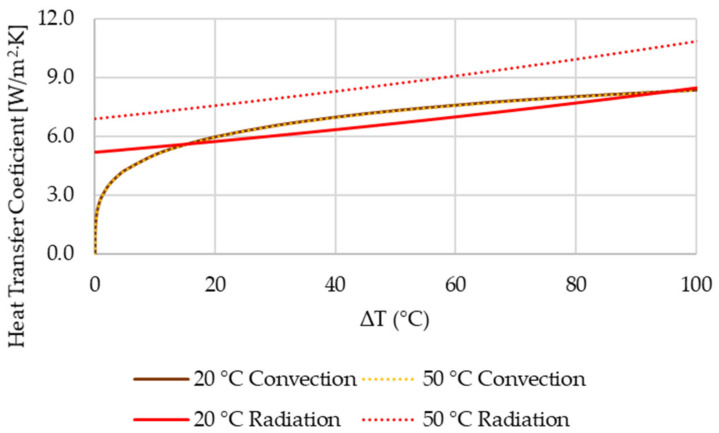
Miniaturization of electronic devices leads to new heat dissipation challenges and traditional cooling methods need to be replaced by new better ones. Polymer heat sinks may, thanks to their unique properties, replace standardly used heat sink materials in certain applications, especially in applications with high ambient temperature. Polymers natively dispose of high surface emissivity in comparison with glossy metals. This high emissivity allows a larger amount of heat to be dissipated to the ambient with the fourth power of its absolute surface temperature. This paper shows the change in radiative and convective heat transfer from polymer heat sinks used in different ambient temperatures. Furthermore, the observed polymer heat sinks have differently oriented graphite filler caused by their molding process differences, therefore their thermal conductivity anisotropies and overall cooling efficiencies also differ. Furthermore, it is also shown that a high radiative heat transfer leads to minimizing these cooling efficiency differences between these polymer heat sinks of the same geometry. The measurements were conducted at HEATLAB, Brno University of Technology.
电子设备的小型化带来了新的散热挑战,传统的冷却方法需要被更新更好的方法所取代。聚合物散热器由于其独特的性能,在某些应用中可能会取代标准使用的散热器材料,特别是在环境温度较高的应用中。与光滑的金属相比,聚合物本身具有较高的表面发射率。这种高发射率使得大量的热量能够以其绝对表面温度的四次方散发到周围环境中。本文展示了在不同环境温度下使用的聚合物散热器的辐射和对流热传递变化。此外,观察到的聚合物散热器由于其成型工艺的差异而具有不同取向的石墨填料,因此它们的热导率各向异性和整体冷却效率也不同。此外,研究还表明,高辐射热传递能够使这些相同几何形状的聚合物散热器之间的冷却效率差异最小化。测量是在布尔诺技术大学的热实验室进行的。