Memorial Sloan Kettering Cancer Center, New York, New York, USA
Weill Cornell Medical College, New York, New York, USA.
J Immunother Cancer. 2021 Jul;9(7). doi: 10.1136/jitc-2021-002646.
Avelumab (anti-programmed death ligand 1 (PD-L1)) is approved in multiple countries for the treatment of metastatic Merkel cell carcinoma (mMCC), a rare and aggressive skin cancer. We report efficacy and safety data and exploratory biomarker analyses from a cohort of patients with mMCC treated with first-line avelumab in a phase II trial.
Patients with treatment-naive mMCC received avelumab 10 mg/kg intravenously every 2 weeks. The primary endpoint was durable response, defined as objective response (complete or partial response; assessed by independent review) lasting ≥6 months. Additional assessments included progression-free survival (PFS), overall survival (OS), safety, and biomarker analyses.
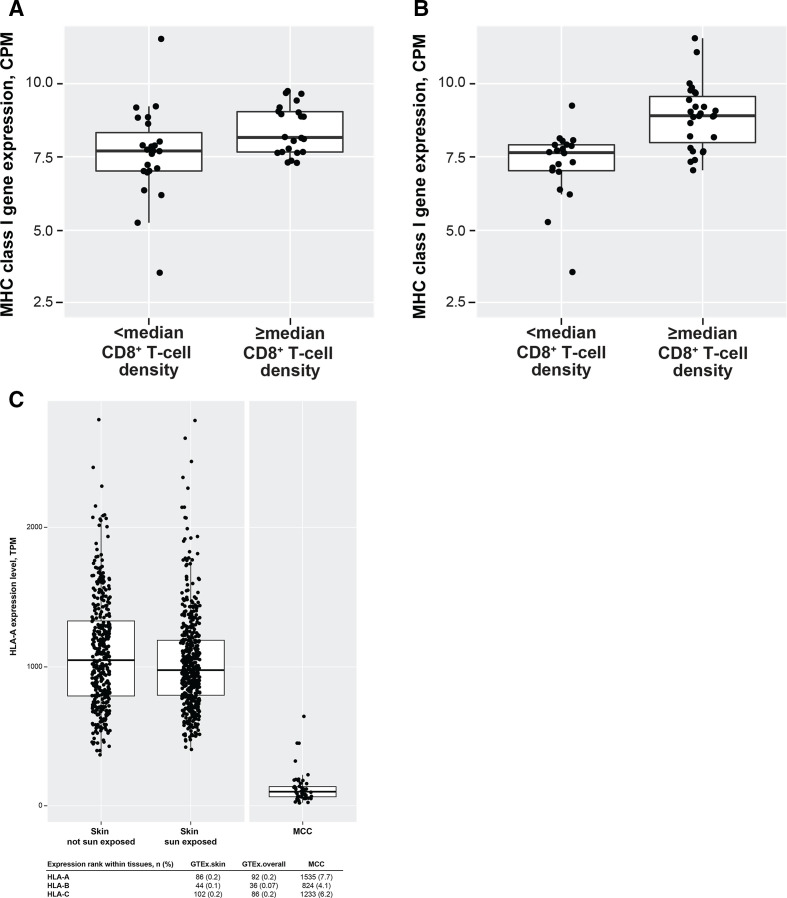
In 116 patients treated with avelumab, median follow-up was 21.2 months (range: 14.9-36.6). Thirty-five patients had a response lasting ≥6 months, giving a durable response rate of 30.2% (95% CI: 22.0% to 39.4%). The objective response rate was 39.7% (95% CI: 30.7% to 49.2%). Median PFS was 4.1 months (95% CI: 1.4 to 6.1) and median OS was 20.3 months (95% CI: 12.4 to not estimable). Response rates were numerically higher in patients with PD-L1+ tumors, Merkel cell polyomavirus (MCPyV)-negative tumors, and tumors with increased intratumoral CD8 T-cell density. Exploratory analyses did not identify a biomarker that could reliably predict a response to first-line treatment with avelumab; however, a novel gene expression signature to identify the presence of MCPyV+ tumors was derived. Treatment-related adverse events (any grade) occurred in 94 (81.0%) patients, including grade 3/4 events in 21 (18.1%) patients; no treatment-related deaths occurred.
In patients with mMCC, first-line treatment with avelumab led to responses in 40% and durable responses in 30%, and was associated with a low rate of grade 3/4 treatment-related adverse events.
avelumab(抗程序性死亡配体 1(PD-L1))已在多个国家获得批准,用于治疗转移性默克尔细胞癌(mMCC),这是一种罕见且侵袭性的皮肤癌。我们报告了在一项 II 期试验中,一线使用avelumab 治疗初治 mMCC 患者的疗效和安全性数据以及探索性生物标志物分析结果。
未经治疗的 mMCC 患者接受avelumab 10 mg/kg,每 2 周静脉输注一次。主要终点是持久反应,定义为客观反应(完全或部分缓解;由独立审查评估)持续≥6 个月。其他评估包括无进展生存期(PFS)、总生存期(OS)、安全性和生物标志物分析。
在接受avelumab 治疗的 116 例患者中,中位随访时间为 21.2 个月(范围:14.9-36.6)。35 例患者的反应持续时间≥6 个月,持久反应率为 30.2%(95%CI:22.0%至 39.4%)。客观缓解率为 39.7%(95%CI:30.7%至 49.2%)。中位 PFS 为 4.1 个月(95%CI:1.4 至 6.1),中位 OS 为 20.3 个月(95%CI:12.4 至无法估计)。在 PD-L1+肿瘤、Merkel 细胞多瘤病毒(MCPyV)阴性肿瘤和肿瘤内 CD8 T 细胞密度增加的患者中,反应率呈数值性升高。探索性分析未发现可可靠预测一线avelumab 治疗反应的生物标志物;然而,衍生了一种新的基因表达谱来识别 MCPyV+肿瘤的存在。任何等级的治疗相关不良事件(AE)发生在 94 例(81.0%)患者中,包括 21 例(18.1%)患者的 3/4 级事件;无治疗相关死亡。
在 mMCC 患者中,一线使用avelumab 治疗可使 40%的患者产生反应,30%的患者产生持久反应,且与 3/4 级治疗相关不良事件的低发生率相关。