Center for Suicide Prevention and Research, Abigail Wexner Research Institute at Nationwide Children's Hospital, Columbus.
Department of Pediatrics, The Ohio State University College of Medicine, Columbus.
JAMA Netw Open. 2021 Jul 1;4(7):e2115683. doi: 10.1001/jamanetworkopen.2021.15683.
Suicide is the eighth leading cause of death among children aged 5 to 11 years, with rates increasing during the past decade. A better understanding of factors associated with childhood suicide can inform developmentally appropriate prevention strategies.
To examine characteristics and precipitating circumstances of childhood suicide.
DESIGN, SETTING, AND PARTICIPANTS: This qualitative study examined restricted-use data from the National Violent Death Reporting System (NVDRS) regarding child suicide decedents aged 5 to 11 years in the US from 2013 to 2017. The NVDRS is a state-based surveillance system that collects data on suicide and violent deaths in 50 states, with restricted-use data available from 37 states. Details and context related to suicide deaths were identified through a content analysis of case narratives from coroner or medical examiner and law enforcement reports associated with each incident.
Characteristics and precipitating circumstances associated with suicide cited in the coroner, medical examiner, and law enforcement case narratives.
Suicide incidence and risk factors for suicide including mental health, prior suicidal behavior, trauma, and peer, school, or family-related problems.
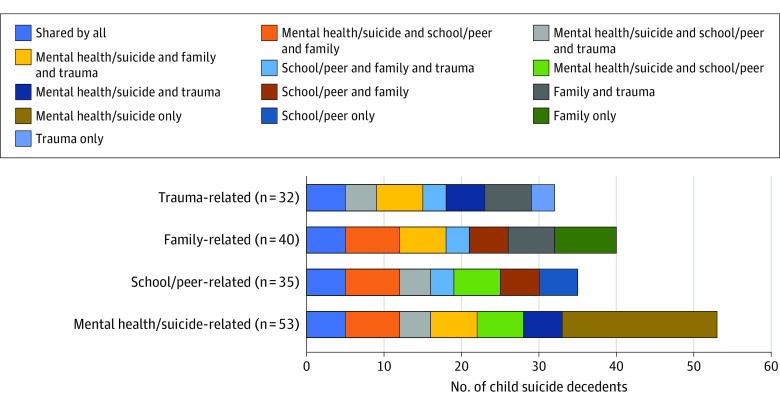
Analyses included 134 child decedents (101 [75.4%] males; 79 [59.0%] White individuals; 109 [81.3%] non-Hispanic individuals; mean [SD] age, 10.6 [0.8] years). Most suicides occurred in the child's home (95.5% [n = 128]), and more specifically in the child's bedroom. Suicide by hanging or suffocation (78.4% [n = 105]) was the most frequent method, followed by firearms (18.7% [n = 25]). Details on gun access were noted in 88.0% (n = 22) of suicides by firearm, and in every case, the child obtained a firearm stored unsafely in the home. Findings revealed childhood suicide was associated with numerous risk factors accumulated over time, and suggest a progression toward suicidal behavior, especially for youth with a history of psychopathology and suicidal behavior. An argument between the child and a family member and/or disciplinary action was often a precipitating circumstance of the suicide.
This qualitative study found that childhood suicide was associated with multiple risk factors and commonly preceded by a negative precipitating event. Potential prevention strategies include improvements in suicide risk assessment, family relations, and lethal means restriction, particularly safe firearm storage. Future research examining the myriad aspects of childhood suicide, including racial/ethnic and sex differences, is needed.
自杀是导致 5 至 11 岁儿童死亡的第八大原因,在过去十年中,这一比率一直在上升。更好地了解与儿童自杀相关的因素,可以为制定适合发展阶段的预防策略提供信息。
研究儿童自杀的特征和诱发情况。
设计、地点和参与者:本定性研究分析了美国国家暴力死亡报告系统(NVDRS)的受限使用数据,该系统记录了 2013 年至 2017 年期间年龄在 5 至 11 岁的儿童自杀死亡案例。NVDRS 是一个基于州的监测系统,收集全美 50 个州的自杀和暴力死亡数据,其中 37 个州提供受限使用数据。通过对每个事件的验尸官或法医以及执法报告中的案例叙述进行内容分析,确定了与自杀死亡相关的细节和背景。
验尸官、法医和执法案例叙述中提到的与自杀相关的特征和诱发因素。
自杀发生率和自杀风险因素,包括心理健康、先前的自杀行为、创伤以及同伴、学校或家庭相关问题。
分析纳入了 134 名儿童死者(101 名[75.4%]男性;79 名[59.0%]白人;109 名[81.3%]非西班牙裔个体);平均(标准差)年龄为 10.6(0.8)岁。大多数自杀发生在儿童自己的家中(95.5%[n=128]),更具体地说,是在儿童的卧室。通过上吊或窒息(78.4%[n=105])的自杀方式最为常见,其次是枪支(18.7%[n=25])。在 88.0%(n=22)的自杀案例中都提到了枪支获取途径,在每一个案例中,孩子都是从家中不安全存放的枪支中获得的。研究结果表明,儿童自杀与随着时间的推移积累的众多风险因素有关,并表明自杀行为的发生具有一定的渐进性,尤其是对于有精神病史和自杀行为的青少年。孩子与家庭成员之间的争吵和/或纪律处分通常是自杀的诱发事件。
本定性研究发现,儿童自杀与多种风险因素有关,通常在自杀前发生负性诱发事件。潜在的预防策略包括改进自杀风险评估、家庭关系和限制致命手段,特别是安全储存枪支。需要进一步研究儿童自杀的多个方面,包括种族/民族和性别差异。