Department of Gastric Surgery, Fujian Medical University Union Hospital, Fuzhou, China.
Key Laboratory of Ministry of Education of Gastrointestinal Cancer, Fujian Medical University, Fuzhou, China.
JAMA Netw Open. 2021 Jul 1;4(7):e2114180. doi: 10.1001/jamanetworkopen.2021.14180.
Gastric neuroendocrine carcinoma and mixed adenoneuroendocrine carcinoma are rare pathological types of gastric cancer, and there is a lack of multicenter studies comparing the prognosis and recurrence patterns of gastric neuroendocrine carcinoma, gastric mixed adenoneuroendocrine carcinoma, and gastric adenocarcinoma.
To compare the differences in long-term survival and patterns of recurrence among gastric neuroendocrine carcinoma, gastric mixed adenoneuroendocrine carcinoma, and gastric adenocarcinoma.
DESIGN, SETTING, AND PARTICIPANTS: This cohort study included patients with resectable gastric neuroendocrine carcinoma and gastric mixed adenoneuroendocrine carcinoma at 23 hospitals in China from January 2006 to December 2016. In addition, patients with gastric adenocarcinoma were selected as controls. Propensity score-matched analysis was used to match pathological stage among the different pathological types, and disease-free survival (DFS), postrecurrence survival (PRS), and patterns of recurrence were examined. Data analysis was conducted from July 15, 2020, to October 21, 2020.
Curative resection for gastric neuroendocrine carcinoma, gastric mixed adenoneuroendocrine carcinoma, and gastric adenocarcinoma.
The main outcomes were DFS and patterns of recurrence.
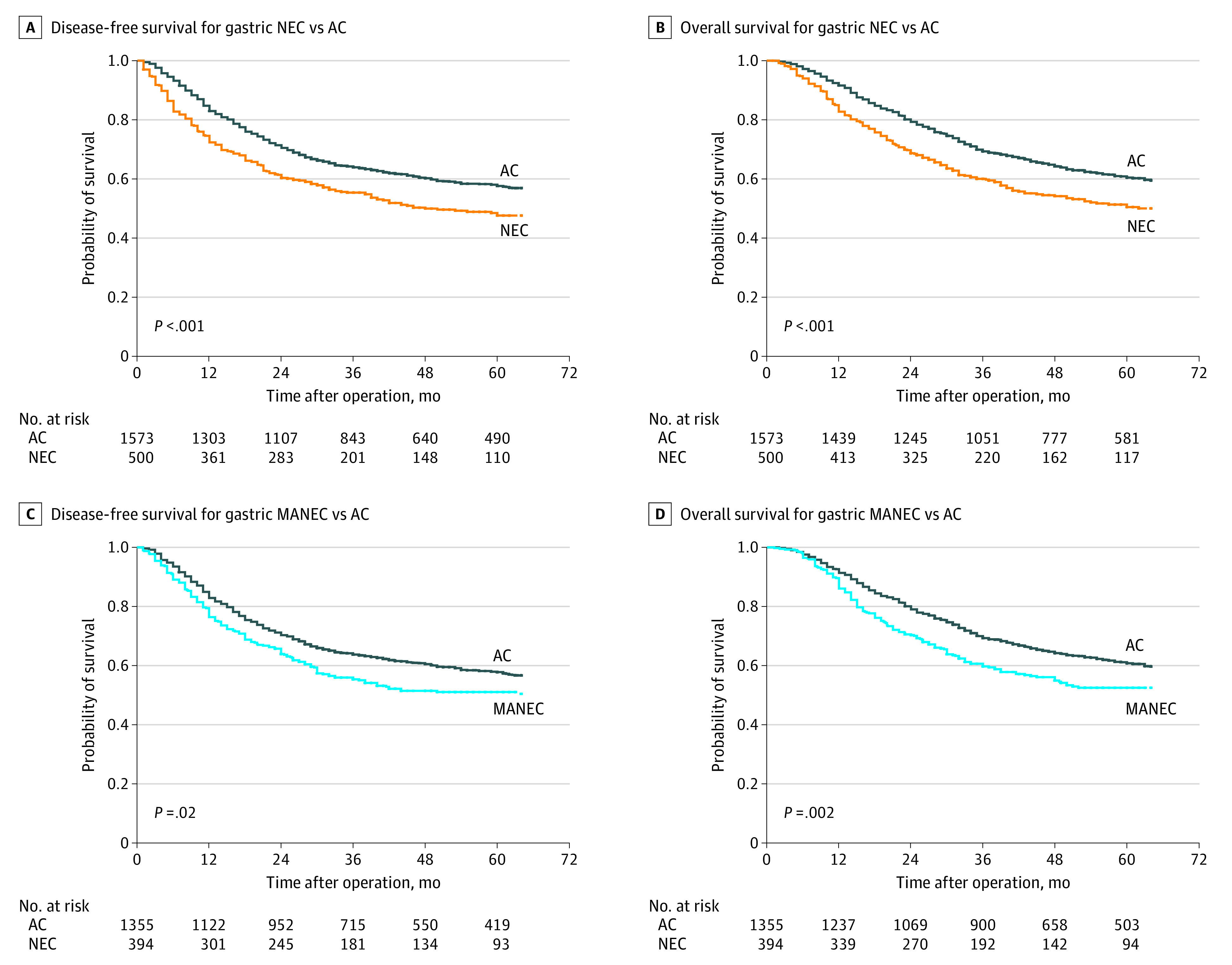
A total of 3689 patients were analyzed (median [interquartile range] age, 62 [55-69] years; 2748 [74.5%] men), including 503 patients (13.6%) with gastric neuroendocrine carcinoma, 401 patients (10.9%) with gastric mixed adenoneuroendocrine carcinoma, and 2785 patients (75.5%) with gastric adenocarcinoma. After propensity score matching, 5-year DFS was 47.6% (95% CI, 42.7%-52.5%) for patients with gastric neuroendocrine carcinoma, compared with 57.6% (95% CI, 55.1%-60.1%) with gastric adenocarcinoma (P < .001) and 51.1% (95% CI, 46.0%-56.2%) for patients with gastric mixed adenoneuroendocrine carcinoma, compared with 57.8% (95% CI, 55.1%-60.5%) patients with gastric adenocarcinoma (P = .02). Multivariable analyses found that, compared with gastric adenocarcinoma, gastric neuroendocrine carcinoma (hazard ratio [HR], 1.64; 95% CI, 1.40-1.93) and gastric mixed adenoneuroendocrine carcinoma (HR, 1.25; 95% CI, 1.05-1.49) were independent risk factors associated with worse DFS. Compared with matched patients with gastric adenocarcinoma, patients with gastric neuroendocrine carcinoma were more likely to have distant recurrence (268 patients [17.2%] vs 101 patients [23.7%]; P = .002), as were patients with gastric mixed adenoneuroendocrine carcinoma (232 patients [17.3%] vs 76 patients [22.8%]; P = .02). In multivariate analysis, gastric neuroendocrine carcinoma (HR, 2.22; 95% CI, 1.66-2.98) and gastric mixed adenoneuroendocrine carcinoma (HR, 1.70; 95% CI, 1.24-2.34) were independent risk factors associated with distant recurrence. Additionally, T3 to T4 stage (odds ratio, 2.84; 95% CI, 1.57-5.14; P = .001) and lymph node metastasis (odds ratio, 2.01; 95% CI, 1.31-3.10; P = .002) were independent risk factors associated with distant recurrence of gastric neuroendocrine carcinoma and gastric mixed adenoneuroendocrine carcinoma.
This cohort study found that patients with gastric neuroendocrine carcinoma or gastric mixed adenoneuroendocrine carcinoma had worse prognoses and were more prone to distant recurrence than those with gastric adenocarcinoma. Thus, different follow-up and treatment strategies should be developed to improve the long-term survival of patients with gastric neuroendocrine carcinoma or gastric mixed adenoneuroendocrine carcinoma, especially patients with tumors penetrating into the subserosa or deeper layers or with lymph node metastasis.
胃神经内分泌癌和混合性腺神经内分泌癌是罕见的胃癌病理类型,缺乏多中心研究比较胃神经内分泌癌、胃混合性腺神经内分泌癌和胃腺癌的预后和复发模式。
比较胃神经内分泌癌、胃混合性腺神经内分泌癌和胃腺癌的长期生存和复发模式差异。
设计、地点和参与者:本队列研究纳入了中国 23 家医院 2006 年 1 月至 2016 年 12 月期间可切除的胃神经内分泌癌和胃混合性腺神经内分泌癌患者。此外,还选择了胃腺癌患者作为对照组。采用倾向评分匹配分析对不同病理类型的病理分期进行匹配,并检查无病生存(DFS)、复发后生存(PRS)和复发模式。数据分析于 2020 年 7 月 15 日至 2020 年 10 月 21 日进行。
胃神经内分泌癌、胃混合性腺神经内分泌癌和胃腺癌的根治性切除术。
主要结局是 DFS 和复发模式。
共分析了 3689 例患者(中位[四分位距]年龄,62[55-69]岁;男性 2748 例[74.5%]),其中 503 例(13.6%)为胃神经内分泌癌患者,401 例(10.9%)为胃混合性腺神经内分泌癌患者,2785 例(75.5%)为胃腺癌患者。在倾向评分匹配后,胃神经内分泌癌患者的 5 年 DFS 为 47.6%(95%CI,42.7%-52.5%),而胃腺癌患者为 57.6%(95%CI,55.1%-60.1%)(P<.001),胃混合性腺神经内分泌癌患者为 51.1%(95%CI,46.0%-56.2%),而胃腺癌患者为 57.8%(95%CI,55.1%-60.5%)(P=.02)。多变量分析发现,与胃腺癌相比,胃神经内分泌癌(HR,1.64;95%CI,1.40-1.93)和胃混合性腺神经内分泌癌(HR,1.25;95%CI,1.05-1.49)是与 DFS 较差相关的独立危险因素。与匹配的胃腺癌患者相比,胃神经内分泌癌患者更易发生远处复发(268 例[17.2%] vs 101 例[23.7%];P=.002),胃混合性腺神经内分泌癌患者也更易发生远处复发(232 例[17.3%] vs 76 例[22.8%];P=.02)。多变量分析显示,胃神经内分泌癌(HR,2.22;95%CI,1.66-2.98)和胃混合性腺神经内分泌癌(HR,1.70;95%CI,1.24-2.34)是远处复发的独立危险因素。此外,T3 至 T4 期(比值比,2.84;95%CI,1.57-5.14;P=.001)和淋巴结转移(比值比,2.01;95%CI,1.31-3.10;P=.002)是胃神经内分泌癌和胃混合性腺神经内分泌癌远处复发的独立危险因素。
本队列研究发现,胃神经内分泌癌或胃混合性腺神经内分泌癌患者的预后较差,且较胃腺癌患者更易发生远处复发。因此,应制定不同的随访和治疗策略,以改善胃神经内分泌癌或胃混合性腺神经内分泌癌患者的长期生存,尤其是肿瘤穿透浆膜或更深层或有淋巴结转移的患者。