Cruz Aristides I, Beck Jennifer J, Ellington Matthew D, Mayer Stephanie W, Pennock Andrew T, Stinson Zachary S, VandenBerg Curtis D, Barrow Brooke, Gao Burke, Ellis Henry B
Department of Orthopaedic Surgery, Warren Alpert Medical School of Brown University, Providence, Rhode Island.
Hasbro Children's Hospital, Providence, Rhode Island.
JB JS Open Access. 2020 Dec 30;5(4). doi: 10.2106/JBJS.OA.20.00106. eCollection 2020 Oct-Dec.
Graft choice for pediatric anterior cruciate ligament reconstruction (ACLR) is determined by several factors. There is limited information on the use and outcomes of allograft ACLR in pediatric patients. The purpose of this systematic review and meta-analysis was to quantify reported failure rates of allograft versus autograft ACLR in patients ≤19 years of age with ≥2 years of follow-up. We hypothesized that there would be higher rates of failure for allograft compared with autograft ACLR in this population.
PubMed/MEDLINE and Embase databases were systematically searched for literature regarding allograft and autograft ACLR in pediatric/adolescent patients. Articles were included if they described a cohort of patients with average age of ≤19 years, had a minimum of 2 years of follow-up, described graft failure as an outcome, and had a Level of Evidence grade of I to III. Qualitative review and quantitative meta-analysis were performed to compare graft failure rates. A random-effects model was created to compare failure events in patients receiving allograft versus autograft in a pairwise fashion. Data analysis was completed using RevMan 5.3 software (The Cochrane Collaboration).
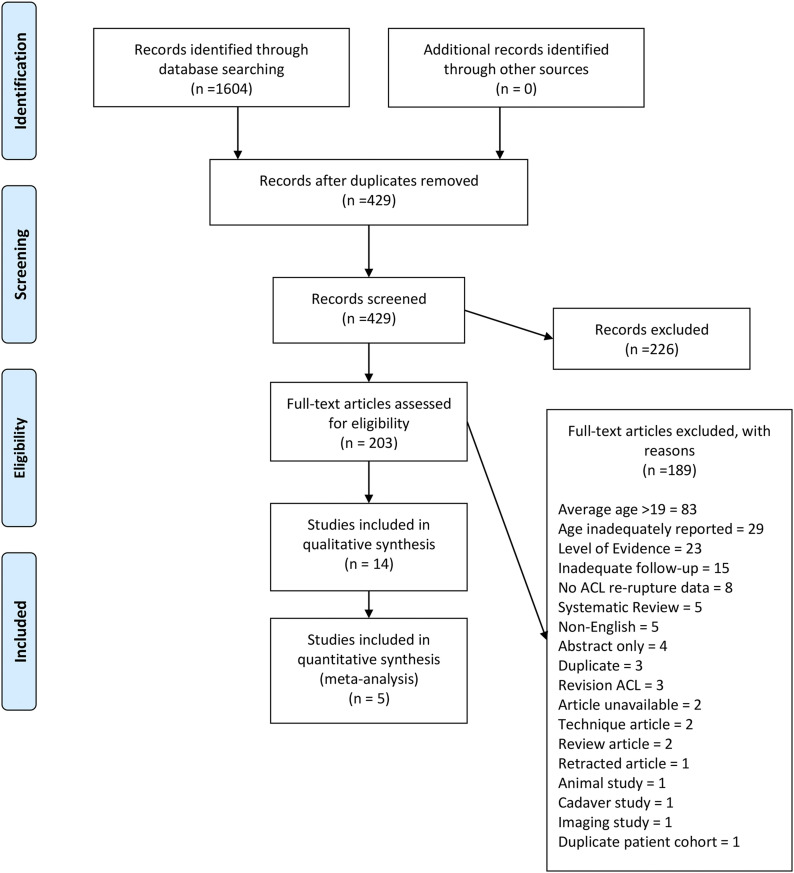
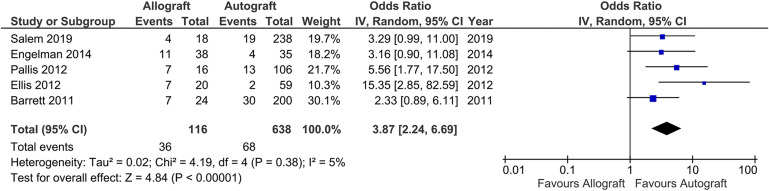
The database search identified 1,604 studies; 203 full-text articles were assessed for eligibility. Fourteen studies met the inclusion criteria for qualitative review; 5 studies were included for quantitative meta-analysis. Bone-patellar tendon-bone (BTB) represented 58.2% (n = 1,012) of the autografts, and hamstring grafts represented 41.8% (n = 727). Hybrid allografts (autograft + supplemental allograft) represented 12.8% (n = 18) of all allograft ACLRs (n = 141). The unweighted, pooled failure rate for each graft type was 8.5% for BTB, 16.6% for hamstring, and 25.5% for allograft. Allografts were significantly more likely than autografts to result in graft failure (odds ratio, 3.87; 95% confidence interval, 2.24 to 6.69).
Allograft ACLR in pediatric and adolescent patients should be used judiciously, as existing studies revealed a significantly higher failure rate for allograft compared with autograft ACLR in this patient population. Additional studies are needed to improve the understanding of variables associated with the high ACLR failure rate among pediatric and adolescent patients.
Therapeutic Level III. See Instructions for Authors for a complete description of levels of evidence.
小儿前交叉韧带重建术(ACLR)的移植物选择由多种因素决定。关于同种异体移植物ACLR在小儿患者中的应用及结果的信息有限。本系统评价和荟萃分析的目的是量化报告的年龄≤19岁且随访≥2年的患者中同种异体移植物与自体移植物ACLR的失败率。我们假设在该人群中,同种异体移植物ACLR的失败率高于自体移植物ACLR。
系统检索PubMed/MEDLINE和Embase数据库,查找有关小儿/青少年患者同种异体移植物和自体移植物ACLR的文献。如果文章描述了平均年龄≤19岁的患者队列,至少有2年的随访,将移植物失败作为一项结果进行描述,且证据等级为I至III级,则纳入该文章。进行定性综述和定量荟萃分析以比较移植物失败率。创建随机效应模型以成对比较接受同种异体移植物与自体移植物的患者的失败事件。使用RevMan 5.3软件(Cochrane协作网)完成数据分析。
数据库检索确定了1604项研究;评估了203篇全文文章的合格性。14项研究符合定性综述的纳入标准;5项研究纳入定量荟萃分析。骨-髌腱-骨(BTB)占自体移植物的58.2%(n = 1012),腘绳肌移植物占41.8%(n = 727)。混合同种异体移植物(自体移植物+补充同种异体移植物)占所有同种异体移植物ACLR(n = 141)的12.8%(n = 18)。每种移植物类型的未加权合并失败率为:BTB为8.5%,腘绳肌为16.6%,同种异体移植物为25.5%。同种异体移植物导致移植物失败的可能性显著高于自体移植物(优势比,3.87;95%置信区间,2.24至6.69)。
小儿和青少年患者的同种异体移植物ACLR应谨慎使用,因为现有研究表明,在该患者群体中,同种异体移植物ACLR的失败率显著高于自体移植物ACLR。需要更多研究来提高对小儿和青少年患者ACLR高失败率相关变量的认识。
治疗性III级。有关证据水平的完整描述,请参阅作者须知。