Rousseau Anne-Françoise, Minguet Pauline, Colson Camille, Kellens Isabelle, Chaabane Sourour, Delanaye Pierre, Cavalier Etienne, Chase J Geoffrey, Lambermont Bernard, Misset Benoit
Department of Intensive Care and Burn Center, University Hospital of Liège, Sart-Tilman B35, 4000, Liège, Belgium.
Department of Nephrology, University Hospital of Liège, Liège, Belgium.
Ann Intensive Care. 2021 Jul 29;11(1):118. doi: 10.1186/s13613-021-00910-9.
Many patients with coronavirus disease 2019 (COVID-19) required critical care. Mid-term outcomes of the survivors need to be assessed. The objective of this single-center cohort study was to describe their physical, cognitive, psychological, and biological outcomes at 3 months following intensive care unit (ICU)-discharge (M3).
All COVID-19 adults who survived an ICU stay ≥ 7 days and attended the M3 consultation at our multidisciplinary follow-up clinic were involved. They benefited from a standardized assessment, addressing health-related quality of life (EQ-5D-3L), sleep disorders (PSQI), and the three principal components of post-intensive care syndrome (PICS): physical status (Barthel index, handgrip and quadriceps strength), mental health disorders (HADS and IES-R), and cognitive impairment (MoCA). Biological parameters referred to C-reactive protein and creatinine.
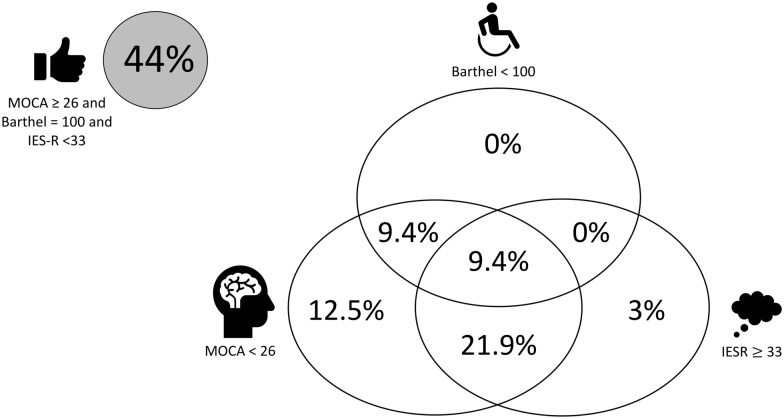
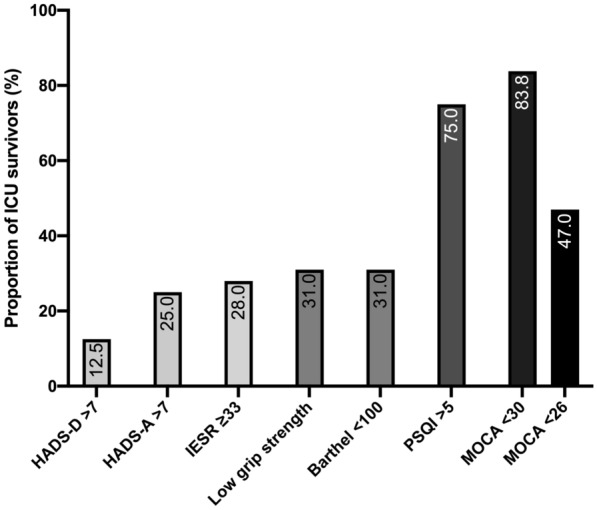
Among the 92 patients admitted to our ICU for COVID-19, 42 survived a prolonged ICU stay and 32 (80%) attended the M3 follow-up visit. Their median age was 62 [49-68] years, 72% were male, and nearly half received inpatient rehabilitation following ICU discharge. At M3, 87.5% (28/32) had not regained their baseline level of daily activities. Only 6.2% (2/32) fully recovered, and had normal scores for the three MoCA, IES-R and Barthel scores. The main observed disorders were PSQI > 5 (75%, 24/32), MoCA < 26 (44%, 14/32), Barthel < 100 (31%, 10/32) and IES-R ≥ 33 (28%, 9/32). Combined disorders were observed in 13/32 (40.6%) of the patients. The EQ-5D-3L visual scale was rated at 71 [61-80]. A quarter of patients (8/32) demonstrated a persistent inflammation based on CRP blood level (9.3 [6.8-17.7] mg/L).
The burden of severe COVID-19 and prolonged ICU stay was considerable in the present cohort after 3 months, affecting both functional status and biological parameters. These data are an argument on the need for closed follow-up for critically ill COVID-19 survivors.
许多2019冠状病毒病(COVID-19)患者需要重症监护。需要评估幸存者的中期结局。这项单中心队列研究的目的是描述他们在重症监护病房(ICU)出院后3个月(M3)时的身体、认知、心理和生物学结局。
纳入所有在ICU住院≥7天且在我们多学科随访门诊参加M3会诊的成年COVID-19幸存者。他们接受了标准化评估,包括健康相关生活质量(EQ-5D-3L)、睡眠障碍(PSQI)以及重症监护后综合征(PICS)的三个主要组成部分:身体状况(Barthel指数、握力和股四头肌力量)、心理健康障碍(HADS和IES-R)以及认知障碍(MoCA)。生物学参数涉及C反应蛋白和肌酐。
在我们ICU收治的92例COVID-19患者中,42例在ICU长期住院后存活,32例(80%)参加了M3随访。他们的中位年龄为62[49-68]岁,72%为男性,近一半患者在ICU出院后接受了住院康复治疗。在M3时,87.5%(28/32)的患者尚未恢复到基线日常活动水平。只有6.2%(2/32)的患者完全康复,且MoCA、IES-R和Barthel评分均正常。观察到的主要障碍为PSQI>5(75%,24/32)、MoCA<26(44%,14/32)、Barthel<100(31%,10/32)和IES-R≥33(28%,9/32)。13/32(40.6%)的患者存在合并障碍。EQ-5D-3L视觉模拟量表评分为71[61-80]。四分之一的患者(8/32)基于CRP血水平显示存在持续性炎症(9.3[6.8-17.7]mg/L)。
在本队列中,3个月后严重COVID-19和ICU长期住院的负担相当大,影响了功能状态和生物学参数。这些数据支持对重症COVID-19幸存者进行密切随访的必要性。