Division of Laboratory Medicine, Department of Diagnostics and of Medical Specialties, Geneva University Hospitals and Geneva University, Geneva, Switzerland.
Centre for Vaccinology, Department of Pathology and Immunology, University of Geneva, Geneva, Switzerland.
Eur J Clin Invest. 2021 Nov;51(11):e13661. doi: 10.1111/eci.13661. Epub 2021 Aug 4.
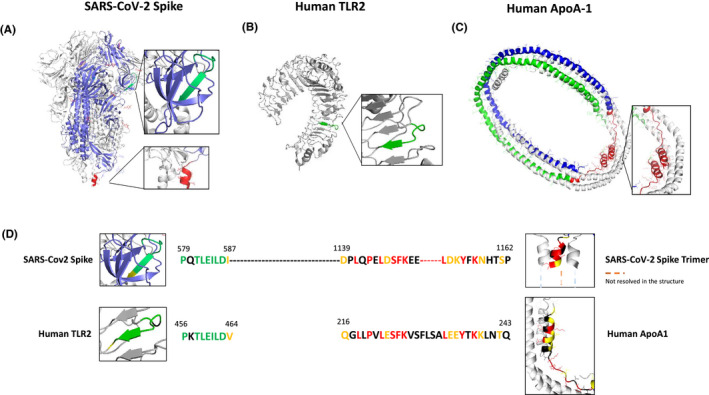
Unravelling autoimmune targets triggered by SARS-CoV-2 infection may provide crucial insights into the physiopathology of the disease and foster the development of potential therapeutic candidate targets and prognostic tools. We aimed at determining (a) the association between anti-SARS-CoV-2 and anti-apoA-1 humoral response and (b) the degree of linear homology between SARS-CoV-2, apoA-1 and Toll-like receptor 2 (TLR2) epitopes.
Bioinformatics modelling coupled with mimic peptides engineering and competition experiments were used to assess epitopes sequence homologies. Anti-SARS-CoV-2 and anti-apoA-1 IgG as well as cytokines were assessed by immunoassays on a case-control (n = 101), an intensive care unit (ICU; n = 126) and a general population cohort (n = 663) with available samples in the pre and post-pandemic period.
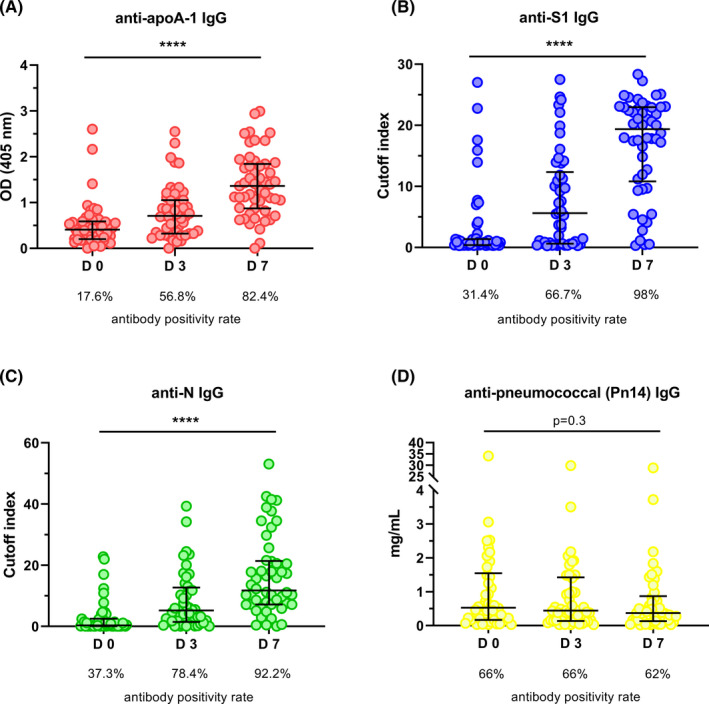
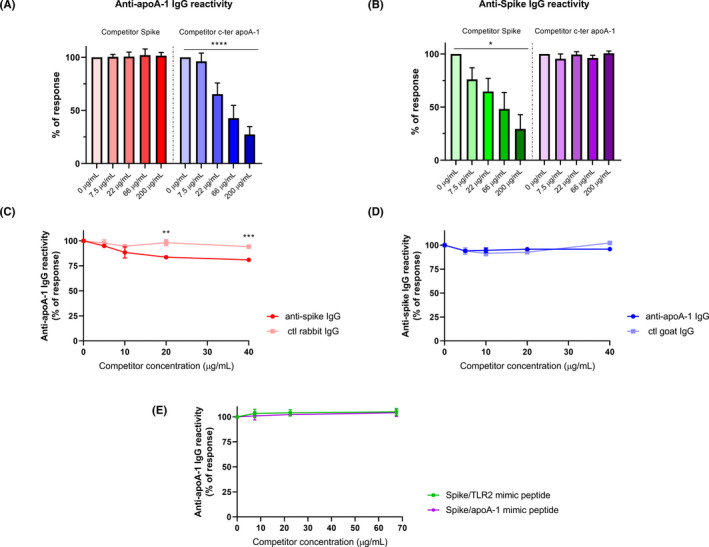
Using bioinformatics modelling, linear sequence homologies between apoA-1, TLR2 and Spike epitopes were identified but without experimental evidence of cross-reactivity. Overall, anti-apoA-1 IgG levels were higher in COVID-19 patients or anti-SARS-CoV-2 seropositive individuals than in healthy donors or anti-SARS-CoV-2 seronegative individuals (P < .0001). Significant and similar associations were noted between anti-apoA-1, anti-SARS-CoV-2 IgG, cytokines and lipid profile. In ICU patients, anti-SARS-CoV-2 and anti-apoA-1 seroconversion rates displayed similar 7-day kinetics, reaching 82% for anti-apoA-1 seropositivity. In the general population, SARS-CoV-2-exposed individuals displayed higher anti-apoA-1 IgG seropositivity rates than nonexposed ones (34% vs 16.8%; P = .004).
COVID-19 induces a marked humoral response against the major protein of high-density lipoproteins. As a correlate of poorer prognosis in other clinical settings, such autoimmunity signatures may relate to long-term COVID-19 prognosis assessment and warrant further scrutiny in the current COVID-19 pandemic.
解析由 SARS-CoV-2 感染引发的自身免疫靶标,可能为该疾病的病理生理学提供重要见解,并促进潜在治疗候选靶标的开发和预后工具的发展。我们旨在确定:(a)抗 SARS-CoV-2 和抗载脂蛋白 A-1 体液反应之间的关联;(b)SARS-CoV-2、载脂蛋白 A-1 和 Toll 样受体 2(TLR2)表位之间的线性同源程度。
生物信息学建模结合模拟肽工程和竞争实验,用于评估表位序列同源性。通过免疫测定法在病例对照(n=101)、重症监护病房(n=126)和一般人群队列(n=663)中评估了抗 SARS-CoV-2 和抗载脂蛋白 A-1 IgG 以及细胞因子,这些样本在大流行前后均有可用。
通过生物信息学建模,确定了载脂蛋白 A-1、TLR2 和 Spike 表位之间的线性序列同源性,但没有交叉反应的实验证据。总体而言,COVID-19 患者或抗 SARS-CoV-2 血清阳性个体的载脂蛋白 A-1 IgG 水平高于健康供体或抗 SARS-CoV-2 血清阴性个体(P<0.0001)。抗载脂蛋白 A-1、抗 SARS-CoV-2 IgG、细胞因子和脂质谱之间存在显著且相似的关联。在 ICU 患者中,抗 SARS-CoV-2 和抗载脂蛋白 A-1 的血清转化率显示出相似的 7 天动力学,抗载脂蛋白 A-1 血清阳性率达到 82%。在一般人群中,暴露于 SARS-CoV-2 的个体的抗载脂蛋白 A-1 IgG 血清阳性率高于未暴露于 SARS-CoV-2 的个体(34%对 16.8%;P=0.004)。
COVID-19 诱导针对高密度脂蛋白主要蛋白的强烈体液反应。由于在其他临床环境中是预后不良的指标,因此这种自身免疫特征可能与 COVID-19 的长期预后评估有关,并且在当前的 COVID-19 大流行中需要进一步研究。