Science & Technology Branch, Environment and Climate Change Canada, 7th Floor, St. Lawrence Centre, 105 McGill Street, Montreal, QC, H2Y 2E7, Canada.
Environ Sci Pollut Res Int. 2021 Dec;28(46):65952-65959. doi: 10.1007/s11356-021-15486-x. Epub 2021 Jul 29.
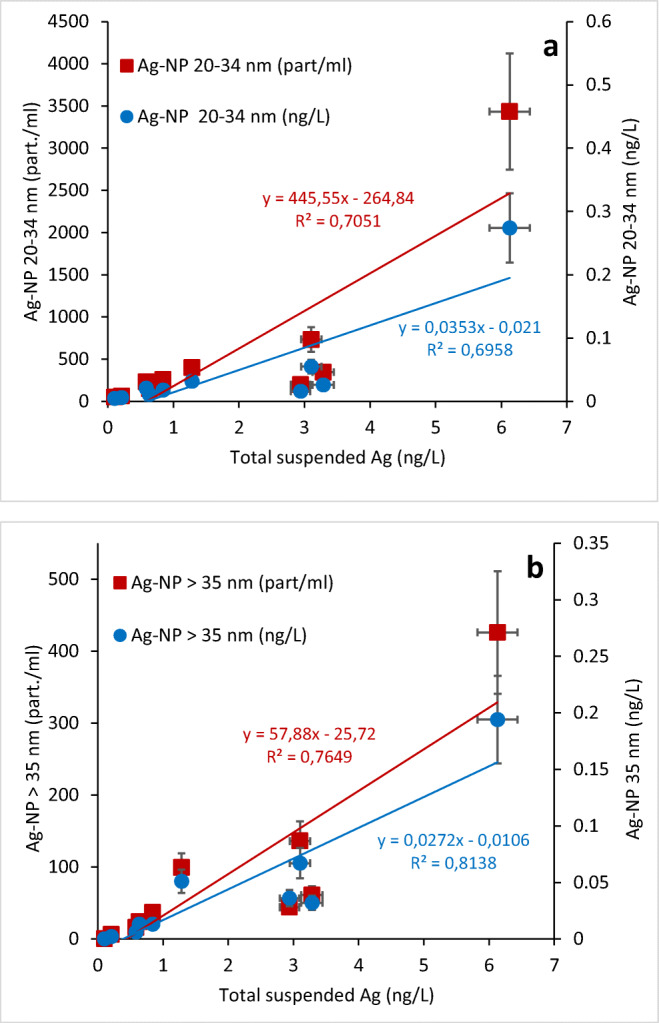
The occurrence of silver (Ag) in urban effluents is partly associated with the increasing use of silver nanoparticles (Ag NPs) as an antiseptic agent in various consumer products. Distinction among Ag forms must be taken into account in the assessment of exposure and toxicological effects to aquatic organisms. Wastewater treatment processes effectively remove Ag particles and colloids (mostly > 95%), but this still leaves notable concentrations (in order of ng/L) escaping to effluent-receiving waters. Total suspended Ag concentrations in various studied effluents ranged from 0.1 to 6 ng/L. The purpose of this study was then to measure and characterize Ag NPs in urban effluents for their concentrations and size distribution using the single particle ICP-MS technique (SP-ICP-MS). Wastewater influents and effluents from various treatment plants-from aerated lagoons to advanced treatment technology-were collected for three sampling days. Our results showed the presence of Ag NP in all samples with concentrations reaching 0.5 ng/L on a mass basis. However, on a particle number basis, Ag NP concentrations (expressed in particle/mL) in the 20-34-nm fraction (up to 3400 particles/mL) were much more abundant (> 700%) than in the > 35-nm larger fraction. The proportion of Ag at the nanoscale (1-100 nm) represents less than 8% of the total suspended Ag for all effluent samples, regardless of their origins. A significant correlation (linear regression: r > 0.7) was observed between Ag NP and total suspended Ag concentrations in investigated effluents. Because Ag nanotoxicity is size dependent, the determination of size distribution and exposure concentration on a particle number basis is urgently needed for risk assessment of this class of nanoparticles.
城市废水中银(Ag)的出现部分与越来越多地将纳米银颗粒(Ag NPs)用作各种消费品中的防腐剂有关。在评估水生生物的暴露和毒理学效应时,必须考虑到 Ag 形态的区别。废水处理工艺可以有效地去除 Ag 颗粒和胶体(大部分 >95%),但仍有显著浓度(以 ng/L 计)逸出到废水接收水域。在各种研究废水中,总悬浮 Ag 浓度范围为 0.1 至 6 ng/L。本研究的目的是使用单颗粒 ICP-MS 技术(SP-ICP-MS)测量和表征城市废水中的 Ag NPs 浓度和粒径分布。从曝气塘到先进处理技术的各种处理厂的废水进水和出水在三个采样日进行了收集。我们的结果表明,所有样品中均存在 Ag NP,其浓度在质量基础上达到 0.5 ng/L。然而,在粒子数基础上,20-34nm 粒径分数(高达 3400 粒子/mL)中的 Ag NP 浓度(以粒子/mL 表示)比>35nm 较大粒径分数中的浓度(高出 700%)更为丰富。在所有废水样品中,Ag 纳米颗粒(1-100nm)的比例均不到总悬浮 Ag 的 8%,而与它们的来源无关。在所研究的废水中,Ag NP 与总悬浮 Ag 浓度之间观察到显著的相关性(线性回归:r > 0.7)。由于 Ag 纳米毒性与尺寸有关,因此迫切需要根据粒子数确定粒径分布和暴露浓度,以评估此类纳米颗粒的风险。