Department of Internal Medicine III, Division of Cardiology, Pneumology, Angiology and Intensive Care, University of Cologne, 50937, Cologne, Germany.
Fire Department City of Cologne, Institute for Security Science and Rescue Technology, Cologne, Germany.
J Neurol. 2022 Mar;269(3):1530-1537. doi: 10.1007/s00415-021-10722-3. Epub 2021 Jul 30.
To test if the early kinetics of neurofilament light (NFL) in blood adds to the absolute values of NFL in the prediction of outcome, and to evaluate if NFL can discriminate individuals with severe hypoxic-ischemic brain injury (sHIBI) from those with other causes of poor outcome after out-of-hospital cardiac arrest (OHCA).
Monocentric retrospective study involving individuals following non-traumatic OHCA between April 2014 and April 2016. NFL concentrations were determined on a SiMoA HD-1 device using NF-Light Advantage Kits.
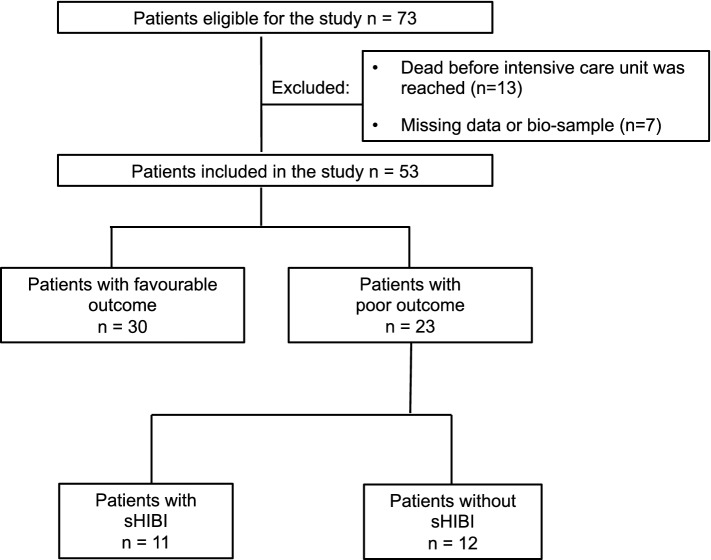
Of 73 patients screened, 53 had serum samples available for NFL measurement at three timepoints (after 3, 24, and 48 h of admission). Of these 53 individuals, 43.4% had poor neurologic outcome at discharge as assessed by Glasgow-Pittsburgh cerebral performance categories, and, according to a current prognostication algorithm, poor outcome due to sHIBI in 20.7%.
Blood NFL and its early kinetics for prognostication of outcome and prediction of sHIBI after OHCA.
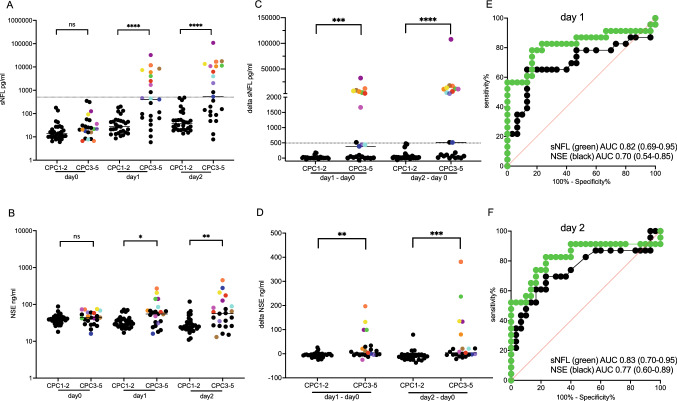
An absolute NFL > 508.6 pg/ml 48 h after admission, or a change in NFL > 494 pg/ml compared with an early baseline value predicted outcome, and discriminated severe sHIBI from other causes of unfavorable outcome after OHCA with high sensitivity (100%, 95%CI 70.0-100%) and specificity (91.7%, 95%CI 62.5-100%).
Not only absolute values of NFL, but also early changes in NFL predict the outcome following OHCA, and may differentiate sHIBI from other causes of poor outcome after OHCA with high sensitivity and specificity. Our study adds to published data, overall corroborating that NFL measured in blood should be implemented in prognostication algorithms used in clinical routine.
检测血液中神经丝轻链(NFL)的早期动力学是否能增加其绝对值在预后预测中的作用,并评估 NFL 是否可鉴别院外心脏骤停(OHCA)后发生严重缺氧缺血性脑损伤(sHIBI)与其他不良预后的患者。
本研究为单中心回顾性研究,纳入了 2014 年 4 月至 2016 年 4 月间发生非创伤性 OHCA 的患者。使用 SiMoA HD-1 设备和 NF-Light Advantage 试剂盒测定 NFL 浓度。
在筛选的 73 例患者中,有 53 例在入院后 3、24 和 48 小时三个时间点获得了可用于 NFL 测量的血清样本。这 53 例患者中,43.4%在出院时格拉斯哥-匹兹堡脑功能预后评分较差,根据目前的预后算法,20.7%的患者预后不良是由于 sHIBI。
血液 NFL 及其早期动力学对 OHCA 后预后的预测和 sHIBI 的预测。
入院后 48 小时 NFL 绝对值>508.6pg/ml,或与早期基线值相比 NFL 变化>494pg/ml,可预测结局,并能以 100%(95%CI 70.0-100%)的高敏感性和 91.7%(95%CI 62.5-100%)的特异性鉴别 sHIBI 与 OHCA 后其他不良预后的原因。
不仅是 NFL 的绝对值,而且其早期变化也可以预测 OHCA 后的结局,并具有高敏感性和特异性,可以区分 sHIBI 与 OHCA 后其他不良预后的原因。我们的研究增加了已发表的数据,总体上证实了血液中 NFL 的测量应该被纳入临床常规使用的预后算法中。