A. I. Virtanen Institute for Molecular Sciences, University of Eastern Finland, Neulaniementie 2, 70211, Kuopio, Finland.
Institute of Biomedicine, University of Eastern Finland, Yliopistonranta 1E, 70211, Kuopio, Finland.
Mol Neurobiol. 2021 Nov;58(11):5438-5458. doi: 10.1007/s12035-021-02475-x. Epub 2021 Jul 30.
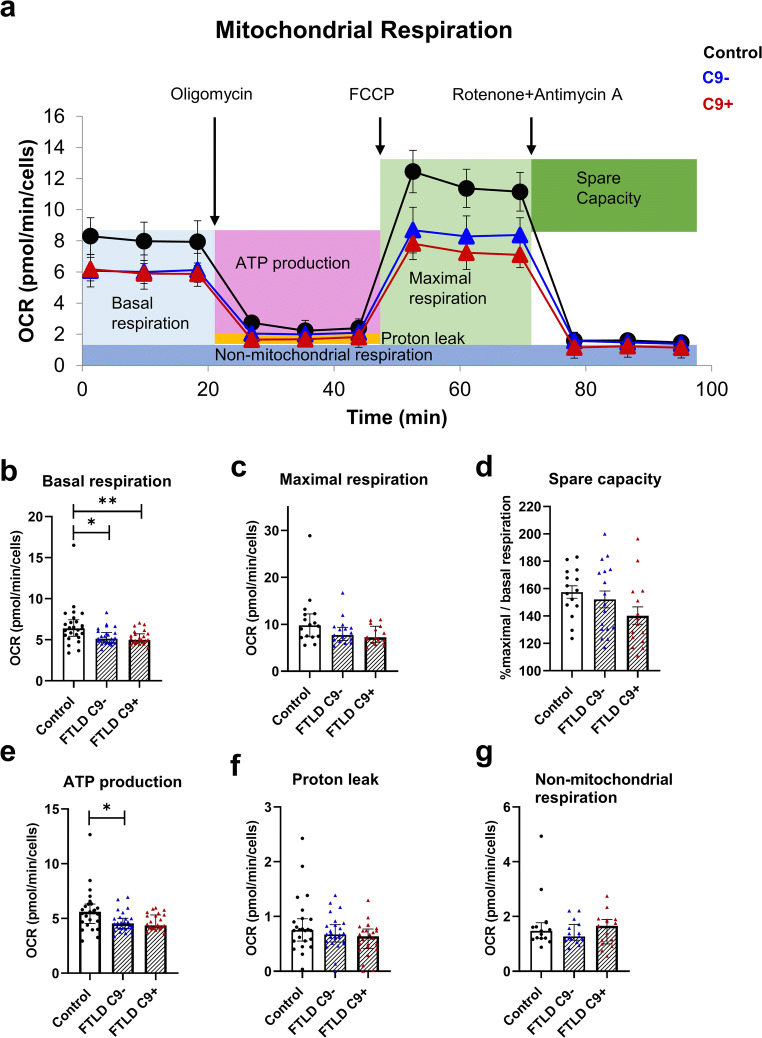
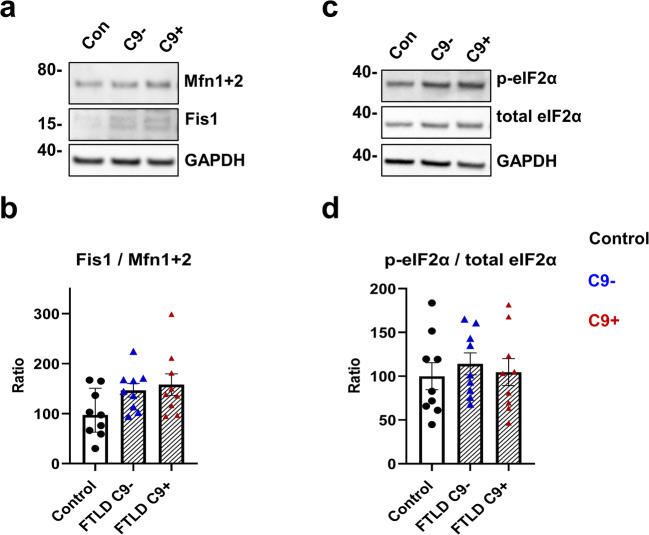
Frontotemporal lobar degeneration (FTLD) is a clinically, genetically, and neuropathologically heterogeneous group of neurodegenerative syndromes, leading to progressive cognitive dysfunction and frontal and temporal atrophy. C9orf72 hexanucleotide repeat expansion (C9-HRE) is the most common genetic cause of FTLD, but pathogenic mechanisms underlying FTLD are not fully understood. Here, we compared cellular features and functional properties, especially related to protein degradation pathways and mitochondrial function, of FTLD patient-derived skin fibroblasts from C9-HRE carriers and non-carriers and healthy donors. Fibroblasts from C9-HRE carriers were found to produce RNA foci, but no dipeptide repeat proteins, and they showed unchanged levels of C9orf72 mRNA transcripts. The main protein degradation pathways, the ubiquitin-proteasome system and autophagy, did not show alterations between the fibroblasts from C9-HRE-carrying and non-carrying FTLD patients and compared to healthy controls. An increase in the number and size of p62-positive puncta was evident in fibroblasts from both C9-HRE carriers and non-carriers. In addition, several parameters of mitochondrial function, namely, basal and maximal respiration and respiration linked to ATP production, were significantly reduced in the FTLD patient-derived fibroblasts from both C9-HRE carriers and non-carriers. Our findings suggest that FTLD patient-derived fibroblasts, regardless of whether they carry the C9-HRE expansion, show unchanged proteasomal and autophagic function, but significantly impaired mitochondrial function and increased accumulation of p62 when compared to control fibroblasts. These findings suggest the possibility of utilizing FTLD patient-derived fibroblasts as a platform for biomarker discovery and testing of drugs targeted to specific cellular functions, such as mitochondrial respiration.
额颞叶变性(FTLD)是一组临床上、遗传上和神经病理学上具有异质性的神经退行性综合征,导致进行性认知功能障碍和额颞叶萎缩。C9orf72 六核苷酸重复扩增(C9-HRE)是 FTLD 最常见的遗传原因,但 FTLD 的发病机制尚未完全了解。在这里,我们比较了 C9-HRE 携带者和非携带者以及健康供体的 FTLD 患者来源的皮肤成纤维细胞的细胞特征和功能特性,特别是与蛋白质降解途径和线粒体功能相关的特征。发现 C9-HRE 携带者的成纤维细胞产生 RNA 焦点,但没有二肽重复蛋白,并且它们的 C9orf72 mRNA 转录本水平没有变化。主要的蛋白质降解途径,即泛素-蛋白酶体系统和自噬,在 C9-HRE 携带和非携带 FTLD 患者的成纤维细胞之间以及与健康对照相比没有改变。在 C9-HRE 携带者和非携带者的成纤维细胞中,p62 阳性斑点的数量和大小明显增加。此外,C9-HRE 携带和非携带 FTLD 患者来源的成纤维细胞的几项线粒体功能参数,即基础和最大呼吸以及与 ATP 产生相关的呼吸,均显著降低。我们的研究结果表明,FTLD 患者来源的成纤维细胞,无论是否携带 C9-HRE 扩增,与对照成纤维细胞相比,蛋白酶体和自噬功能没有改变,但线粒体功能显著受损,p62 积累增加。这些发现表明,FTLD 患者来源的成纤维细胞可能成为发现生物标志物和测试针对特定细胞功能(如线粒体呼吸)的药物的平台。