Department of Physiology, Faculty of Medicine, University of Debrecen, Debrecen, Hungary.
Department of Ophthalmology, University of Szeged, Szeged, Hungary.
J Biol Chem. 2021 Sep;297(3):101015. doi: 10.1016/j.jbc.2021.101015. Epub 2021 Jul 27.
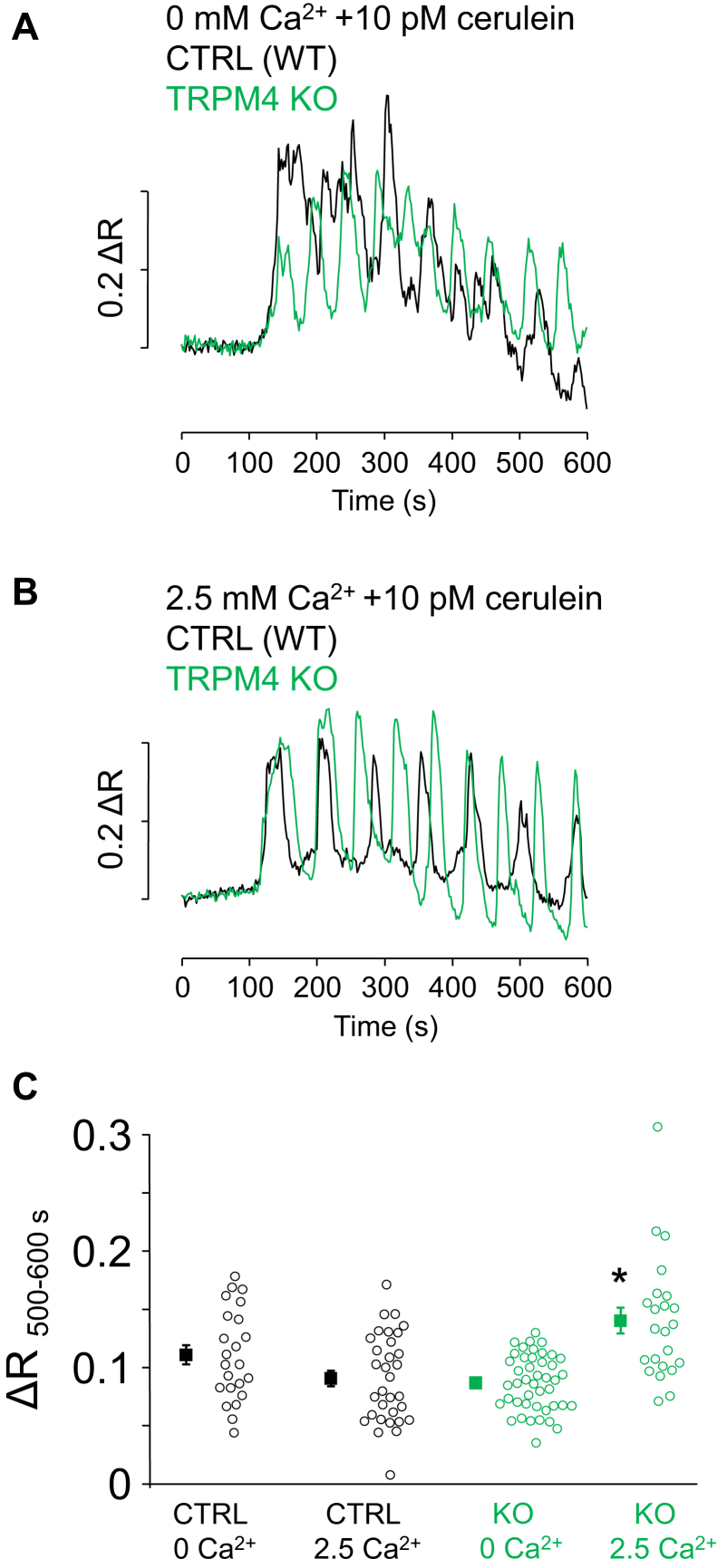
Transient receptor potential cation channel subfamily M member 4 (TRPM4) is a Ca-activated nonselective cation channel that mediates membrane depolarization. Although, a current with the hallmarks of a TRPM4-mediated current has been previously reported in pancreatic acinar cells (PACs), the role of TRPM4 in the regulation of acinar cell function has not yet been explored. In the present study, we identify this TRPM4 current and describe its role in context of Ca signaling of PACs using pharmacological tools and TRPM4-deficient mice. We found a significant Ca-activated cation current in PACs that was sensitive to the TRPM4 inhibitors 9-phenanthrol and 4-chloro-2-[[2-(2-chlorophenoxy)acetyl]amino]benzoic acid (CBA). We demonstrated that the CBA-sensitive current was responsible for a Ca-dependent depolarization of PACs from a resting membrane potential of -44.4 ± 2.9 to -27.7 ± 3 mV. Furthermore, we showed that Ca influx was higher in the TRPM4 KO- and CBA-treated PACs than in control cells. As hormone-induced repetitive Ca transients partially rely on Ca influx in PACs, the role of TRPM4 was also assessed on Ca oscillations elicited by physiologically relevant concentrations of the cholecystokinin analog cerulein. These data show that the amplitude of Ca signals was significantly higher in TRPM4 KO than in control PACs. Our results suggest that PACs are depolarized by TRPM4 currents to an extent that results in a significant reduction of the inward driving force for Ca. In conclusion, TRPM4 links intracellular Ca signaling to membrane potential as a negative feedback regulator of Ca entry in PACs.
瞬时受体电位阳离子通道亚家族 M 成员 4(TRPM4)是一种 Ca 激活的非选择性阳离子通道,介导膜去极化。虽然以前在胰腺腺泡细胞(PACs)中已经报道了具有 TRPM4 介导电流特征的电流,但 TRPM4 在调节腺泡细胞功能中的作用尚未得到探索。在本研究中,我们使用药理学工具和 TRPM4 缺陷小鼠鉴定了这种 TRPM4 电流,并描述了其在 PACs Ca 信号转导中的作用。我们发现 PACs 中有一个显著的 Ca 激活阳离子电流,该电流对 TRPM4 抑制剂 9-菲咯啉和 4-氯-2-[[2-(2-氯苯氧基)乙酰基]氨基]苯甲酸(CBA)敏感。我们证明,CBA 敏感电流负责 PACs 从静息膜电位-44.4±2.9 到-27.7±3 mV 的 Ca 依赖性去极化。此外,我们表明,TRPM4 KO 和 CBA 处理的 PACs 中的 Ca 内流高于对照细胞。由于激素诱导的重复 Ca 瞬变部分依赖于 PACs 中的 Ca 内流,因此还评估了 TRPM4 在生理相关浓度的胆囊收缩素类似物亮啡肽诱导的 Ca 振荡中的作用。这些数据表明,在 TRPM4 KO 中 Ca 信号的幅度明显高于对照 PACs。我们的结果表明,TRPM4 电流使 PACs 去极化,导致 Ca 内流的内向驱动力显著降低。总之,TRPM4 将细胞内 Ca 信号与膜电位联系起来,作为 PACs 中 Ca 内流的负反馈调节剂。