Panidi Ioli, Bogdanis Gregory C, Terzis Gerasimos, Donti Anastasia, Konrad Andreas, Gaspari Vasiliki, Donti Olyvia
Sports Performance Laboratory, School of Physical Education and Sport Science, National and Kapodistrian, University of Athens, Athens, Greece.
Institute of Human Movement Science, Sport and Health, University of Graz, Graz, Austria.
Front Physiol. 2021 Jul 16;12:701338. doi: 10.3389/fphys.2021.701338. eCollection 2021.
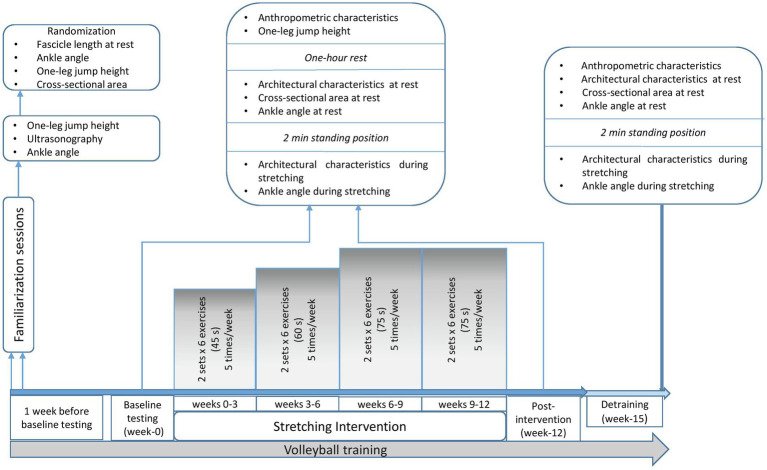
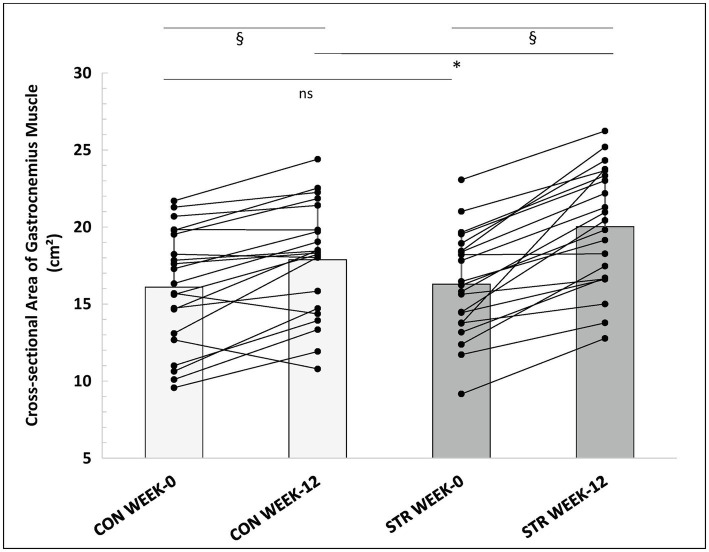
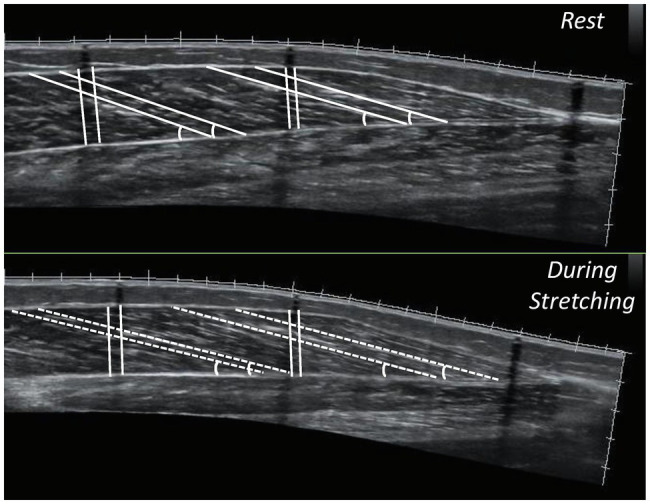
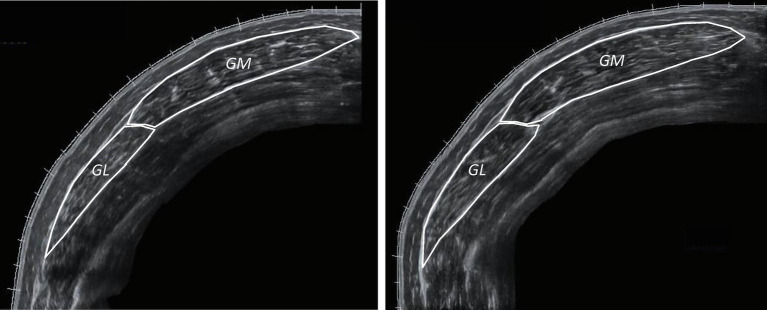
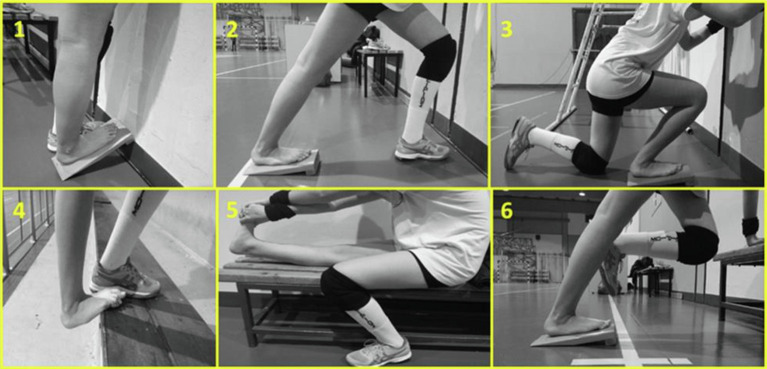
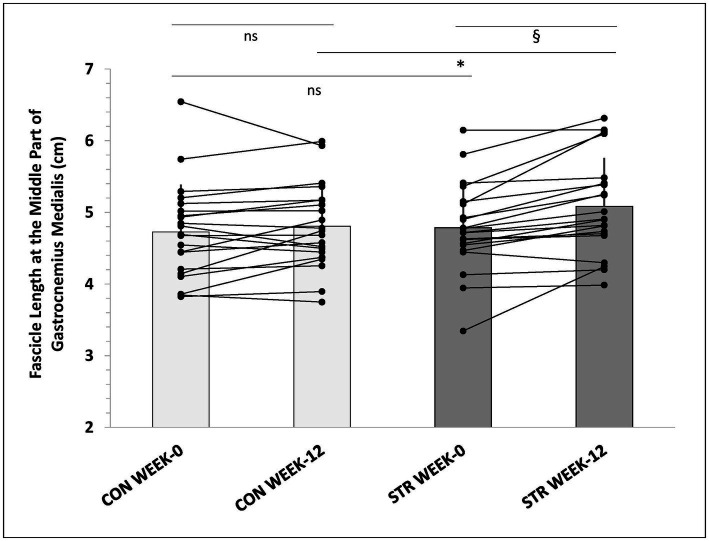
This study examined the effects of high-volume static stretching training on gastrocnemius muscle architecture, ankle angle and jump height in 21 female adolescent volleyball players. Static stretching of the plantar flexors of one leg (STR) was performed five times/week for 12 weeks, in addition to volleyball training, with the contra-lateral leg used as control (CON). Total duration of stretching per session increased from 540 s (week 1) to 900 s (week 12). At baseline, week 12 and after 3 weeks of detraining, muscle architecture at the middle and the distal part of both gastrocnemius heads (medialis and lateralis) and ankle angle were examined at rest and at maximum dorsiflexion. At the same time-points gastrocnemius cross-sectional area (CSA) was also assessed, while jumping height was measured at baseline and week 12. Following intervention, ankle dorsiflexion increased in both legs with a greater increase in STR than CON (22 ± 20% vs. 8 ± 17%, < 0.001). Fascicle length at the middle part of gastrocnemius medialis increased only in the STR, at rest (6 ± 7%, = 0.006) and at maximum dorsiflexion (11 ± 7%, < 0.001). Fascicle length at maximum dorsiflexion also increased at the distal part of gastrocnemius lateralis of STR (15 ± 13%, < 0.001). A greater increase in CSA (23 ± 14% vs. 13 ± 14%, < 0.001) and in one-leg jumping height (27 ± 30% vs. 17 ± 23%, < 0.001) was found in STR than CON. Changes in ankle angle, fascicle length and CSA were maintained following detraining. High-volume stretching training for 12 weeks results in ankle dorsiflexion, fascicle length and muscle cross sectional area increases in adolescent female volleyball players. These adaptations may partly explain improvements in jump performance.
本研究调查了大剂量静态拉伸训练对21名青春期女性排球运动员腓肠肌结构、踝关节角度和跳跃高度的影响。除排球训练外,对一条腿的跖屈肌进行静态拉伸(STR),每周5次,共12周,对侧腿作为对照(CON)。每次拉伸的总时长从第1周的540秒增加到第12周的900秒。在基线、第12周以及停训3周后,在休息和最大背屈时检查双侧腓肠肌两头(内侧和外侧)中部和远端的肌肉结构以及踝关节角度。在相同时间点还评估了腓肠肌横截面积(CSA),同时在基线和第12周测量跳跃高度。干预后,双腿的踝关节背屈均增加,STR组的增加幅度大于CON组(22±20%对8±17%,<0.001)。仅STR组内侧腓肠肌中部的肌束长度在休息时(6±7%,=0.006)和最大背屈时(11±7%,<0.001)增加。STR组外侧腓肠肌远端在最大背屈时的肌束长度也增加(15±13%,<0.001)。STR组的CSA增加幅度(23±14%对13±14%,<0.001)和单腿跳跃高度增加幅度(27±30%对17±23%,<0.001)均大于CON组。停训后踝关节角度、肌束长度和CSA的变化得以维持。为期12周的大剂量拉伸训练可使青春期女性排球运动员的踝关节背屈、肌束长度和肌肉横截面积增加。这些适应性变化可能部分解释了跳跃成绩的提高。