Choi Youn-Ho, Park DoJoon
Department of Orthopaedic Surgery, St. Vincent's Hospital, College of Medicine, The Catholic University of Korea, Seoul, Republic of Korea.
Case Rep Orthop. 2021 Jul 19;2021:6654969. doi: 10.1155/2021/6654969. eCollection 2021.
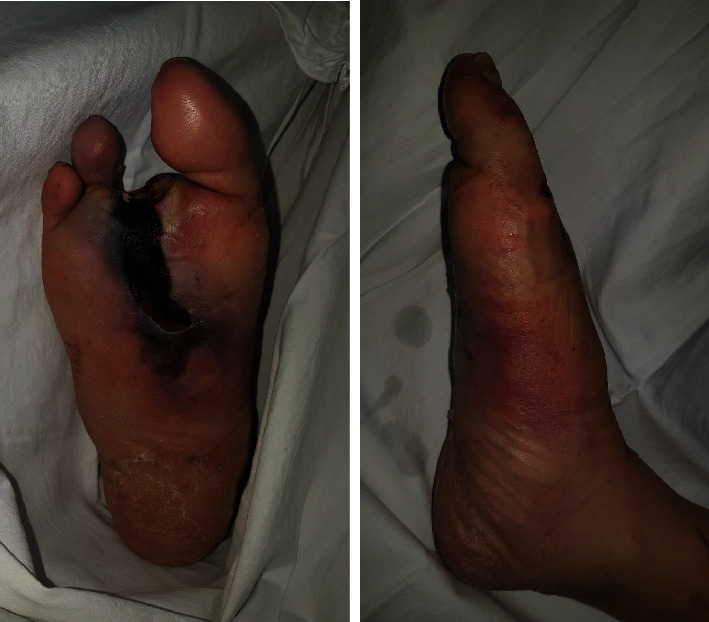
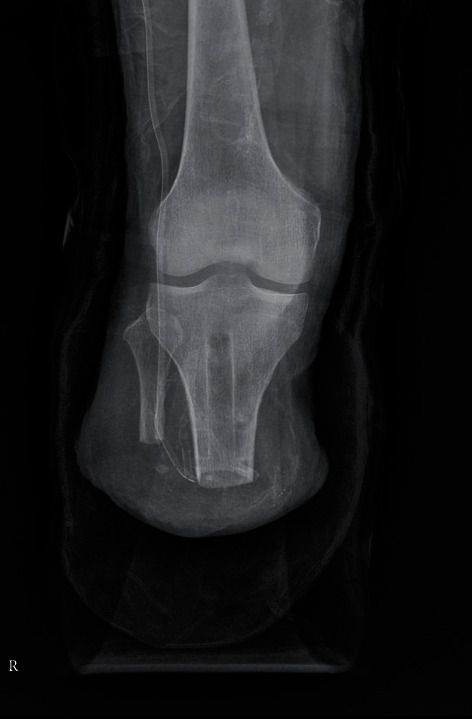
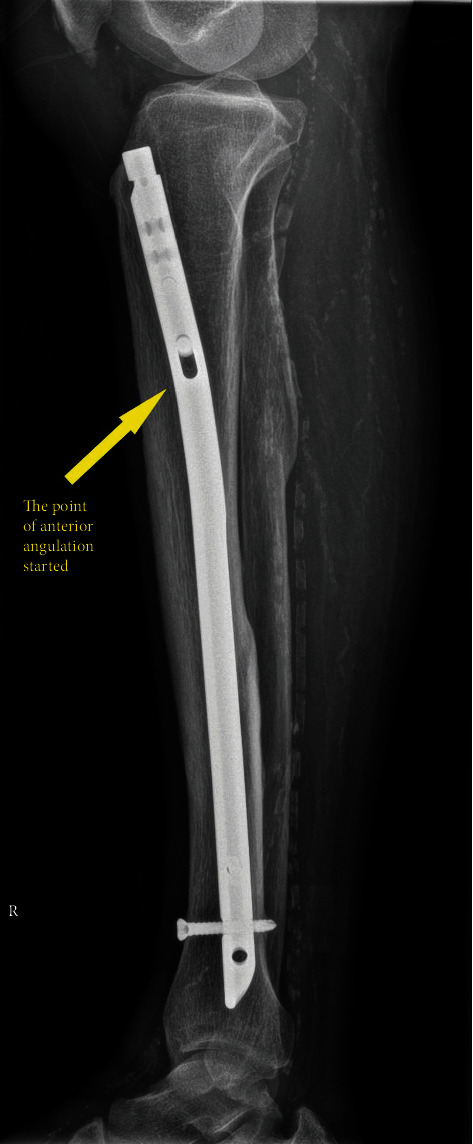
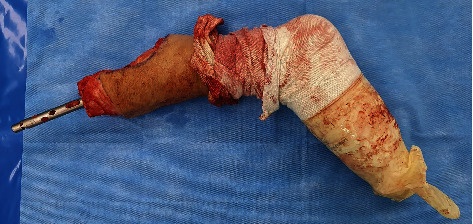
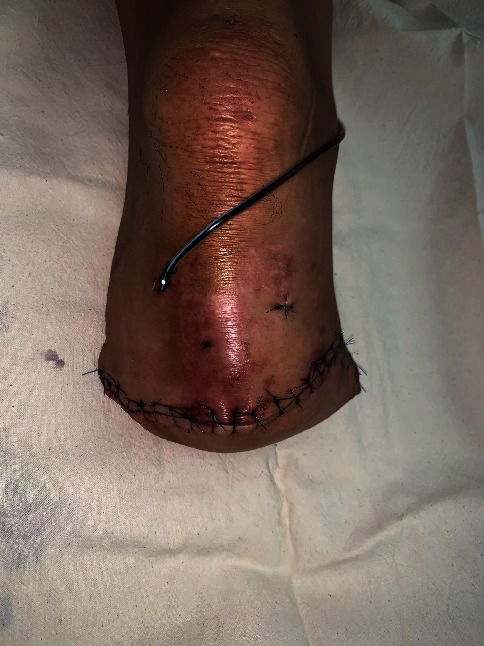
Transtibial amputation is the preferred strategy for treating a diabetic foot with an infection and necrosis. However, if a tibial intramedullary nail was previously inserted into the ipsilateral lower extremity, the nail must be removed to perform the transtibial amputation. In this special situation, the removal of the tibial intramedullary nail can cause various complications after transtibial amputation. We present a case and surgical technique report of a 46-year-old male with an uncontrolled diabetic foot with tibial intramedullary nail insertion. With the nail and ankle fixed by distal interlocking screws, a below-knee amputation was performed by removing the nail and the amputated limb together. This surgical method is expected to reduce postoperative complications such as infections and patella instability after the amputation of a diabetic foot.
经胫骨截肢术是治疗伴有感染和坏死的糖尿病足的首选策略。然而,如果先前已将胫骨髓内钉插入同侧下肢,则必须取出髓内钉以进行经胫骨截肢术。在这种特殊情况下,取出胫骨髓内钉会在经胫骨截肢术后引发各种并发症。我们报告了一例46岁男性糖尿病足伴胫骨髓内钉植入且病情控制不佳的病例及手术技术。通过远端交锁螺钉固定髓内钉和踝关节,将髓内钉与截肢肢体一并去除,实施了膝下截肢术。这种手术方法有望减少糖尿病足截肢术后感染和髌骨不稳定等术后并发症。