Brancatella Alessandro, Lupi Isabella, Montanelli Lucia, Ricci Debora, Viola Nicola, Sgrò Daniele, Antonangeli Lucia, Sardella Chiara, Brogioni Sandra, Piaggi Paolo, Molinaro Eleonora, Bianchi Francesca, Aragona Michele, Antonuzzo Andrea, Sbrana Andrea, Lucchesi Maurizio, Chella Antonio, Falcone Alfredo, Del Prato Stefano, Elisei Rossella, Marcocci Claudio, Caturegli Patrizio, Santini Ferruccio, Latrofa Francesco
Department of Clinical and Experimental Medicine, University of Pisa, Pisa 56126, Italy.
Endocrinology Unit, Azienda Ospedaliero-Universitaria Pisana, University Hospital of Pisa, Pisa 56124, Italy.
J Endocr Soc. 2021 May 15;5(9):bvab093. doi: 10.1210/jendso/bvab093. eCollection 2021 Sep 1.
Thyrotoxicosis is a common immune-related adverse event in patients treated with programmed cell death protein-1 (PD1) or programmed cell death protein ligand-1 (PD-L1) blockade. A detailed endocrinological assessment, including thyroid ultrasound and scintigraphy, is lacking, as are data on response to treatment and follow-up.
The aim of this study was to better characterize the thyrotoxicosis secondary to immune checkpoint inhibitors, gaining insights into pathogenesis and treatment.
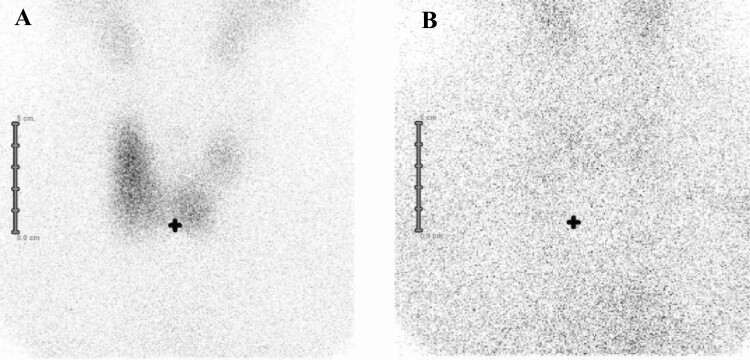
We conducted a retrospective study of 20 consecutive patients who had normal thyroid function before starting immunotherapy and then experienced thyrotoxicosis on PD1 or PD-L1 blockade. Clinical assessment was combined with thyroid ultrasound, technecium scintiscan, and longitudinal thyroid function tests.
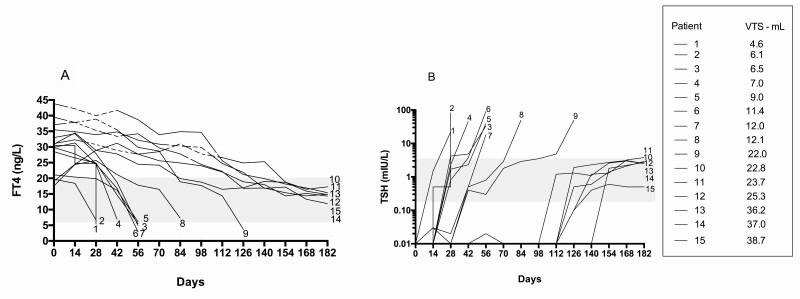
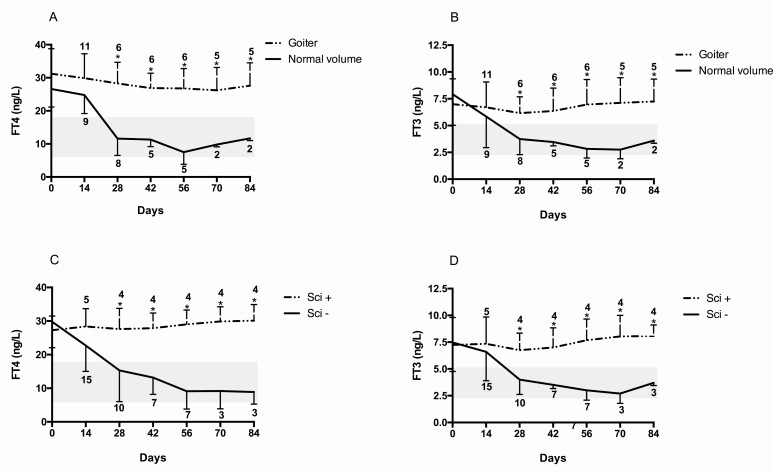
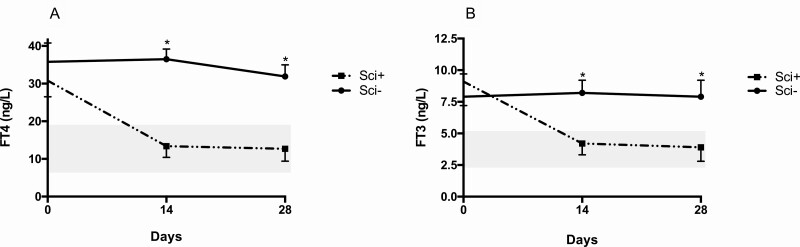
Five patients had normal or increased scintigraphic uptake (Sci+), no serum antibodies against the thyrotropin receptor, and remained hyperthyroid throughout follow-up. The other 15 patients had no scintigraphic uptake (Sci-) and experienced destructive thyrotoxicosis followed by hypothyroidism (N = 9) or euthyroidism (N = 6). Hypothyroidism was more readily seen in those with normal thyroid volume than in those with goiter ( = .04). Among Sci- individuals, a larger thyroid volume was associated with a longer time to remission ( < .05). Methimazole (MMI) was effective only in Sci+ individuals ( < .05).
Administration of PD1- or PD-L1-blocking antibodies may induce 2 different forms of thyrotoxicosis that appear similar in clinical severity at onset: a type 1 characterized by persistent hyperthyroidism that requires treatment with MMI, and a type 2, characterized by destructive and transient thyrotoxicosis that evolves to hypothyroidism or euthyroidism. Thyroid scintigraphy and ultrasound help in differentiating and managing these 2 forms of iatrogenic thyrotoxicosis.
甲状腺毒症是接受程序性细胞死亡蛋白1(PD1)或程序性细胞死亡蛋白配体1(PD-L1)阻断治疗的患者中常见的免疫相关不良事件。目前缺乏详细的内分泌评估,包括甲状腺超声和闪烁扫描,也缺乏关于治疗反应和随访的数据。
本研究的目的是更好地描述免疫检查点抑制剂继发的甲状腺毒症,深入了解其发病机制和治疗方法。
我们对20例在开始免疫治疗前甲状腺功能正常、随后在接受PD1或PD-L1阻断治疗时出现甲状腺毒症的连续患者进行了回顾性研究。临床评估结合甲状腺超声、锝闪烁扫描和甲状腺功能纵向检测。
5例患者闪烁扫描摄取正常或增加(Sci+),血清中无促甲状腺素受体抗体,在整个随访过程中均为甲状腺功能亢进。其他15例患者闪烁扫描无摄取(Sci-),经历了破坏性甲状腺毒症,随后出现甲状腺功能减退(n = 9)或甲状腺功能正常(n = 6)。甲状腺体积正常的患者比有甲状腺肿的患者更容易出现甲状腺功能减退(P = 0.04)。在Sci-个体中,甲状腺体积越大,缓解时间越长(P < 0.05)。甲巯咪唑(MMI)仅对Sci+个体有效(P < 0.05)。
给予PD1或PD-L1阻断抗体可能诱发两种不同形式的甲状腺毒症,在发病时临床严重程度相似:1型以持续性甲状腺功能亢进为特征,需要用MMI治疗;2型以破坏性和短暂性甲状腺毒症为特征,随后发展为甲状腺功能减退或甲状腺功能正常。甲状腺闪烁扫描和超声有助于区分和管理这两种医源性甲状腺毒症。