Bem Junior Luiz Severo, Lemos Nilson Batista, de Lima Luís Felipe Gonçalves, Dias Artêmio José Araruna, Neto Otávio da Cunha Ferreira, de Lira Carlos Cezar Sousa, Diniz Andrey Maia Silva, Rabelo Nicollas Nunes, Barroso Luciana Karla Viana, Valença Marcelo Moraes, de Azevedo Filho Hildo Rocha Cirne
College of Medical Sciences, Unifacisa University Center, Campina Grande, Paraíba.
Neuroscience Post-Graduate Program, Federal University of Pernambuco, Recife, Pernambuco.
Surg Neurol Int. 2021 Jun 28;12:319. doi: 10.25259/SNI_200_2021. eCollection 2021.
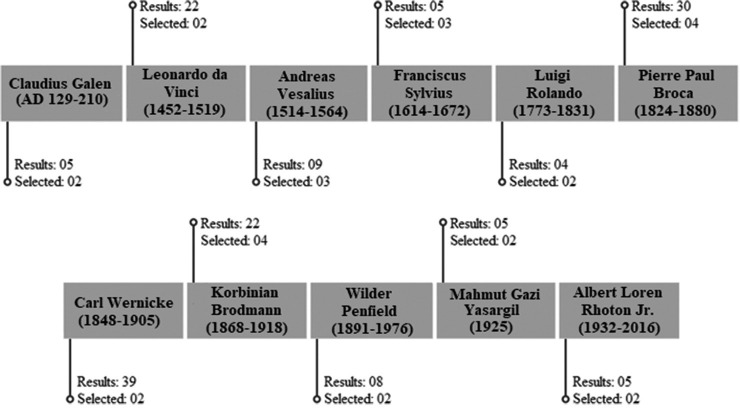
This article reports the evolution and consolidation of the knowledge of neuroanatomy through the analysis of its history. Thus, we propose to describe in a historical review to summarize the main theories and concepts that emerged throughout brain anatomy history and understand how the socio-historical context can reflect on the nature of scientific knowledge. Therefore, among the diverse scientists, anatomists, doctors, and philosophers who were part of this history, there was a strong influence of the studies of Claudius Galen (AD 129-210), Leonardo da Vinci (1452- 1519), Andreas Vesalius (1514-1564), Franciscus Sylvius (1614-1672), Luigi Rolando (1773-1831), Pierre Paul Broca (1824-1880), Carl Wernicke (1848-1905), Korbinian Brodmann (1868-1918), Wilder Penfield (1891-1976), Mahmut Gazi Yasargil (1925), and Albert Loren Rhoton Jr. (1932-2016) on the fundamentals of neuroanatomy.
本文通过对神经解剖学历史的分析,报告了其知识的演变与巩固。因此,我们建议在一篇历史综述中进行描述,以总结在整个脑解剖学历史中出现的主要理论和概念,并理解社会历史背景如何能够反映科学知识的本质。所以,在构成这段历史的众多科学家、解剖学家、医生和哲学家中,克劳狄乌斯·盖伦(公元129 - 210年)、列奥纳多·达·芬奇(1452 - 1519年)、安德烈亚斯·维萨里(1514 - 1564年)、弗朗西斯库斯·西尔维乌斯(1614 - 1672年)、路易吉·罗兰多(1773 - 1831年)、皮埃尔·保罗·布罗卡(1824 - 1880年)、卡尔·韦尼克(1848 - 1905年)、科比尼安·布罗德曼(1868 - 1918年)、怀尔德·彭菲尔德(1891 - 1976年)、马哈茂德·加齐·亚萨尔吉尔(1925年出生)以及小阿尔伯特·洛伦·罗顿(1932 - 2016年)的研究对神经解剖学基础产生了重大影响。