Department of Ophthalmology, Byers Eye Institute, Stanford University, Palo Alto, CA, United States of America.
Department of Ophthalmology, Retina Service, Massachusetts Eye and Ear, Harvard Medical School, Boston, MA, United States of America.
PLoS One. 2021 Aug 4;16(8):e0252878. doi: 10.1371/journal.pone.0252878. eCollection 2021.
To study the effect of statin exposure on the progression from non-exudative to exudative age-related macular degeneration (AMD).
Retrospective cohort study of commercially insured patients diagnosed with non-exudative AMD (n = 231,888) from 2007 to 2015. Time-to-event analysis of the association between exposure to lipid-lowering medications and time from non-exudative AMD to exudative AMD diagnosis was conducted. Outcome measures included progression to exudative AMD, indicated by diagnosis codes for exudative AMD or procedural codes for intravitreal injections.
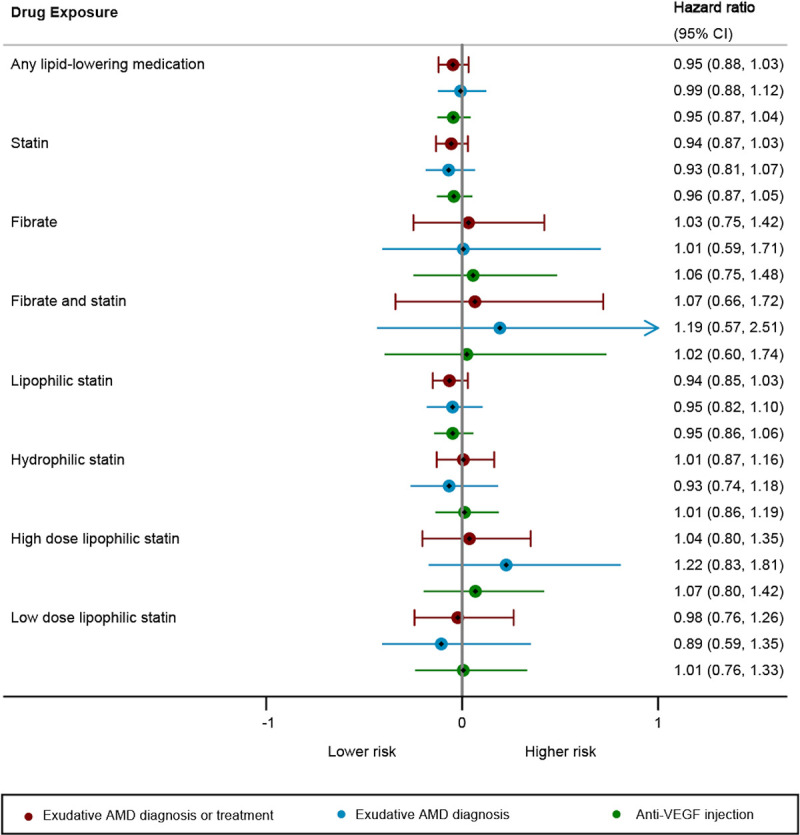
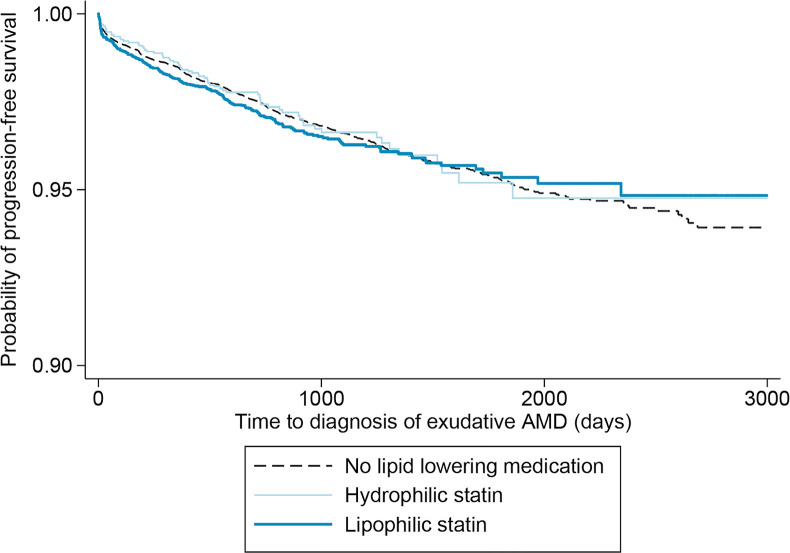
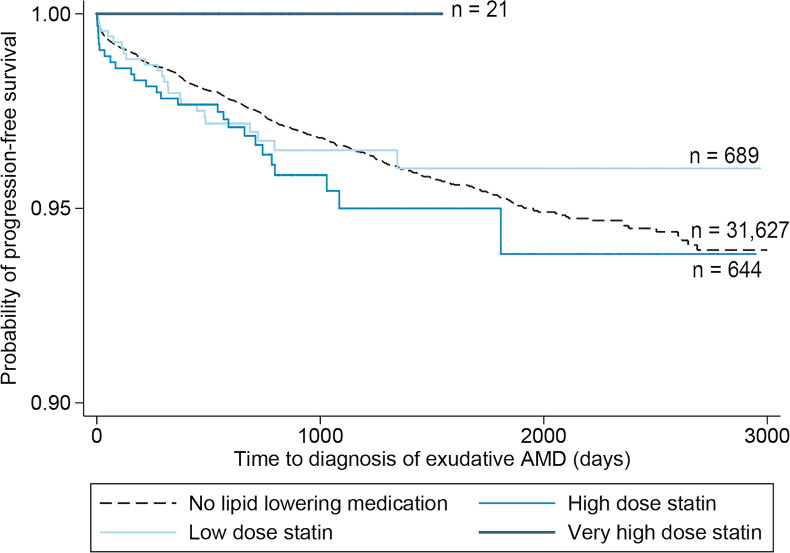
In the year before and after first AMD diagnosis, 11,330 patients were continuously prescribed lipid-lowering medications and 31,627 patients did not take any lipid-lowering medication. Of those taking statins, 21 (1.6%) patients were on very-high-dose lipophilic statins, 644 (47.6%) on high-dose lipophilic statins, and 689 (50.9%) on low-dose lipophilic statins. We found no statistically significant relationship between exposure to low (HR 0.89, 95% CI 0.83 to 1.38) or high-dose lipophilic statins (HR 1.12, 95% CI 0.86 to 1.45) and progression to exudative AMD. No patients taking very-high-dose lipophilic statins converted from non-exudative to exudative AMD, though this difference was not statistically significant due to the subgroup size (p = .23, log-rank test).
No statistically significant relationship was found between statin exposure and risk of AMD progression. Interestingly, no patients taking very-high-dose lipophilic statins progressed to exudative AMD, a finding that warrants further exploration.
研究他汀类药物暴露对非渗出性年龄相关性黄斑变性(AMD)向渗出性 AMD 进展的影响。
这是一项回顾性队列研究,纳入了 2007 年至 2015 年间被诊断为非渗出性 AMD 的商业保险患者 231888 例。采用时间事件分析方法,分析了降脂药物暴露与非渗出性 AMD 向渗出性 AMD 诊断之间的关联。主要结局指标包括进展为渗出性 AMD,其定义为渗出性 AMD 的诊断代码或眼内注射的操作代码。
在首次 AMD 诊断前后的一年中,11330 例患者持续处方降脂药物,31627 例患者未服用任何降脂药物。在服用他汀类药物的患者中,21 例(1.6%)患者使用了超高剂量亲脂性他汀类药物,644 例(47.6%)使用了高剂量亲脂性他汀类药物,689 例(50.9%)使用了低剂量亲脂性他汀类药物。我们未发现暴露于低剂量(HR 0.89,95%CI 0.83 至 1.38)或高剂量亲脂性他汀类药物(HR 1.12,95%CI 0.86 至 1.45)与进展为渗出性 AMD 之间存在统计学显著关系。尽管由于亚组规模较小(p =.23,对数秩检验),没有服用超高剂量亲脂性他汀类药物的患者从非渗出性 AMD 转化为渗出性 AMD,但这一差异无统计学意义。
未发现他汀类药物暴露与 AMD 进展风险之间存在统计学显著关系。有趣的是,没有服用超高剂量亲脂性他汀类药物的患者进展为渗出性 AMD,这一发现值得进一步探索。