Department of Obstetrics, Fujian Maternity and Child Health Hospital, Affiliated Hospital of Fujian Medical University, No. 18 Daoshan Road, Gulou District, Fuzhou, Fujian, 350001, People's Republic of China.
Department of Gynecology, Fujian Maternity and Child Health Hospital, Affiliated Hospital of Fujian Medical University, No. 18 Daoshan Road, Gulou District, Fuzhou, Fujian, 350001, People's Republic of China.
BMC Pregnancy Childbirth. 2021 Aug 4;21(1):538. doi: 10.1186/s12884-021-04027-6.
The risk of fetal loss is higher among ≥35-year-olds than younger women. The present study aimed to explore the causes and factors influencing fetal loss in advanced maternal age (AMA).
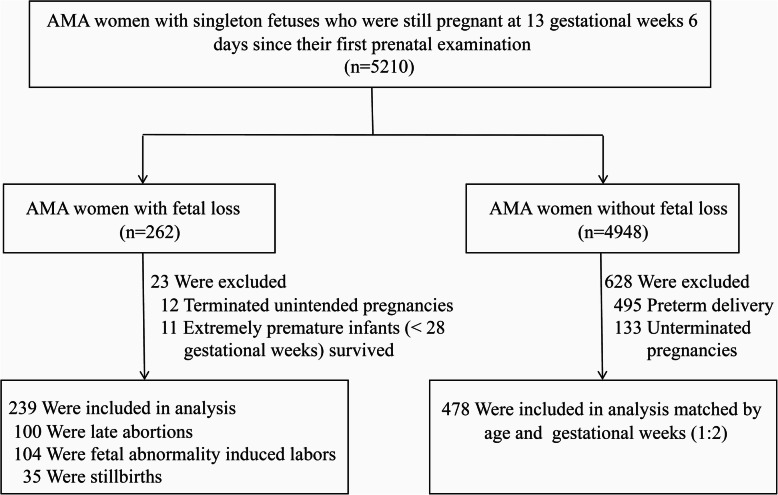
AMA women with singleton fetuses (< 14 gestational weeks) who underwent their first prenatal examination in the Obstetrics Department of Fujian Maternity and Child Health Hospital from December 2018 to June 2020 were included in this cohort study. Those who terminated the pregnancy before 14 gestational weeks were excluded. A baseline survey was conducted, and follow-up was carried out until the termination of the pregnancy. Clinical data were extracted to analyse the causes of fetal loss among them. In the nested case-control study, the AMA women with fetal loss were enrolled as the case group, and women without fetal loss in the same period were enrolled as the control group, in a 1:2 ratio matched by age and gestational weeks. Logistic regression models were used to analyse the factors influencing fetal loss.
A total of 239 women with fetal loss and 478 controls were enrolled. The causes of fetal loss were most often fetal factors, followed by maternal factors, umbilical cord factors, and placental factors. Multivariate logistic regression analysis indicated that junior high school education and below (adjusted odds ratio (aOR) = 5.13, 95% confidence interval (CI): 2.19-12.02), senior high school education (aOR = 4.91, 95% CI: 2.09-11.54), residence in a rural area (aOR = 2.85, 95% CI: 1.92-4.25), unemployment (aOR = 1.81, 95% CI: 1.20-2.71), spontaneous abortion history (aOR = 1.88, 95% CI: 1.26-2.80), preterm birth history (aOR = 11.08, 95% CI: 2.90-42.26), hypertensive disorders of pregnancy (aOR = 7.20, 95% CI: 2.24-23.12), and preterm premature rupture of membranes (aOR = 4.12, 95% CI: 1.53-11.11) were risk factors for fetal loss.
Low educational level, unemployment, abnormal pregnancy/labor history, and pregnancy complications were correlated with the incidence of fetal loss in AMA. Thus, early identification as well as a targeted intervention, should be conducted.
≥35 岁孕妇的胎儿丢失风险高于年轻女性。本研究旨在探讨高龄产妇(AMA)胎儿丢失的原因和影响因素。
本队列研究纳入 2018 年 12 月至 2020 年 6 月在福建妇幼保健院妇产科接受首次产前检查、孕周<14 周的单胎 AMA 孕妇,排除妊娠 14 周前终止妊娠者。进行基线调查,并随访至妊娠终止。提取临床资料分析胎儿丢失原因。在巢式病例对照研究中,将 AMA 胎儿丢失孕妇纳入病例组,同期无胎儿丢失孕妇纳入对照组,按年龄和孕周 1:2 匹配。采用 logistic 回归模型分析影响胎儿丢失的因素。
共纳入 239 例胎儿丢失孕妇和 478 例对照。胎儿丢失的主要原因为胎儿因素,其次为母体因素、脐带因素和胎盘因素。多因素 logistic 回归分析显示,初中及以下文化程度(调整优势比(aOR)=5.13,95%置信区间(CI):2.19-12.02)、高中文化程度(aOR=4.91,95%CI:2.09-11.54)、农村居住(aOR=2.85,95%CI:1.92-4.25)、失业(aOR=1.81,95%CI:1.20-2.71)、自然流产史(aOR=1.88,95%CI:1.26-2.80)、早产史(aOR=11.08,95%CI:2.90-42.26)、妊娠期高血压疾病(aOR=7.20,95%CI:2.24-23.12)和胎膜早破(aOR=4.12,95%CI:1.53-11.11)是胎儿丢失的危险因素。
低文化程度、失业、异常妊娠/分娩史和妊娠并发症与 AMA 胎儿丢失的发生率相关,应早期识别并进行针对性干预。