Division of Adolescent Medicine, Children's Mercy Kansas City, 2401 Gillham Rd, Kansas City, MO, 64108, USA.
Division of Clinical Pharmacology, Toxicology and Therapeutic Innovation, Children's Mercy Kansas City, Kansas City, MO, USA.
Harm Reduct J. 2021 Aug 4;18(1):83. doi: 10.1186/s12954-021-00532-1.
The sharp rise in opioid use disorder (OUD) among women coupled with disproportionally high rates of unintended pregnancy have led to a four-fold increase in the number of pregnant women with OUD in the United States over the past decade. Supporting intentional family planning can have multiple health benefits and reduce harms related to OUD but requires a comprehensive understanding of women's perspectives of preventing unintended pregnancies. The purpose of this study was to comprehensively evaluate the knowledge, attitudes and experiences as they relate to seeking contraception, particularly LARCs, among women with active or recovered opioid misuse.
In-depth interviews and focus group discussions with 36 women with current or past opioid misuse were recorded and transcribed. Transcripts were coded by ≥ 2 investigators. Themes related to contraceptive care seeking were identified and contextualized within the Health Belief Model.
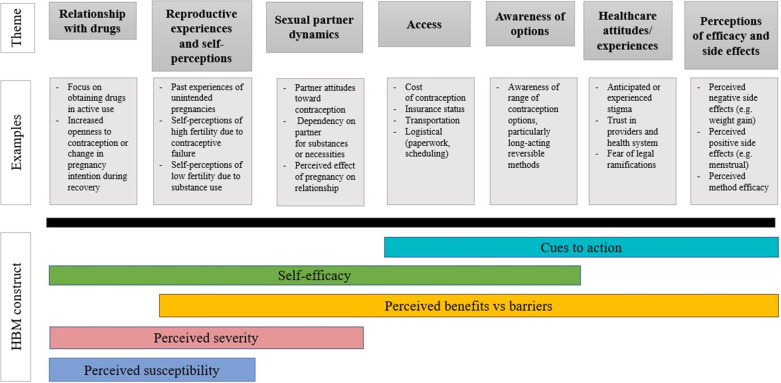
Our analysis revealed seven interwoven themes that describe individual level factors associated with contraceptive care seeking in women with current or past opioid misuse: relationship with drugs, reproductive experiences and self-perceptions, sexual partner dynamics, access, awareness of options, healthcare attitudes/experiences, and perceptions of contraception efficacy/ side effects. Overall, perceived susceptibility and severity to unintended pregnancy varied, but most women perceived high benefits of contraception, particularly LARC. However, perceived barriers were too high for most to obtain desired contraception to support family planning intentions.
The individual-level factors identified should inform the design of integrated services to promote patient-centered contraceptive counseling as a form of harm reduction. Interventions should reduce barriers to contraceptive access, particularly LARCs, and establish counseling strategies that use open, non-judgmental communication, acknowledge the continuum of reproductive needs, explore perceived susceptibility to pregnancy, and utilize peer educators.
在过去十年中,美国女性阿片类药物使用障碍(OUD)的急剧上升,加上意外怀孕率的不成比例地高,导致患有 OUD 的孕妇数量增加了四倍。支持有意的计划生育可以带来多种健康益处,并减少与 OUD 相关的危害,但需要全面了解女性对预防意外怀孕的看法。本研究的目的是全面评估知识、态度和经验,以了解当前或已康复的阿片类药物滥用女性寻求避孕,特别是长效可逆避孕(LARC)的情况。
对 36 名有当前或过去阿片类药物滥用的女性进行深入访谈和焦点小组讨论,并进行记录和转录。由≥2 名研究人员对转录本进行编码。确定与避孕护理寻求相关的主题,并将其纳入健康信念模型中进行背景化。
我们的分析揭示了七个相互交织的主题,描述了与当前或过去阿片类药物滥用女性避孕护理寻求相关的个体层面因素:与毒品的关系、生殖经历和自我认知、性伴侣动态、获取途径、对选择的认识、医疗保健态度/经验以及对避孕效果/副作用的看法。总体而言,对意外怀孕的易感性和严重性的看法各不相同,但大多数女性认为避孕的好处很高,特别是 LARC。然而,对大多数女性来说,获得所需避孕措施以支持计划生育意图的障碍过高。
确定的个体层面因素应告知设计综合服务,以促进以患者为中心的避孕咨询,作为减少伤害的一种形式。干预措施应减少避孕获取的障碍,特别是 LARC,并建立咨询策略,使用开放、非评判性的沟通,承认生殖需求的连续性,探讨对怀孕的易感性,并利用同伴教育者。