Takahashi Wataru, Morita Takehiro, Tanaka Kiu, Ide Shougo, Hujimori Kouki, Takahashi Yasuhumi
Division of Cardiovascular Medicine, National Hospital Organization, Shinshu Ueda Medical Center, Ueda, Nagano, Japan.
J Cardiol Cases. 2020 Dec 30;24(2):49-51. doi: 10.1016/j.jccase.2020.12.011. eCollection 2021 Aug.
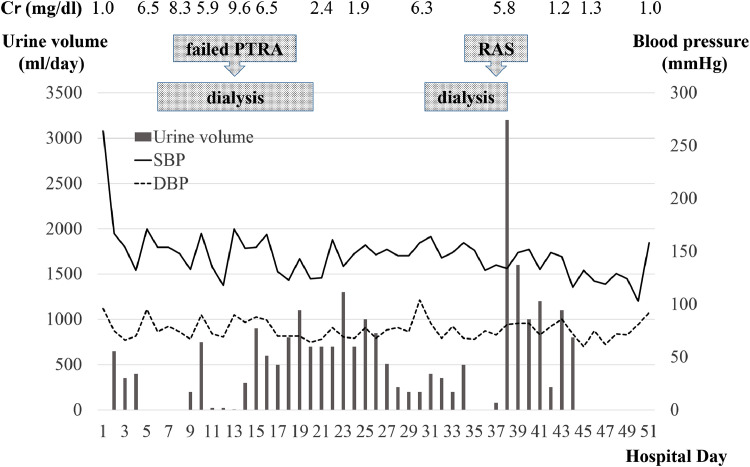
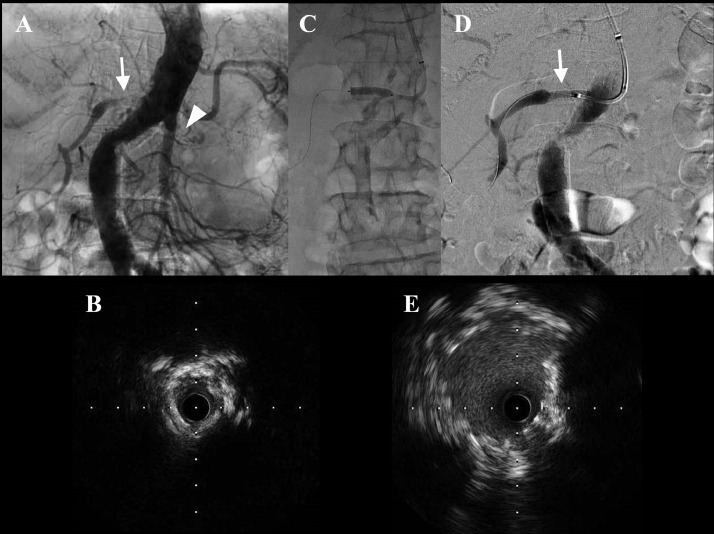
Because previous randomized clinical trials have failed to show any benefits of renal artery stenting (RAS), clinicians have been confused regarding the optimal management of patients with atherosclerotic renal artery stenosis (ARAS). Here, we report a notable case with ARAS whose clinical course could help clinicians identify patients suitable for RAS. A 66-year-old woman with ARAS and some parameter abnormalities on renal duplex ultrasound was admitted to our hospital with severe hypertension (>250 mmHg). After the initiation of antihypertensive intravenous treatment, the patient manifested acute worsening of renal function over 6 days and required dialysis. Because renal failure continued to deteriorate over more than 4 weeks, we performed stenting to the severe ostial stenosis of the right renal artery. As a result, the patient achieved dramatic improvement in renal function and successful withdrawal from dialysis and has maintained stable control of blood pressure without additional events for more than 2 years since discharge. This case suggests that careful analysis of the patient's profile, such as history of rapidly deteriorating renal failure, presence of bilateral ARAS, or a solitary functional kidney, in addition to various parameters of renal duplex ultrasound, may help predict the efficacy of RAS in patients with ARAS. < Because several randomized studies have reported negative results for renal artery stenting (RAS), an individual-based approach is required for the treatment of atherosclerotic renal artery stenosis (ARAS). To determine whether RAS could be effective in patients with ARAS, it is important to assess patient-specific characteristics such as progression of renal failure (e.g. acute worsening), presence of bilateral ARAS, or the existence of a solitary functional kidney, as well as parameters of related examinations such as the renal arterial resistive index.>.
由于既往随机临床试验未能显示肾动脉支架置入术(RAS)有任何益处,临床医生对于动脉粥样硬化性肾动脉狭窄(ARAS)患者的最佳治疗方案感到困惑。在此,我们报告1例ARAS患者,其临床病程有助于临床医生识别适合RAS治疗的患者。1例66岁患有ARAS且肾 duplex超声检查有一些参数异常的女性因严重高血压(>250 mmHg)入院。在开始静脉降压治疗后,患者在6天内肾功能急剧恶化,需要进行透析。由于肾衰竭在4周多的时间里持续恶化,我们对右肾动脉严重开口处狭窄进行了支架置入术。结果,患者肾功能显著改善,成功停止透析,自出院以来血压一直稳定控制,超过2年未出现其他事件。该病例表明,除了肾duplex超声的各种参数外,仔细分析患者的情况,如肾衰竭快速恶化史、双侧ARAS的存在或单功能肾的存在,可能有助于预测RAS对ARAS患者的疗效。<由于多项随机研究报告了肾动脉支架置入术(RAS)的阴性结果,因此动脉粥样硬化性肾动脉狭窄(ARAS)的治疗需要采取基于个体的方法。为了确定RAS对ARAS患者是否有效,评估患者的特定特征如肾衰竭进展(如急性恶化)、双侧ARAS的存在或单功能肾的存在,以及相关检查参数如肾动脉阻力指数非常重要。>