Dutta Sohini, Beaver Jasmin, Halcomb Carly J, Jasnow Aaron M
School of Biomedical Sciences and Brain Health Research Institute, Kent State University, Kent, OH, 44242, USA.
Department of Psychological Sciences and Brain Health Research Institute, Kent State University, Kent, OH, 44242, USA.
Neurobiol Stress. 2021 Jul 14;15:100365. doi: 10.1016/j.ynstr.2021.100365. eCollection 2021 Nov.
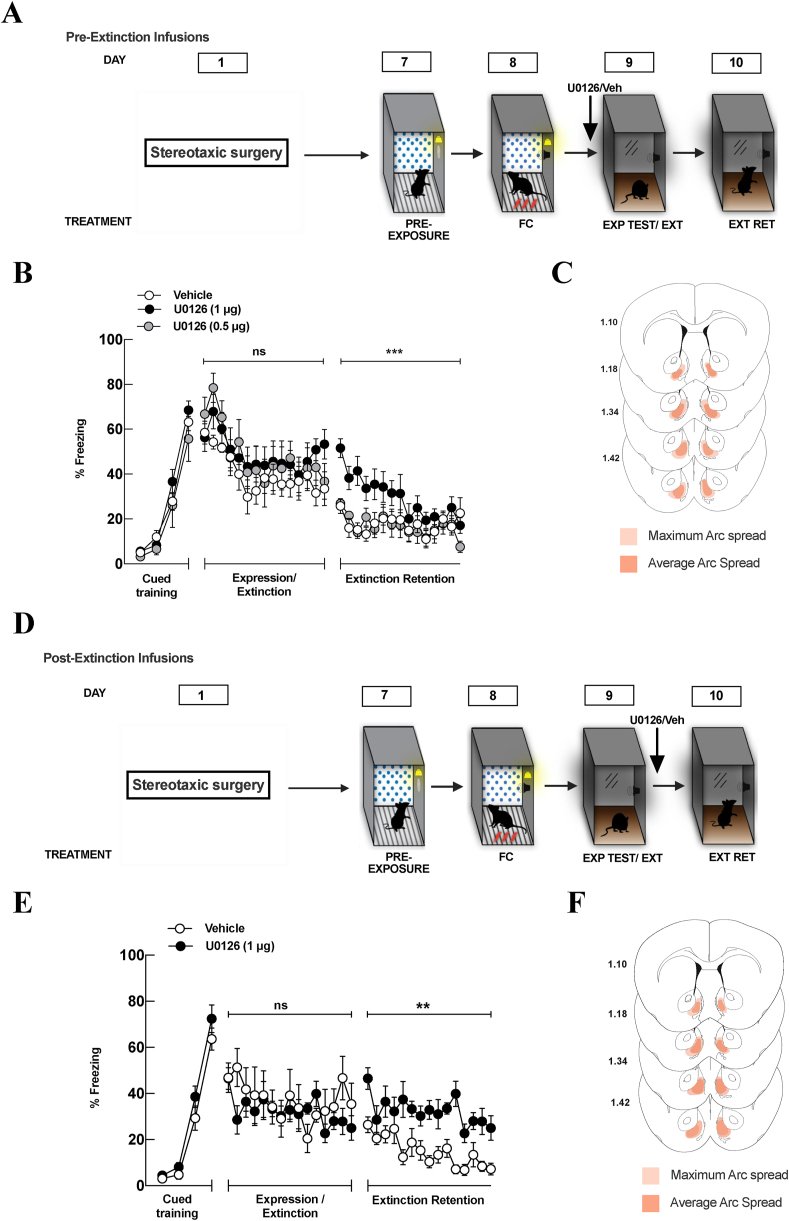
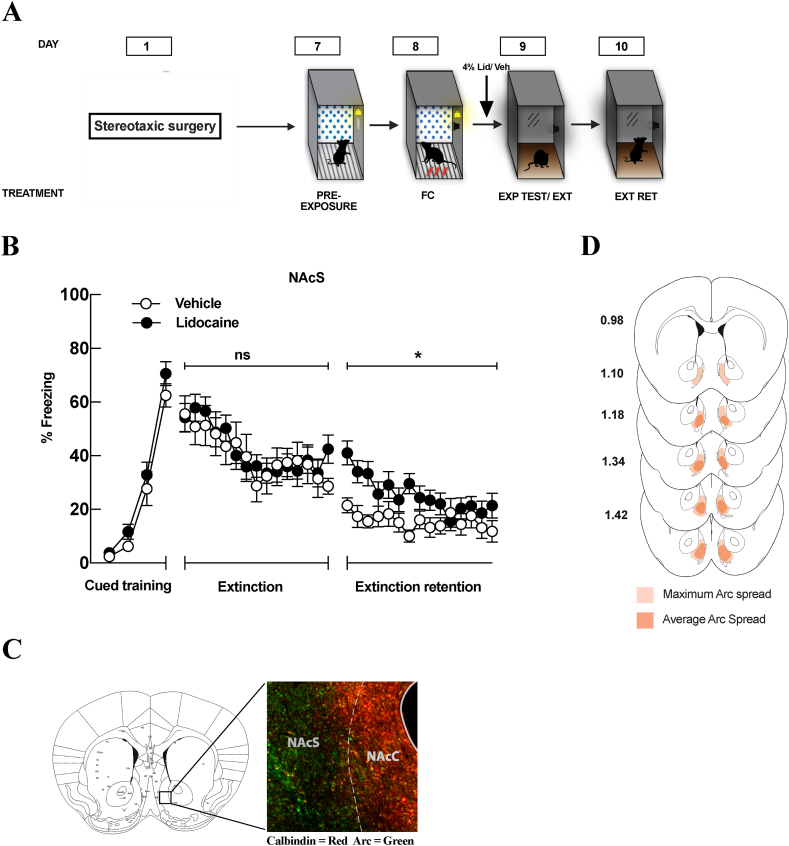
The nucleus accumbens (NAc), consisting of core (NAcC) and shell (NAcS) sub-regions, has primarily been studied as a locus mediating the effects of drug reward and addiction. However, there is ample evidence that this region is also involved in regulating aversive responses, but the exact role of the NAc and its subregions in regulating associative fear processing remains unclear. Here, we investigated the specific contribution of the NAcC and NAcS in regulating both fear expression and fear extinction in C57BL/6J mice. Using Arc expression as an indicator of neuronal activity, we first show that the NAcC is specifically active only in response to an associative fear cue during an expression test. In contrast, the NAcS is specifically active during fear extinction. We next inactivated each subregion using lidocaine and demonstrated that the NAcC is necessary for fear expression, but not for extinction learning or consolidation of extinction. In contrast, we demonstrate that the NAcS is necessary for the consolidation of extinction, but not fear expression or extinction learning. Further, inactivation of mGluR1 or ERK signaling specifically in the NAcS disrupted the consolidation of extinction but had no effect on fear expression or extinction learning itself. Our data provide the first evidence for the importance of the ERK/MAPK pathway as the underlying neural mechanism facilitating extinction consolidation within the NAcS. These findings suggest that the NAc subregions play dissociable roles in regulating fear recall and the consolidation of fear extinction, and potentially implicate them as critical regions within the canonical fear circuit.
伏隔核(NAc)由核心(NAcC)和壳(NAcS)子区域组成,主要被作为介导药物奖赏和成瘾作用的位点进行研究。然而,有充分的证据表明该区域也参与调节厌恶反应,但NAc及其子区域在调节联想性恐惧加工中的具体作用仍不清楚。在此,我们研究了NAcC和NAcS在调节C57BL/6J小鼠恐惧表达和恐惧消退中的具体作用。以Arc表达作为神经元活动的指标,我们首先表明,在表达测试中,NAcC仅在对联想性恐惧线索作出反应时特异性激活。相反,NAcS在恐惧消退过程中特异性激活。接下来,我们用利多卡因使每个子区域失活,并证明NAcC对恐惧表达是必需的,但对消退学习或消退巩固不是必需的。相反,我们证明NAcS对消退巩固是必需的,但对恐惧表达或消退学习不是必需的。此外,特异性地在NAcS中使mGluR1或ERK信号失活会破坏消退巩固,但对恐惧表达或消退学习本身没有影响。我们的数据首次证明了ERK/MAPK通路作为促进NAcS内消退巩固的潜在神经机制的重要性。这些发现表明,NAc子区域在调节恐惧回忆和恐惧消退巩固中发挥不同的作用,并可能暗示它们是经典恐惧回路中的关键区域。