Department of Medical Oncology, Fondazione Istituto di Ricovero e Cura a Carattere Scientifico, Istituto Nazionale dei Tumori, Milan, Italy.
Unit of Immunotherapy of Human Tumors, Fondazione Istituto di Ricovero e Cura a Carattere Scientifico, Istituto Nazionale dei Tumori, Milan, Italy.
Oncologist. 2021 Dec;26(12):1079-1084. doi: 10.1002/onco.13926. Epub 2021 Sep 21.
Outcomes of patients with metastatic melanoma discontinuing BRAF-targeted therapy for cumulative toxicity after sustained response are unknown.
This retrospective case series analysis conducted at a single Cancer Center in Italy included patients with BRAF mutated metastatic melanoma treated with a BRAF inhibitor as a single agent or in combination with a MEK inhibitor between June 1, 2011 and January 1, 2020 and interrupted treatment due to cumulative toxicity after achieving complete response (CR) or long-lasting partial response (PR; i.e. >12 months).
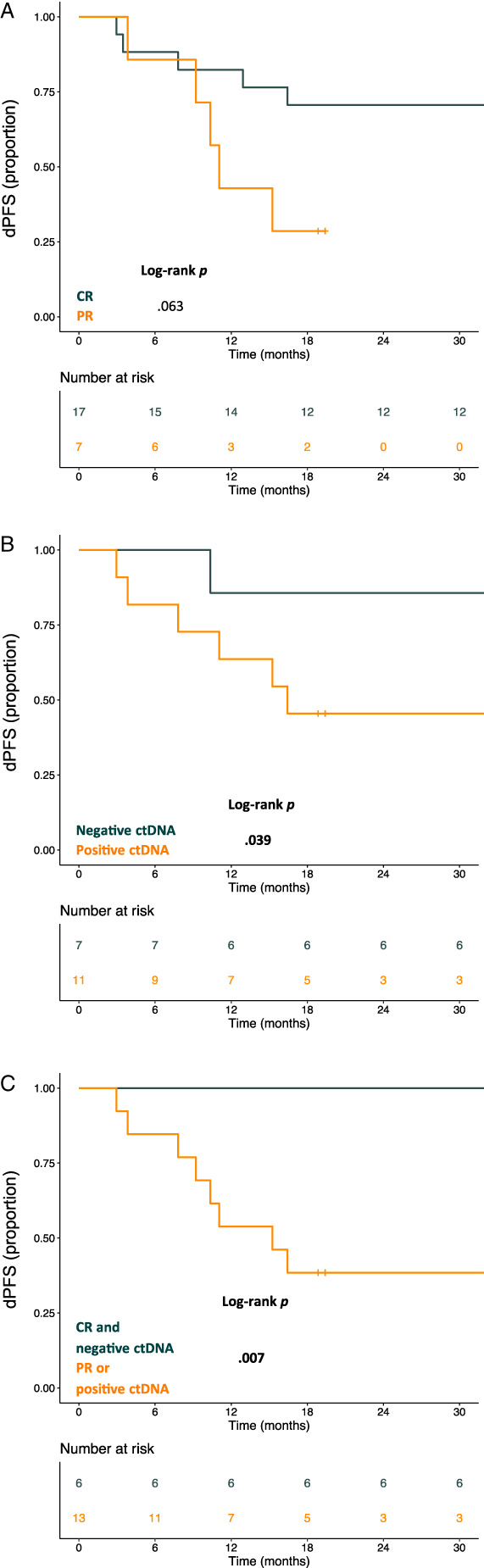
We included 24 patients with a median treatment duration of 59.4 months (95% confidence interval [CI], 55.4-63.4; range, 12-88). CR and PR were achieved in 71% and 29% of patients, respectively. At a median follow-up after treatment discontinuation of 37.8 months (95% CI, 33.7-41.9), the 12-month progression-free survival after discontinuation (dPFS) rate was 70.8% (95% CI 54.8-91.6) and 24-month dPFS rate was 58.3% (95% CI, 41.6-81.8). Baseline patient and tumor characteristics as well as treatment duration and best response did not significantly impact on dPFS. Patients with CR and negative circulating tumor DNA (ctDNA) at time of discontinuation had a significantly improved dPFS compared with patients with either radiological residual disease or ctDNA positivity (p = .007). No patient in CR with undetectable ctDNA experienced progression.
The risk of progression is high even in patients with sustained sensitivity to BRAF/MEK inhibitors. Integration of liquid biopsy in clinical trials investigating the optimal management of patients with sustained sensitivity to BRAF/MEK inhibitors is warranted.
Outcomes of patients with metastatic melanoma discontinuing BRAF-targeted therapy for cumulative toxicity are unknown. This study analyzed patients with sustained responses (median treatment duration 59.4 months). Twelve- and 24-month progression-free survival following discontinuation were 70.8% and 58.3%, respectively. Complete response and negative circulating tumor DNA at time of discontinuation are promising prognostic biomarkers in this setting.
对于因累积毒性而停止接受 BRAF 靶向治疗后出现持续缓解的转移性黑色素瘤患者,其治疗结局尚不清楚。
本研究是一项在意大利单一癌症中心开展的回顾性病例系列分析,纳入了 2011 年 6 月 1 日至 2020 年 1 月 1 日期间接受 BRAF 抑制剂单药或联合 MEK 抑制剂治疗的 BRAF 突变转移性黑色素瘤患者,这些患者在完全缓解(CR)或长时间持久部分缓解(PR;即 >12 个月)后因累积毒性而中断治疗。
本研究共纳入 24 例患者,中位治疗时间为 59.4 个月(95%置信区间 [CI]:55.4-63.4;范围:12-88)。分别有 71%和 29%的患者达到了 CR 和 PR。在停止治疗后中位随访 37.8 个月(95%CI:33.7-41.9)时,停止治疗后 12 个月无进展生存率(dPFS)为 70.8%(95%CI:54.8-91.6),24 个月 dPFS 率为 58.3%(95%CI:41.6-81.8)。停止治疗时患者和肿瘤特征、治疗持续时间以及最佳缓解等基线特征均未显著影响 dPFS。与存在影像学残留疾病或 ctDNA 阳性的患者相比,停止治疗时达到 CR 且无循环肿瘤 DNA(ctDNA)的患者具有显著改善的 dPFS(p=0.007)。未达到 CR 但 ctDNA 检测阴性的患者未出现进展。
即使是对 BRAF/MEK 抑制剂持续敏感的患者,其进展风险也很高。在临床试验中纳入液体活检以探索对 BRAF/MEK 抑制剂持续敏感的患者的最佳治疗管理是必要的。
对于因累积毒性而停止接受 BRAF 靶向治疗的转移性黑色素瘤患者,其治疗结局尚不清楚。本研究分析了持续缓解(中位治疗时间 59.4 个月)的患者。停止治疗后 12 个月和 24 个月的无进展生存率分别为 70.8%和 58.3%。停止治疗时达到 CR 且无循环肿瘤 DNA(ctDNA)是该治疗结局的有前景的预后生物标志物。