Liu Xin, Song Pengkang, Yan Hua, Zhang Longchao, Wang Ligang, Zhao Fuping, Gao Hongmei, Hou Xinhua, Shi Lijun, Li Bugao, Wang Lixian
Institute of Animal Science, Chinese Academy of Agricultural Sciences, Beijing 100193, China.
College of Animal Science, Shanxi Agricultural University, Jinzhong 030801, China.
Animals (Basel). 2021 Jul 12;11(7):2076. doi: 10.3390/ani11072076.
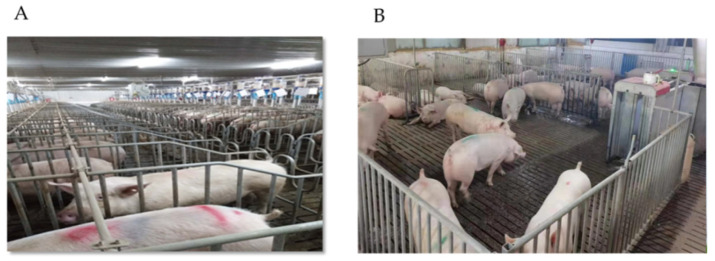
Being in a confined environment causes chronic stress in gestating sows, which is detrimental for sow health, welfare and, consequently, offspring physiology. This study assessed the health and welfare of gestating sows housed in a group housing system compared to individual gestation stalls. After pregnancy was confirmed, experimental sows were divided randomly into two groups: the group housing system (GS), with the electronic sow feeding (ESF) system; or individual stall (IS). The behavior of sows housed in the GS or IS was then compared; throughout pregnancy, GS sows displayed more exploratory behavior, less vacuum chewing, and less sitting behavior ( < 0.05). IS sows showed higher stress hormone levels than GS sows. In particular, at 41 days of gestation, the concentration of the adrenocorticotropic hormone (ACTH) and adrenaline (A) in IS sows was significantly higher than that of GS sows, and the A level of IS sows remained significantly higher at 71 days of gestation ( < 0.01). The lipopolysaccharide (LPS) test was carried out in the weaned piglets of the studied sows. Compared with the offspring of gestating sows housed in GS (PG) or IS (PS), PG experienced a shorter period of high temperature and showed a quicker return to the normal state ( < 0.05). Additionally, their lower levels of stress hormone ( < 0.01) suggest that PG did not suffer from as much stress as PS. These findings suggested that gestating sows housed in GS were more able to carry out their natural behaviors and, therefore, had lower levels of stress and improved welfare. In addition, PG also showed better disease resistance and resilience. These results will provide a research basis for the welfare and breeding of gestating sows.
处于密闭环境会给妊娠母猪带来慢性应激,这对母猪健康、福利以及后代生理状况都不利。本研究评估了与个体妊娠限位栏相比,群养系统中妊娠母猪的健康和福利状况。确认怀孕后,将实验母猪随机分为两组:采用电子饲喂系统的群养系统组(GS)和个体限位栏组(IS)。然后比较了GS组和IS组母猪的行为;在整个妊娠期,GS组母猪表现出更多的探索行为、更少的空嚼行为和更少的静卧行为(P<0.05)。IS组母猪的应激激素水平高于GS组母猪。特别是在妊娠41天时,IS组母猪促肾上腺皮质激素(ACTH)和肾上腺素(A)的浓度显著高于GS组母猪,且在妊娠71天时,IS组母猪的A水平仍显著更高(P<0.01)。对所研究母猪的断奶仔猪进行了脂多糖(LPS)试验。与GS组妊娠母猪(PG)或IS组妊娠母猪(PS)的后代相比,PG组经历高温的时间较短,且恢复到正常状态的速度更快(P<0.05)。此外,它们较低的应激激素水平(P<0.01)表明,PG组没有PS组那么大的应激。这些结果表明,群养系统中的妊娠母猪更能进行其自然行为,因此应激水平较低,福利状况得到改善。此外,PG组还表现出更好的抗病能力和恢复能力。这些结果将为妊娠母猪的福利和育种提供研究依据。