Liu Jui-Ming, Shen Chin-Yao, Lau Wallis C Y, Shao Shih-Chieh, Man Kenneth K C, Hsu Ren-Jun, Wu Chun-Te, Lai Edward Chia-Cheng
Division of Urology, Department of Surgery, Taoyuan General Hospital, Ministry of Health and Welfare, Taoyuan 33004, Taiwan.
School of Pharmacy, Institute of Clinical Pharmacy and Pharmaceutical Sciences, College of Medicine, National Cheng Kung University, Tainan 70101, Taiwan.
Cancers (Basel). 2021 Jul 31;13(15):3861. doi: 10.3390/cancers13153861.
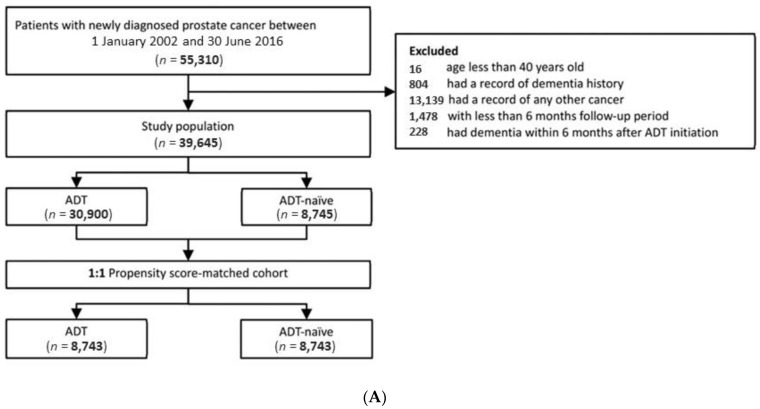
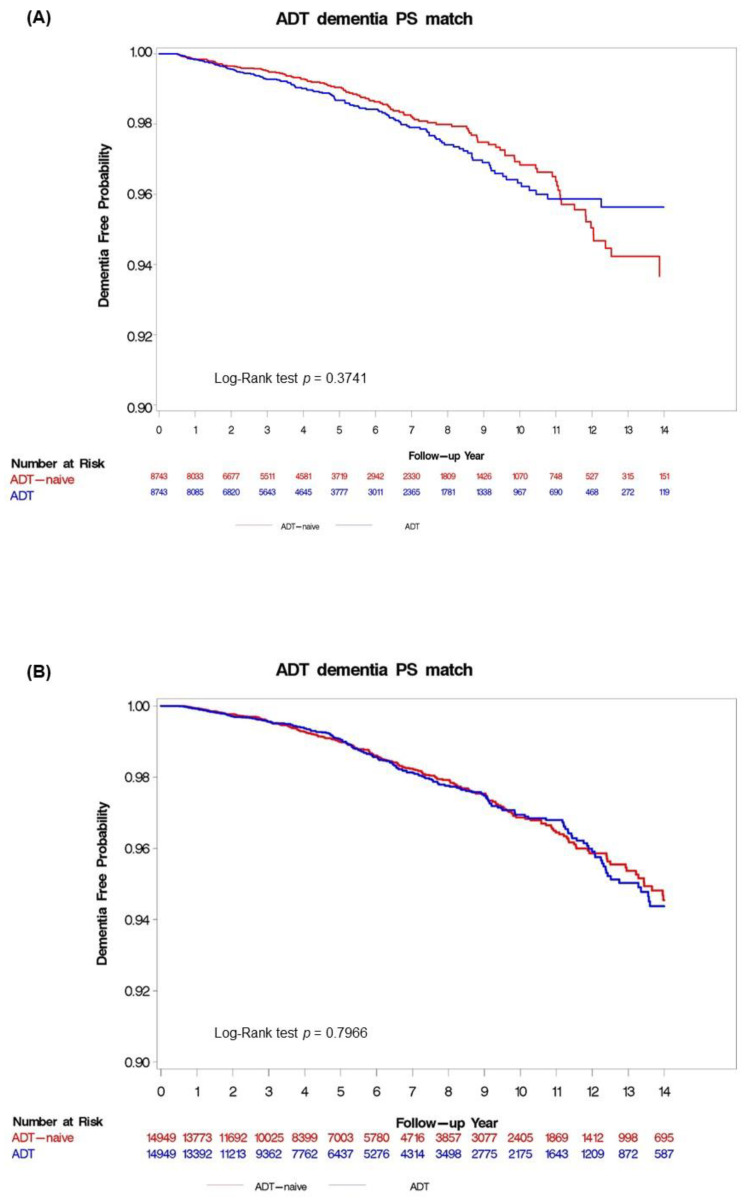
The risk of dementia after androgen deprivation therapy (ADT) in patients with advanced prostate cancer (PCa) remains controversial. This study aimed to evaluate the association between ADT and the incidence of dementia in patients with PCa. We identified patients newly diagnosed with PCa in the National Health Insurance Database of Taiwan from 1 January 2002 to 30 June 2016 and in The Health Improvement Network of the United Kingdom (UK) from 1 January 1998 to 31 March 2018. We classified patients with PCa into ADT and ADT-naïve groups. Propensity score (PS) methods were used to minimize the differences in characteristics between the groups. We performed a Cox proportional hazard model to obtain the adjusted hazard ratio (HR) to compare the incidence of dementia between the groups. Our ADT group comprised 8743 and 73,816 patients in Taiwan and the UK, respectively, which were matched 1:1 to ADT-naïve patients by PS. The incidence rates of dementia in the ADT group were 2.74 versus 3.03 per 1000 person-years in the ADT naïve groups in Taiwan, and 2.81 versus 2.79 per 1000 person-years in the UK. There was no statistical difference between ADT and ADT-naïve groups (adjusted HR: 1.12; 95% confidence interval (CI): 0.87-1.43 in Taiwan and adjusted HR: 1.02; 95% CI: 0.85-1.23 in the UK). We found no association between the incidence of dementia and ADT in patients with advanced PCa in either database. Further studies are warranted to evaluate other possible triggers of incident dementia in patients receiving ADT for advanced PCa.
晚期前列腺癌(PCa)患者接受雄激素剥夺治疗(ADT)后发生痴呆的风险仍存在争议。本研究旨在评估ADT与PCa患者痴呆发病率之间的关联。我们在台湾国民健康保险数据库中确定了2002年1月1日至2016年6月30日新诊断为PCa的患者,以及在英国健康改善网络中确定了1998年1月1日至2018年3月31日新诊断为PCa的患者。我们将PCa患者分为ADT组和未接受ADT组。采用倾向评分(PS)方法以尽量减少两组之间特征的差异。我们进行了Cox比例风险模型以获得调整后的风险比(HR),以比较两组之间痴呆的发病率。我们的ADT组在台湾和英国分别有8743例和73816例患者,通过PS与未接受ADT的患者进行1:1匹配。台湾地区ADT组痴呆发病率为每1000人年2.74例,未接受ADT组为每1000人年3.03例;英国ADT组为每1000人年2.81例,未接受ADT组为每1000人年2.79例。ADT组和未接受ADT组之间无统计学差异(台湾地区调整后HR:1.12;95%置信区间(CI):0.87 - 1.43;英国调整后HR:1.02;95%CI:0.85 - 1.23)。我们在两个数据库中均未发现晚期PCa患者痴呆发病率与ADT之间存在关联。有必要进一步开展研究以评估接受晚期PCa的ADT治疗的患者发生痴呆的其他可能触发因素。