Unité Bioinformatique Evolutive, Département de Biologie Computationelle, Institut Pasteur, Paris, France.
Hub Bioinformatique et Biostatistique, Département de Biologie Computationelle, Institut Pasteur, Paris, France.
PLoS Pathog. 2021 Aug 9;17(8):e1009786. doi: 10.1371/journal.ppat.1009786. eCollection 2021 Aug.
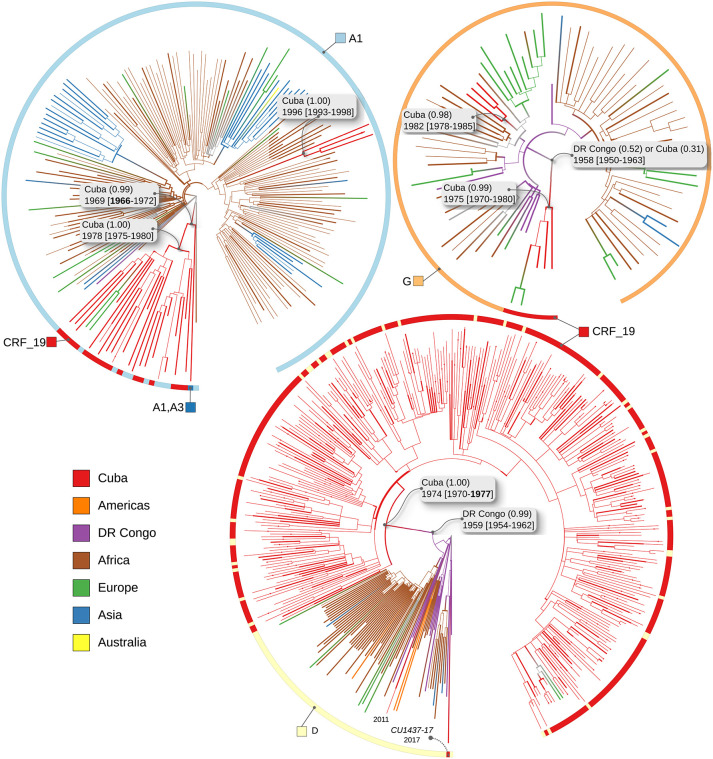
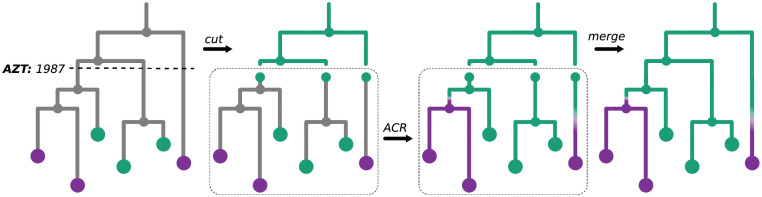
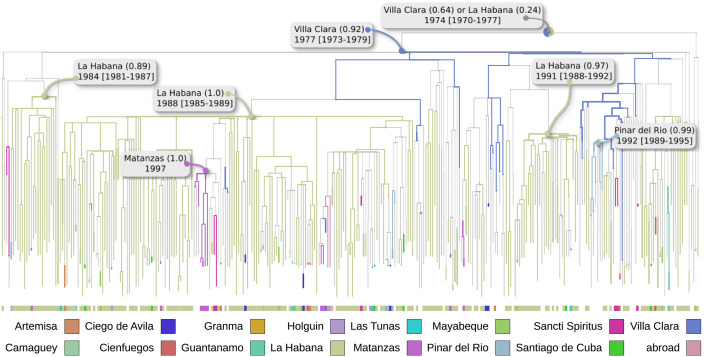
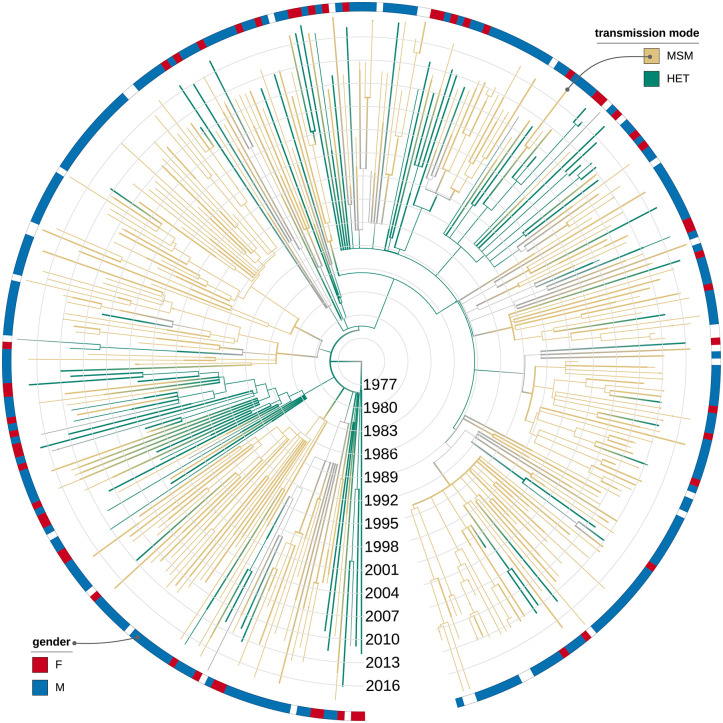
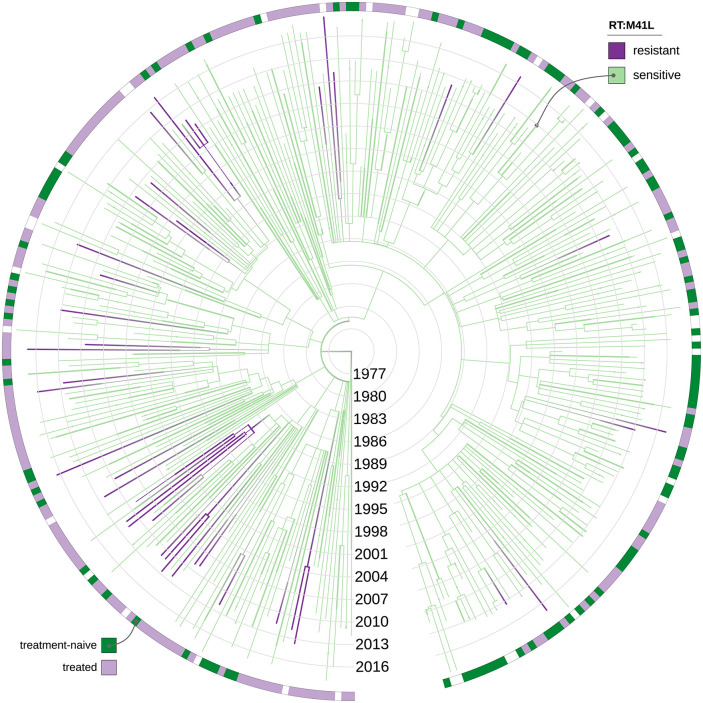
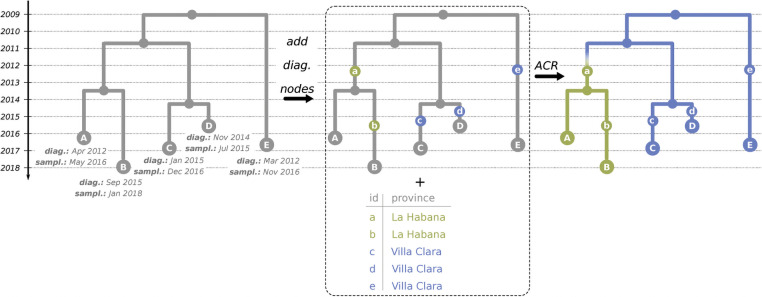
CRF19 is a recombinant form of HIV-1 subtypes D, A1 and G, which was first sampled in Cuba in 1999, but was already present there in 1980s. CRF19 was reported almost uniquely in Cuba, where it accounts for ∼25% of new HIV-positive patients and causes rapid progression to AIDS (∼3 years). We analyzed a large data set comprising ∼350 pol and env sequences sampled in Cuba over the last 15 years and ∼350 from Los Alamos database. This data set contained both CRF19 (∼315), and A1, D and G sequences. We performed and combined analyses for the three A1, G and D regions, using fast maximum likelihood approaches, including: (1) phylogeny reconstruction, (2) spatio-temporal analysis of the virus spread, and ancestral character reconstruction for (3) transmission mode and (4) drug resistance mutations (DRMs). We verified these results with a Bayesian approach. This allowed us to acquire new insights on the CRF19 origin and transmission patterns. We showed that CRF19 recombined between 1966 and 1977, most likely in Cuban community stationed in Congo region. We further investigated CRF19 spread on the Cuban province level, and discovered that the epidemic started in 1970s, most probably in Villa Clara, that it was at first carried by heterosexual transmissions, and then quickly spread in the 1980s within the "men having sex with men" (MSM) community, with multiple transmissions back to heterosexuals. The analysis of the transmission patterns of common DRMs found very few resistance transmission clusters. Our results show a very early introduction of CRF19 in Cuba, which could explain its local epidemiological success. Ignited by a major founder event, the epidemic then followed a similar pattern as other subtypes and CRFs in Cuba. The reason for the short time to AIDS remains to be understood and requires specific surveillance, in Cuba and elsewhere.
CRF19 是一种重组形式的 HIV-1 亚型 D、A1 和 G,于 1999 年在古巴首次采样,但早在 20 世纪 80 年代就在那里存在。CRF19 几乎只在古巴被报告,在那里它占新 HIV 阳性患者的约 25%,并导致艾滋病快速进展(约 3 年)。我们分析了一个包含过去 15 年在古巴采样的约 350 个 pol 和 env 序列以及来自洛斯阿拉莫斯数据库的约 350 个序列的大数据集。该数据集包含 CRF19(约 315 个)和 A1、D 和 G 序列。我们使用快速最大似然方法对三个 A1、G 和 D 区域进行了分析和组合,包括:(1)系统发育重建,(2)病毒传播的时空分析,以及(3)传播模式和(4)耐药突变(DRMs)的祖先特征重建。我们使用贝叶斯方法验证了这些结果。这使我们能够获得关于 CRF19 起源和传播模式的新见解。我们表明,CRF19 于 1966 年至 1977 年间重组,最有可能在驻刚果地区的古巴社区中重组。我们进一步研究了 CRF19 在古巴省级的传播情况,发现该疫情始于 20 世纪 70 年代,最有可能在比那尔德里奥省开始,最初由异性传播,然后在 20 世纪 80 年代在“男男性行为者”(MSM)社区迅速传播,随后多次传播给异性恋者。对常见 DRMs 的传播模式的分析发现,很少有耐药性传播集群。我们的结果表明,CRF19 在古巴的引入非常早,这可以解释其在当地的成功流行。由一个主要的创始事件引发,该疫情随后遵循了与古巴其他亚型和 CRF 相似的模式。艾滋病发病时间短的原因仍需了解,并需要在古巴和其他地方进行特定的监测。