Division of Pulmonary and Critical Care Medicine, Massachusetts General Hospital, Boston, MA.
Division of Infectious Diseases, Brigham and Women's Hospital, Boston, MA.
Chest. 2021 Dec;160(6):2324-2331. doi: 10.1016/j.chest.2021.08.003. Epub 2021 Aug 6.
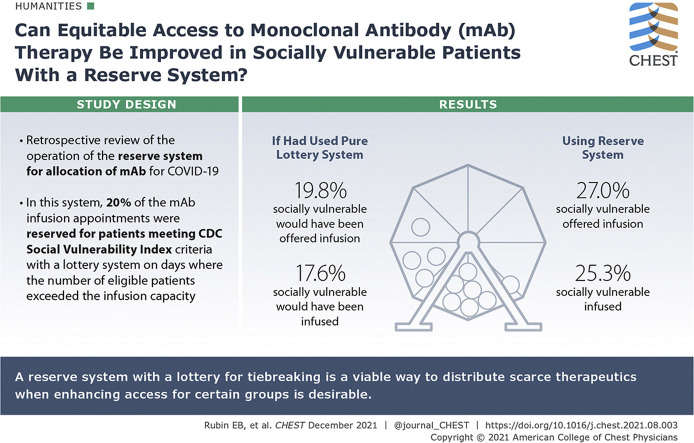
In fall 2020, the Food and Drug Administration issued emergency use authorization for monoclonal antibody (mAb) therapies for outpatients with COVID-19. The Commonwealth of Massachusetts issued guidance outlining the use of a reserve system with a lottery for allocation of mAbs in the event of scarcity that would prioritize socially vulnerable patients for 20% of the infusion slots. The Mass General Brigham health system subsequently implemented such a reserve system.
Can a reserve system be deployed successfully in a large health system in a way that promotes equitable access to mAb therapy among socially vulnerable patients with COVID-19?
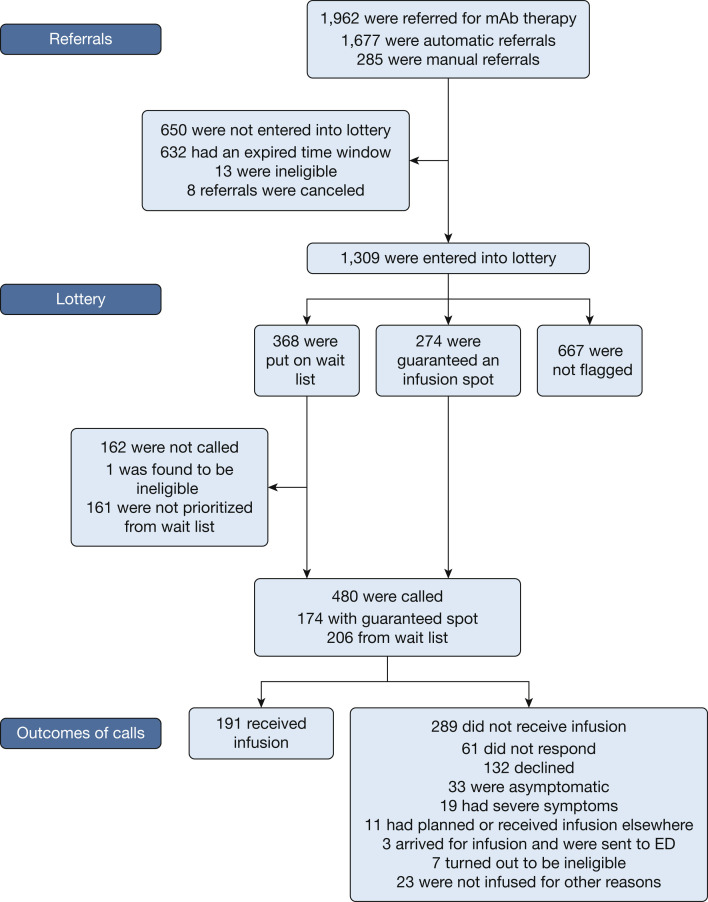
We conducted a retrospective review of the operation of the reserve system for allocation of mAb therapies to identify how referrals moved through the allocation process and what proportion of patients who were offered and received mAb therapies were socially vulnerable.
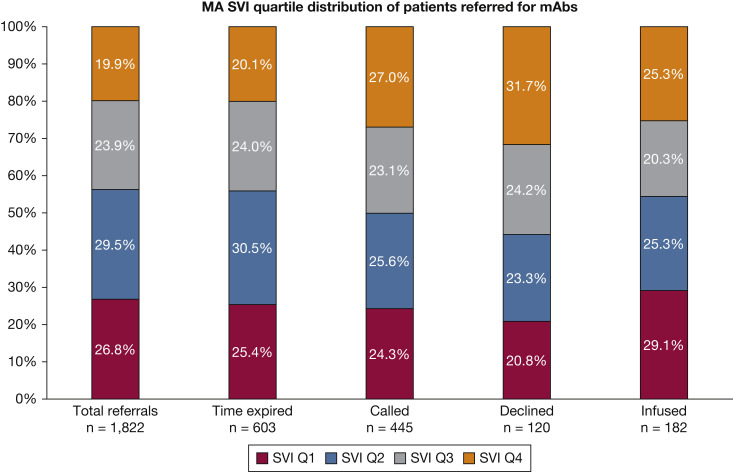
Notwithstanding multiple operational challenges, the reserve system for allocation of mAb therapy worked as intended to enhance the number of socially vulnerable patients who were offered and received mAb therapy. A significantly higher proportion of patients offered mAb therapy were socially vulnerable (27.0%) than would have been the case if the infusion appointments had been allocated using a pure lottery system without a vulnerable reserve (19.8%), and a significantly higher proportion of patient who received infusions were socially vulnerable (25.3%) than would have been the case if the infusion appointments had been allocated using a pure lottery system (17.6%) INTERPRETATION: Our health system experience demonstrates that a reserve system with a lottery for tiebreaking is a viable way to distribute scarce therapeutics when enhancing access for certain groups is desirable.
2020 年秋季,美国食品和药物管理局发布了针对 COVID-19 门诊患者的单克隆抗体(mAb)治疗的紧急使用授权。马萨诸塞州发布了指导意见,概述了在 mAb 短缺时使用储备系统的方法,该系统采用彩票方式分配,优先考虑社会弱势群体的 20%输液名额。随后,马萨诸塞州综合医院实施了这样的储备系统。
在一个大型医疗系统中,储备系统能否成功部署,以促进社会弱势群体获得 COVID-19 mAb 治疗的公平机会?
我们对 mAb 治疗分配储备系统的运作进行了回顾性分析,以确定转介患者如何通过分配流程,以及接受和接受 mAb 治疗的患者中有多少比例是社会弱势群体。
尽管存在多种运营挑战,但分配 mAb 治疗的储备系统按预期运作,增加了提供和接受 mAb 治疗的社会弱势群体患者的数量。接受 mAb 治疗的患者中,社会弱势群体的比例(27.0%)明显高于如果采用没有弱势群体储备的纯彩票系统分配输液预约(19.8%)的情况,接受输液的患者中,社会弱势群体的比例(25.3%)明显高于如果采用纯彩票系统分配输液预约(17.6%)的情况。
我们的医疗系统经验表明,当需要增强某些群体的准入时,采用彩票方式决定平局的储备系统是分配稀缺治疗药物的一种可行方法。