• 文献检索
  • 文档翻译
  • 深度研究
  • 学术资讯
  • Suppr Zotero 插件Zotero 插件
  • 邀请有礼
  • 套餐&价格
  • 历史记录
应用&插件
Suppr Zotero 插件Zotero 插件浏览器插件Mac 客户端Windows 客户端微信小程序
定价
高级版会员购买积分包购买API积分包
服务
文献检索文档翻译深度研究API 文档MCP 服务
关于我们
关于 Suppr公司介绍联系我们用户协议隐私条款
关注我们

Suppr 超能文献

核心技术专利:CN118964589B侵权必究
粤ICP备2023148730 号-1Suppr @ 2026

文献检索

告别复杂PubMed语法,用中文像聊天一样搜索,搜遍4000万医学文献。AI智能推荐,让科研检索更轻松。

立即免费搜索

文件翻译

保留排版,准确专业,支持PDF/Word/PPT等文件格式,支持 12+语言互译。

免费翻译文档

深度研究

AI帮你快速写综述,25分钟生成高质量综述,智能提取关键信息,辅助科研写作。

立即免费体验

脑氧合指导治疗对非创伤性蛛网膜下腔出血的影响。

Brain tissue oxygenation guided therapy and outcome in non-traumatic subarachnoid hemorrhage.

机构信息

Department of Intensive Care, Erasme Hospital, Université Libre de Bruxelles, Route de Lennik, 808, 1070, Brussels, Belgium.

Department of Neurosurgery, Erasme Hospital, Université Libre de Bruxelles, Route de Lennik, 808, 1070, Brussels, Belgium.

出版信息

Sci Rep. 2021 Aug 10;11(1):16235. doi: 10.1038/s41598-021-95602-6.

DOI:10.1038/s41598-021-95602-6
PMID:34376735
原文链接:https://pmc.ncbi.nlm.nih.gov/articles/PMC8355344/
Abstract

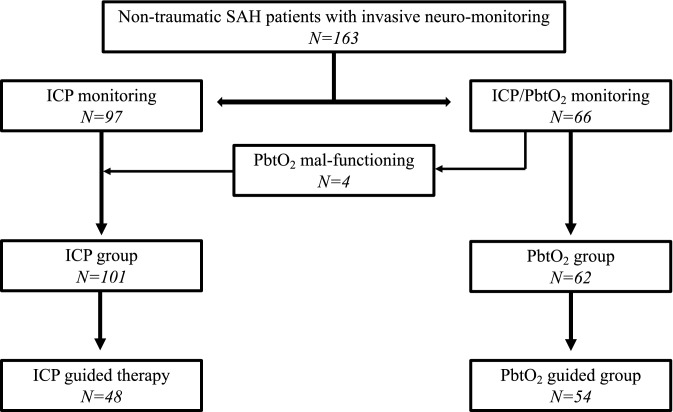
Brain hypoxia can occur after non-traumatic subarachnoid hemorrhage (SAH), even when levels of intracranial pressure (ICP) remain normal. Brain tissue oxygenation (PbtO) can be measured as a part of a neurological multimodal neuromonitoring. Low PbtO has been associated with poor neurologic recovery. There is scarce data on the impact of PbtO guided-therapy on patients' outcome. This single-center cohort study (June 2014-March 2020) included all patients admitted to the ICU after SAH who required multimodal monitoring. Patients with imminent brain death were excluded. Our primary goal was to assess the impact of PbtO-guided therapy on neurological outcome. Secondary outcome included the association of brain hypoxia with outcome. Of the 163 patients that underwent ICP monitoring, 62 were monitored with PbtO and 54 (87%) had at least one episode of brain hypoxia. In patients that required treatment based on neuromonitoring strategies, PbtO-guided therapy (OR 0.33 [CI 95% 0.12-0.89]) compared to ICP-guided therapy had a protective effect on neurological outcome at 6 months. In this cohort of SAH patients, PbtO-guided therapy might be associated with improved long-term neurological outcome, only when compared to ICP-guided therapy.

摘要

脑缺氧可发生于非创伤性蛛网膜下腔出血(SAH)后,即使颅内压(ICP)水平保持正常。脑组织氧合(PbtO)可作为神经多模态神经监测的一部分进行测量。低 PbtO 与神经功能恢复不良有关。关于 PbtO 指导治疗对患者预后的影响的数据很少。这项单中心队列研究(2014 年 6 月至 2020 年 3 月)纳入了所有因 SAH 入住 ICU 并需要多模态监测的患者。排除即将发生脑死亡的患者。我们的主要目标是评估 PbtO 指导治疗对神经结局的影响。次要结局包括脑缺氧与结局的关系。在接受 ICP 监测的 163 名患者中,有 62 名患者接受了 PbtO 监测,其中 54 名(87%)至少发生过一次脑缺氧。在根据神经监测策略需要治疗的患者中,与 ICP 指导治疗相比,PbtO 指导治疗(OR 0.33 [95%CI 0.12-0.89])对 6 个月时的神经结局有保护作用。在本队列的 SAH 患者中,与 ICP 指导治疗相比,PbtO 指导治疗可能与改善长期神经结局相关。
https://cdn.ncbi.nlm.nih.gov/pmc/blobs/ce13/8355344/a631c10a3de8/41598_2021_95602_Fig1_HTML.jpg

相似文献

1
Brain tissue oxygenation guided therapy and outcome in non-traumatic subarachnoid hemorrhage.脑氧合指导治疗对非创伤性蛛网膜下腔出血的影响。
Sci Rep. 2021 Aug 10;11(1):16235. doi: 10.1038/s41598-021-95602-6.
2
Protocolized Brain Oxygen Optimization in Subarachnoid Hemorrhage.蛛网膜下腔出血的脑氧优化方案。
Neurocrit Care. 2019 Oct;31(2):263-272. doi: 10.1007/s12028-019-00753-0.
3
The Role of Brain Tissue Oxygenation Monitoring in the Management of Subarachnoid Hemorrhage: A Scoping Review.脑氧监测在蛛网膜下腔出血管理中的作用:范围综述。
Neurocrit Care. 2023 Aug;39(1):229-240. doi: 10.1007/s12028-023-01680-x. Epub 2023 Feb 17.
4
The Impact of Invasive Brain Oxygen Pressure Guided Therapy on the Outcome of Patients with Traumatic Brain Injury: A Systematic Review and Meta-Analysis.脑氧压力监测指导下的侵入性治疗对创伤性脑损伤患者结局的影响:系统评价和荟萃分析。
Neurocrit Care. 2022 Dec;37(3):779-789. doi: 10.1007/s12028-022-01613-0. Epub 2022 Sep 30.
5
The effect of the volemic and cardiac status on brain oxygenation in patients with subarachnoid hemorrhage: a bi-center cohort study.血容量及心脏状态对蛛网膜下腔出血患者脑氧合的影响:一项双中心队列研究。
Ann Intensive Care. 2021 Dec 16;11(1):176. doi: 10.1186/s13613-021-00960-z.
6
Detection of cerebral hypoperfusion with a dynamic hyperoxia test using brain oxygenation pressure monitoring.利用脑氧压监测进行动态高氧试验检测脑灌注不足。
Crit Care. 2022 Feb 7;26(1):35. doi: 10.1186/s13054-022-03918-0.
7
Brain hypoxia and metabolic crisis are common in patients with acute brain injury despite a normal intracranial pressure.尽管颅内压正常,急性脑损伤患者仍普遍存在脑缺氧和代谢危机。
Sci Rep. 2024 Oct 11;14(1):23828. doi: 10.1038/s41598-024-75129-2.
8
Brain Tissue Oxygenation-Guided Therapy and Outcome in Traumatic Brain Injury: A Single-Center Matched Cohort Study.创伤性脑损伤中脑组织氧合引导治疗与预后:一项单中心匹配队列研究
Brain Sci. 2022 Jul 6;12(7):887. doi: 10.3390/brainsci12070887.
9
Focal cerebral oxygenation and neurological outcome with or without brain tissue oxygen-guided therapy in patients with traumatic brain injury.创伤性脑损伤患者接受或不接受脑组织氧指导治疗的局部脑氧合和神经功能结局。
Acta Neurochir (Wien). 2009 Nov;151(11):1399-409. doi: 10.1007/s00701-009-0398-y.
10
Response of brain oxygen to therapy correlates with long-term outcome after subarachnoid hemorrhage.脑氧对治疗的反应与蛛网膜下腔出血后的长期预后相关。
Neurocrit Care. 2013 Dec;19(3):320-8. doi: 10.1007/s12028-013-9890-6.

引用本文的文献

1
Individualized autoregulation-guided arterial blood pressure management in neurocritical care.神经重症监护中基于个体化自动调节指导的动脉血压管理
Neurotherapeutics. 2025 Jan;22(1):e00526. doi: 10.1016/j.neurot.2025.e00526. Epub 2025 Jan 18.
2
Effects of acetazolamide on intracranial pressure and brain tissue oxygenation on patients with acute brain injury: A pilot physiological study.乙酰唑胺对急性脑损伤患者颅内压和脑组织氧合的影响:一项初步生理学研究。
Physiol Rep. 2025 Jan;13(1):e70159. doi: 10.14814/phy2.70159.
3
Future of neurocritical care: Integrating neurophysics, multimodal monitoring, and machine learning.

本文引用的文献

1
Association of Dose of Intracranial Hypertension with Outcome in Subarachnoid Hemorrhage.颅内压升高剂量与蛛网膜下腔出血预后的关系。
Neurocrit Care. 2021 Jun;34(3):722-730. doi: 10.1007/s12028-021-01221-4. Epub 2021 Apr 12.
2
Treatment of Delayed Cerebral Ischemia in Good-Grade Subarachnoid Hemorrhage: Any Role for Invasive Neuromonitoring?良好分级蛛网膜下腔出血后迟发性脑缺血的治疗:有创神经监测有作用吗?
Neurocrit Care. 2021 Aug;35(1):172-183. doi: 10.1007/s12028-020-01169-x. Epub 2020 Dec 10.
3
Invasive neuromonitoring with an extended definition of delayed cerebral ischemia is associated with improved outcome after poor-grade subarachnoid hemorrhage.
神经重症监护的未来:整合神经物理学、多模态监测与机器学习。
World J Crit Care Med. 2024 Jun 9;13(2):91397. doi: 10.5492/wjccm.v13.i2.91397.
4
"NeuroVanguard": a contemporary strategy in neuromonitoring for severe adult brain injury patients.“NeuroVanguard”:一种用于严重成人颅脑损伤患者的神经监测的当代策略。
Crit Care. 2024 Apr 1;28(1):104. doi: 10.1186/s13054-024-04893-4.
5
Brain Oxygenation Response to Hypercapnia in Patients with Acute Brain Injury.急性脑损伤患者的二氧化碳反应性与脑氧合。
Neurocrit Care. 2024 Apr;40(2):750-758. doi: 10.1007/s12028-023-01833-y. Epub 2023 Sep 11.
6
Prognostic model for aneurysmal subarachnoid hemorrhage patients requiring mechanical ventilation.需要机械通气的动脉瘤性蛛网膜下腔出血患者的预后模型。
Ann Clin Transl Neurol. 2023 Sep;10(9):1569-1577. doi: 10.1002/acn3.51846. Epub 2023 Jul 9.
7
Serum LDH levels may predict poor neurological outcome after aneurysmal subarachnoid hemorrhage.血清 LDH 水平可能预测动脉瘤性蛛网膜下腔出血后的不良神经结局。
BMC Neurol. 2023 Jun 13;23(1):228. doi: 10.1186/s12883-023-03282-8.
8
Multimodal and autoregulation monitoring in the neurointensive care unit.神经重症监护病房中的多模态和自动调节监测
Front Neurol. 2023 Apr 20;14:1155986. doi: 10.3389/fneur.2023.1155986. eCollection 2023.
9
Acute Multidisciplinary Management of Aneurysmal Subarachnoid Hemorrhage (aSAH).急性多学科管理颅内动脉瘤性蛛网膜下腔出血(aSAH)。
Balkan Med J. 2023 Mar 8;40(2):74-81. doi: 10.4274/balkanmedj.galenos.2023.2023-1-100.
10
The Role of Brain Tissue Oxygenation Monitoring in the Management of Subarachnoid Hemorrhage: A Scoping Review.脑氧监测在蛛网膜下腔出血管理中的作用:范围综述。
Neurocrit Care. 2023 Aug;39(1):229-240. doi: 10.1007/s12028-023-01680-x. Epub 2023 Feb 17.
在广泛定义的迟发性脑缺血的情况下进行有创神经监测与较差分级的蛛网膜下腔出血后的改善结果相关。
J Neurosurg. 2020 May 15;134(5):1527-1534. doi: 10.3171/2020.3.JNS20375. Print 2021 May 1.
4
Protocolized Brain Oxygen Optimization in Subarachnoid Hemorrhage.蛛网膜下腔出血的脑氧优化方案。
Neurocrit Care. 2019 Oct;31(2):263-272. doi: 10.1007/s12028-019-00753-0.
5
Clinical prediction of delayed cerebral ischemia in aneurysmal subarachnoid hemorrhage.颅内动脉瘤性蛛网膜下腔出血后迟发性脑缺血的临床预测
J Neurosurg. 2018 Jun 8;130(6):1914-1921. doi: 10.3171/2018.1.JNS172715. Print 2019 Jun 1.
6
Brain Oxygen Optimization in Severe Traumatic Brain Injury Phase-II: A Phase II Randomized Trial.严重创伤性脑损伤II期脑氧优化:一项II期随机试验
Crit Care Med. 2017 Nov;45(11):1907-1914. doi: 10.1097/CCM.0000000000002619.
7
Mortality and Outcome Comparison Between Brain Tissue Oxygen Combined with Intracranial Pressure/Cerebral Perfusion Pressure-Guided Therapy and Intracranial Pressure/Cerebral Perfusion Pressure-Guided Therapy in Traumatic Brain Injury: A Meta-Analysis.脑组织氧联合颅内压/脑灌注压导向治疗与颅内压/脑灌注压导向治疗在创伤性脑损伤中的死亡率及预后比较:一项荟萃分析
World Neurosurg. 2017 Apr;100:118-127. doi: 10.1016/j.wneu.2016.12.097. Epub 2017 Jan 3.
8
Mechanisms of Global Cerebral Edema Formation in Aneurysmal Subarachnoid Hemorrhage.动脉瘤性蛛网膜下腔出血中全脑水肿形成的机制
Neurocrit Care. 2017 Apr;26(2):301-310. doi: 10.1007/s12028-016-0354-7.
9
Management of delayed cerebral ischemia after subarachnoid hemorrhage.蛛网膜下腔出血后迟发性脑缺血的管理
Crit Care. 2016 Oct 14;20(1):277. doi: 10.1186/s13054-016-1447-6.
10
The Effect of Packed Red Blood Cell Transfusion on Cerebral Oxygenation and Metabolism After Subarachnoid Hemorrhage.浓缩红细胞输血对蛛网膜下腔出血后脑氧合及代谢的影响
Neurocrit Care. 2016 Feb;24(1):118-21. doi: 10.1007/s12028-015-0180-3.